Before you buy anything, wash the plate with dish soap. Skin oil is the leading cause of adhesion failure and it is invisible, which is why people spend money on the second most likely cause instead.
How this page is funded. Buy links go to Amazon and we earn a commission on qualifying purchases at no extra cost to you. Commission never decides an order or a score, we accept no free products or sponsored placements, and every roundup names something to skip. Full disclosure.
The picks, ranked
The picks, ranked
#
Product
Best for
Score
Price
1
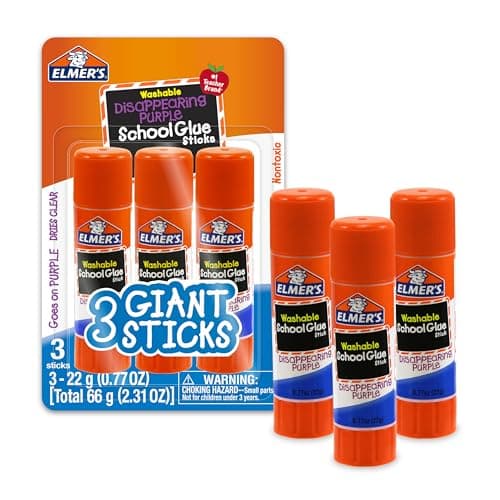
Disappearing Purple Glue StickAdhesion where you need it and release where you need it. The correct answer more often than anything costing more.Water-soluble PVA glue stick
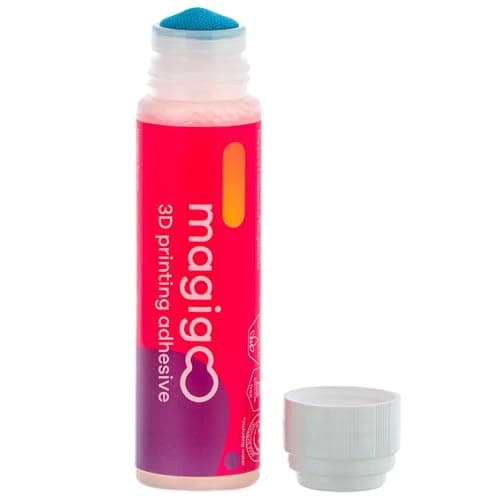
Magigoo 3D Printing AdhesiveEarns its price on ASA, ABS and nylon. On PLA with a clean plate it is money spent on a solved problem.Formulated for high-warp materials
Live prices verified October 17, 2026. Scores are our own fit rating for the stated use, not a measurement and not a customer rating.
A 3D printer bed being prepared before a first layer.
Wash the plate. Genuinely, first.
Skin oil transfers to the plate every time you touch it, it is completely invisible, and it is the leading cause of first-layer adhesion failure. Isopropyl alcohol does not reliably remove it — it dissolves some residues and redistributes others.
Dish soap, warm water, a soft cloth, dry it, then handle it by the edges. This is free and it fixes the majority of adhesion complaints. Do it before you change a single setting or buy a single product.
Then check these, still for free
Z offset. The first layer should be slightly squashed, not round. Round extrusions have little contact area and do not hold.
Bed temperature. Within the published range for the material: 50 to 60 C for PLA, 70 to 90 C for PETG Prusa Research. Higher is not automatically better, and for PETG on smooth PEI it actively increases the bonding problem.
First layer speed. Slower gives the material time to key into the surface. Halving first-layer speed costs a minute.
Brim. Free, and it addresses corner lift directly by giving the corners more area to hold.
When glue is the right answer
A plain PVA glue stick does two opposite jobs and does both well.
As adhesion: a thin layer helps materials that struggle to stick, including nylon and some TPU.
As release: between PETG and smooth PEI it prevents the chemical bond that tears chunks out of the sheet. This is the more valuable use and the one people do not expect.
Apply thinly and evenly. A thick layer produces a rough bottom surface and can lift with the part. It washes off with water, which is the other reason it is preferable to anything more permanent.
When a specialty adhesive earns its price
On materials that warp hard: ASA, ABS, nylon, polycarbonate. These generate real contraction force as they cool Prusa Research, and a formulated adhesive holds where a glue stick lets go.
For PLA on a clean plate, it is money spent on a problem that washing the plate already solved. That is the honest line and it applies to most adhesion products.
The material no adhesive on this page covers
Polypropylene is the exception. It bonds to almost nothing except itself, which is why Magigoo sell a separate PP formula and why Prusa point PP printers at a PP sheet rather than a coating. The surfaces and adhesives that work are on best polypropylene filament.
Adhesion versus warping
They present the same way and have different fixes. A part that never stuck is an adhesion problem: wash, Z offset, temperature. A part that stuck and then lifted at the corners hours in is a warping problem: enclosure, draft exclusion, cooling settings, part geometry.
Adhesive helps the first case and only delays the second. If corners lift on ASA, the fix is on the ASA page, not in this basket.
Things not to do
Hairspray. Works, and coats the whole printer in sticky residue that attracts dust into the motion system.
Blue painter's tape on PEI. Adding a worse surface on top of a good one.
Cranking bed temperature. Causes elephant foot, and on PETG over smooth PEI makes the bonding problem worse.
Scraping with a metal blade. One gouge and the plate is permanently compromised.
Every pick, in detail
01
Disappearing Purple Glue Stick
Elmer's
Almost every adhesion problem · 8.9/10 our fit score
A dollar of school glue is the correct answer more often than any specialty product. It is also a release agent, which is the part people miss.
Published specifications for Disappearing Purple Glue Stick
Use
A thin layer on a clean plate
Prusa guidance
ASA: smooth or powder-coated PEI with a glue stickPrusa Research
What it does well
Works as a release layer under PETG, protecting the plate from over-adhesion
Washes off with warm water, so a bad application costs nothing
What it does not
Needs reapplying and, eventually, washing off entirely
Too thick a layer causes a rough, uneven first layer
Wash the plate with dish soap and water before anything else. Skin oil is invisible, is the leading cause, and alcohol does not remove it reliably. After that, check Z offset, bed temperature and first-layer speed.
+ − Is glue stick bad for my build plate?
No, it protects it. Between PETG and smooth PEI, a glue layer prevents the chemical bond that tears material out of the sheet. It washes off with water.
+ − Do I need a specialty bed adhesive?
Only for materials that warp hard, such as ASA, ABS and nylon. For PLA and PETG on a clean plate, washing and a glue stick cover everything.
+ − My part stuck then lifted at the corners. Why?
That is warping rather than adhesion. The part contracted as it cooled and pulled its own corners up. The fixes are enclosure, draft exclusion, reduced part cooling and changing the part geometry.