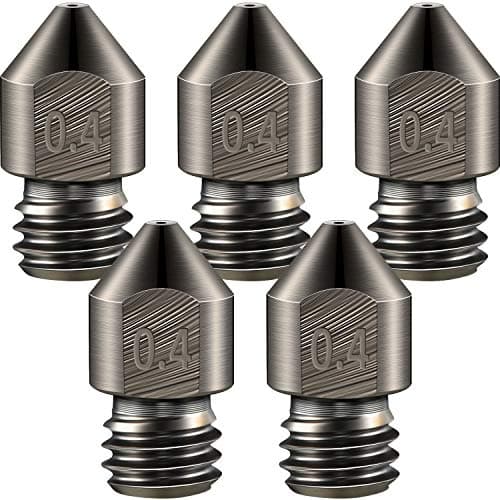
There are two decisions here and only one of them is difficult. Material is decided by whether your filament has a filler in it. Size is decided by what you are trying to optimize.
How this page is funded. Buy links go to Amazon and we earn a commission on qualifying purchases at no extra cost to you. Commission never decides an order or a score, we accept no free products or sponsored placements, and every roundup names something to skip. Full disclosure.
The picks, ranked
The picks, ranked
#
Product
Best for
Score
Price
1
Hardened Steel NozzleThe default for carbon fiber, glass fiber, metal-filled and glow-in-the-dark. A few dollars against an invisible failure.Hardened steel
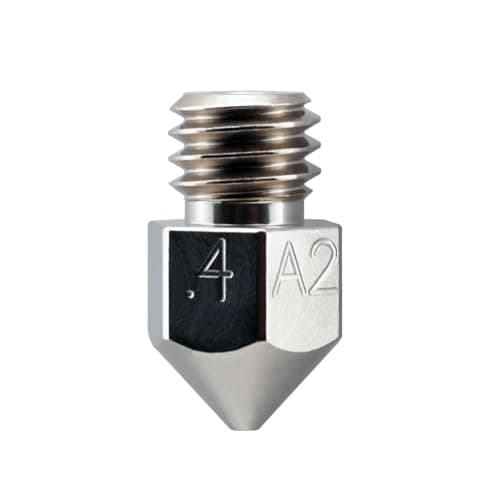
Micro Swiss Plated A2 Hardened Steel NozzlePlating addresses the one real complaint about plain hardened steel: sticky materials cling to it more than to brass.Plated A2 hardened steel
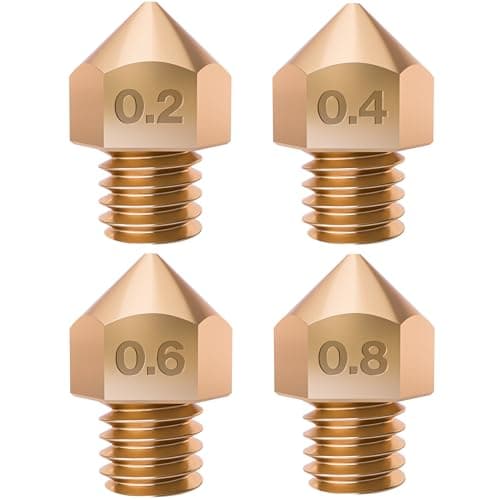
Brass Nozzle AssortmentBest heat conduction and cheapest way to own a 0.6 mm for draft prints. Perfect for PLA, PETG, ABS and TPU.Brass, multiple diameters
Live prices verified October 17, 2026. Scores are our own fit rating for the stated use, not a measurement and not a customer rating.
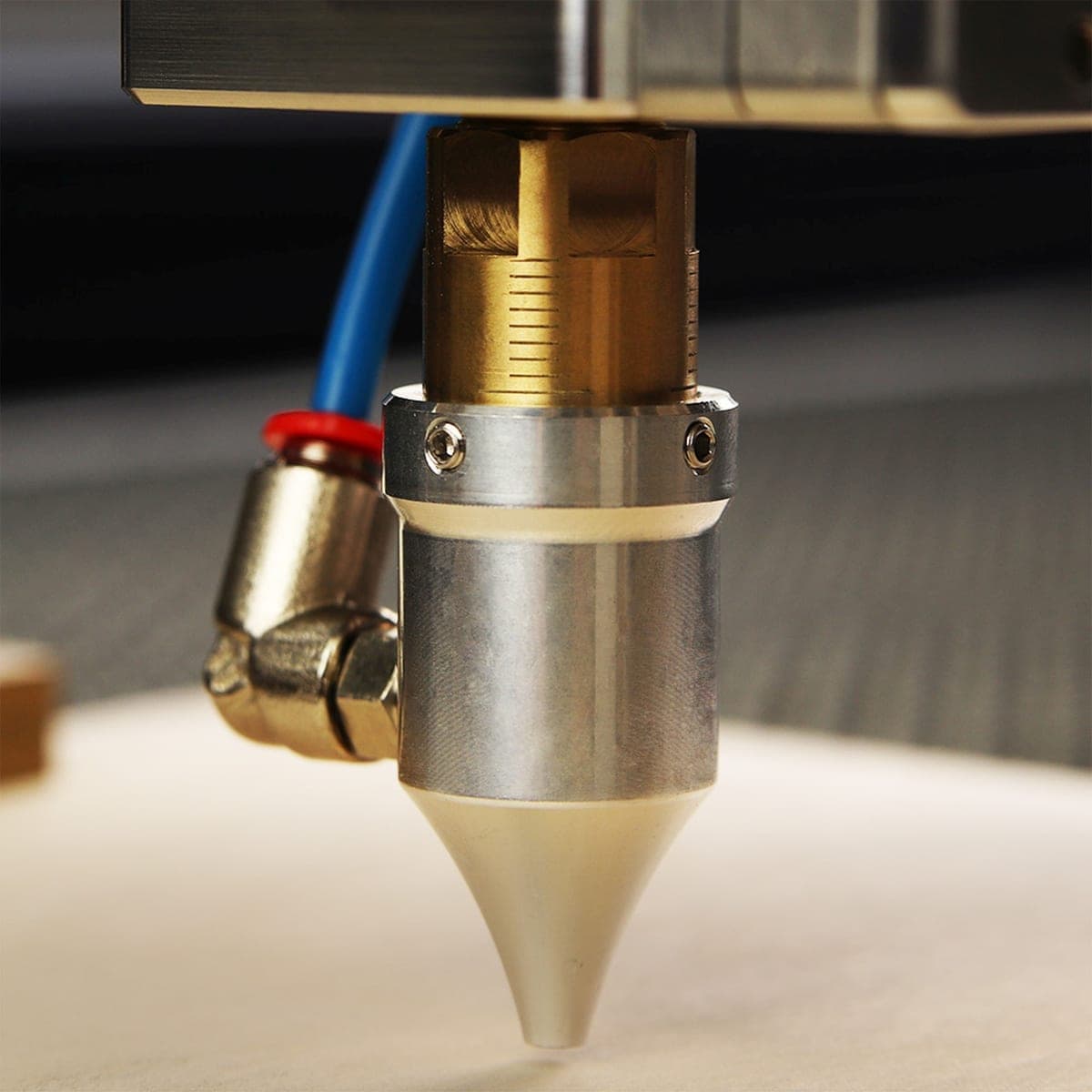
Close crop of a 3D printer hotend and the tip of its nozzle.
Nozzle material against filament type. The wear failure is invisible until dimensions start drifting.
Filament
Brass
Hardened steel
Why
PLA, PETG, ABS, ASA, TPU
Fine
Fine
Unfilled polymers do not abrade the bore
Carbon fiber filled
No
Required
E3D document substantial wear after 250 g
Glass fiber filled
No
Required
Same abrasion mechanism as carbon fiber
Glow in the dark
No
Required
The phosphorescent filler is abrasive
Metal filled
No
Required
Metal powder is the most abrasive filler in common use
Matte / silk PLA
Acceptable
Preferred
Matting agents are mildly abrasive over long runs
Nozzle material against filament type. The wear failure is invisible until dimensions start drifting. Figures from E3D, Prusa Research, retrieved 2026-09-01.
The material decision
It is decided entirely by whether your filament contains a filler. E3D document that abrasive filaments cause substantial wear to brass within a few hundred grams E3D, and unfilled polymers do not abrade the bore at all in any practical time frame.
The table below is the full decision. Unfilled PLA, PETG, ABS, ASA and TPU are fine on brass indefinitely. Anything carbon-filled, glass-filled, metal-filled or glow-in-the-dark needs hardened steel. Matte and silk PLA sit in between: mildly abrasive, acceptable on brass, better on hardened if you print them constantly.
What plating fixes
Plain hardened steel has one real drawback: its surface is less slick than brass, so sticky materials — TPU, some PETG — cling and drag. Plated nozzles address that by putting a low-friction coating on a hardened core.
E3D's own hardened-and-coated design was developed around exactly this combination of requirements E3D: abrasion resistance and a surface that molten polymer does not stick to. If you print both abrasive and sticky materials, that is the nozzle to buy.
The size decision
0.4 mm
The default. Good balance of detail and speed, and every stock profile in every slicer assumes it. Stay here unless you have a reason.
0.6 mm
Faster prints, stronger parts, less detail. Underrated: for functional parts a 0.6 mm nozzle lays wider extrusions that bond better, so parts come out both quicker and tougher. It is also markedly less prone to clogging on filled filament, which is why it is the usual recommendation for carbon fiber — see carbon fiber filament.
0.2 mm and smaller
Fine detail, very slow, clogs readily. For most detail work a resin printer is the better answer than a small nozzle — see filament versus resin.
0.8 mm and larger
Draft prints, large functional parts, vase mode. Fast and coarse.
Changing a nozzle without wrecking the hot end
Heat the hot end first, to around printing temperature. Cold nozzle threads seize on the solidified plastic inside them and you will round the flats or crack the heater block.
Hold the heater block with a second wrench. Torquing against the mount instead is how heat break threads get damaged.
Tighten hot, gently. A nozzle tightened cold leaks once everything expands.
Re-level and re-check the Z offset afterwards. A new nozzle rarely sits at exactly the same height as the old one.
Try cleaning before replacing
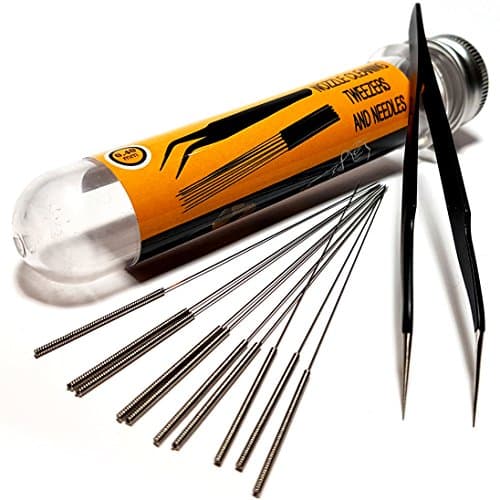
Most nozzles that get replaced were partially clogged rather than worn. A cleaning needle of the correct diameter, pushed through while the nozzle is at temperature, clears the majority of them, and a cold pull removes what the needle does not.
The distinction matters because a clog and a worn bore produce different symptoms: a clog under-extrudes inconsistently, while wear over-extrudes consistently and drifts dimensionally. That difference is the subject of the nozzle wear guide.
Nozzle material and nozzle diameter are separate decisions, and this page is only about the first. Which size to fit for which job, and the published rule that ties layer height to nozzle diameter, are on 3D printer nozzle sizes.
The filament people least expect to need hardened steel is the glow-in-the-dark kind, because the phosphor is a hard mineral powder rather than an obvious fiber — the case is on best glow in the dark filament.
Every pick, in detail
01
Hardened Steel Nozzle
Creality / generic MK8
Any filled filament · 9.2/10 our fit score
The five-dollar part that stops abrasive filament from quietly widening your nozzle mid-print. Buy one before your first carbon fiber spool, not after.
Published specifications for Hardened Steel Nozzle
Common size
0.4 mm
Required for
Carbon fiber, glass filled, glow in the dark, metal filledE3D
Trade-off
Lower thermal conductivity than brass
What it does well
E3D document substantial wear on a brand new brass nozzle after only 250 g of carbon-fiber-filled filament
Cheap enough to keep a spare in the drawer
What it does not
Conducts heat worse than brass, so very high flow rates need a few degrees more
Hardened steel tempers and softens at extreme temperatures — E3D make this point explicitly
Only if you print filled filament: carbon fiber, glass fiber, metal-filled or glow-in-the-dark. E3D document substantial brass wear from abrasives within a few hundred grams. Unfilled PLA, PETG, ABS and TPU are fine on brass.
+ − What nozzle size should I use?
0.4 mm is the default and every stock profile assumes it. 0.6 mm is underrated for functional parts: faster, stronger, and much less prone to clogging on filled filament.
+ − Why does my hardened steel nozzle print worse than brass?
Steel conducts heat less well than brass, so at high flow rates the melt can be less consistent. Print a few degrees hotter, or slightly slower, and the difference disappears.
+ − How do I change a nozzle safely?
Heat the hot end to printing temperature first, hold the heater block with a second wrench, tighten gently while hot, and re-check the Z offset afterwards. Changing a nozzle cold damages threads.