Carbon fill does the same thing to both: more stiffness, better dimensional stability, a matte finish and a nozzle that wears out. What it cannot do is change the base polymer, and that is the whole decision — PLA-CF still softens at PLA temperatures and PETG-CF still does not.
How this page is funded. Buy links go to Amazon and we earn a commission on qualifying purchases at no extra cost to you. Commission never decides an order or a score, we accept no free products or sponsored placements, and every roundup names something to skip. Full disclosure.
The picks, ranked
The picks, ranked
#
Product
Best for
Score
Price
1
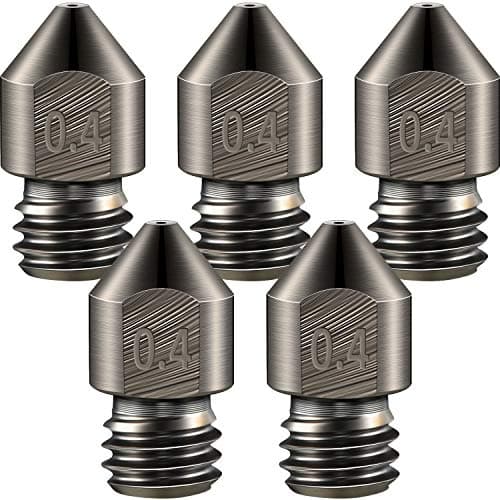
Hardened Steel NozzleNot a suggestion. E3D document brass wearing measurably within a few hundred grams of filled filament, and the damage is invisible until your dimensions drift.Hardened steel, abrasion resistant
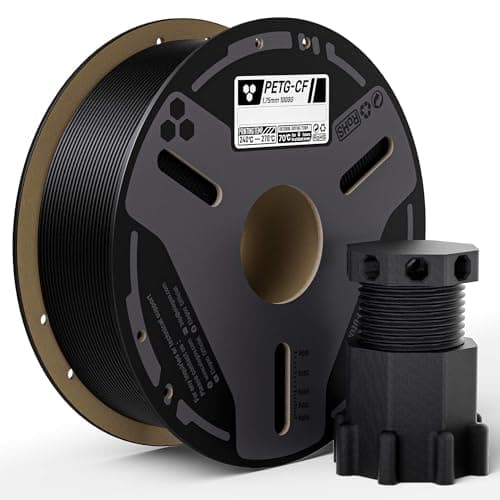
ELEGOO PETG-CFKeeps PETG's heat tolerance and impact resistance and adds the stiffness carbon fill is bought for. The default of the two.PETG base, 215-270 C nozzle, no enclosure
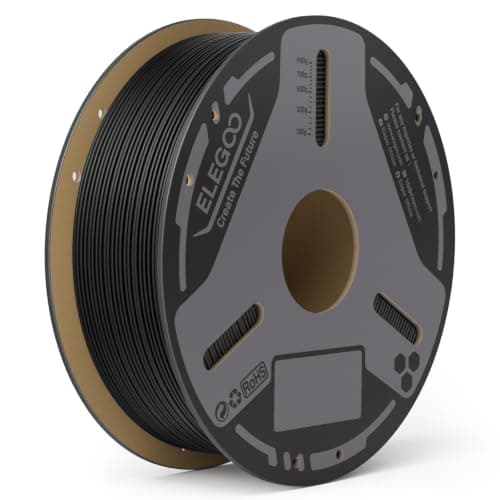
ELEGOO PLA-CFPrints like PLA, costs close to PLA, and has PLA's hard ceiling. Fine for jigs, brackets and display pieces that stay in the house.PLA base, softens above about 60 C
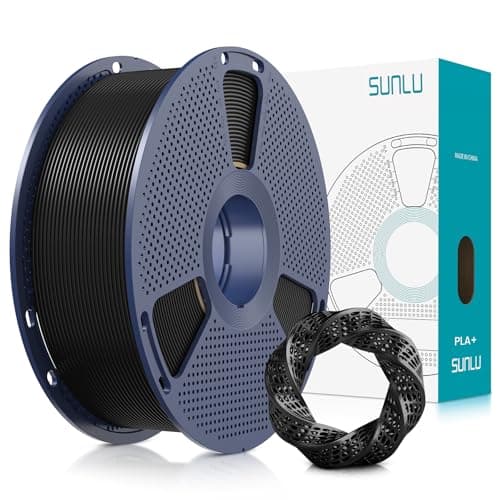
SUNLU PLA+Most people buying carbon fill wanted a stronger part and bought a stiffer one. If yours breaks on impact, unfilled PLA+ is tougher, cheaper and kinder to your nozzle.Unfilled, no nozzle wearSkip this
Live prices verified September 13, 2026. Scores are our own fit rating for the stated use, not a measurement and not a customer rating.
A disassembled 3D printer hotend during maintenance.
The short answer
PETG-CF unless the part never gets warm and you want to spend less. Both spools do the same thing to your printer and to your print quality; the difference is entirely the polymer underneath the fiber, and that difference is heat.
Heat is the whole decision
A carbon-filled PLA softens at exactly the temperature plain PLA softens at. Prusa are explicit that PLA gets soft and deforms above about 60 C Prusa Research, and adding chopped fiber does not move that number — heat deflection is a property of the matrix, not of the filler.
PETG-CF inherits PETG's window instead: Prusa publish 215 to 270 C at the nozzle with a 70 to 90 C bed for PETG, and note the material for impact resistance Prusa Research. That headroom is why a PETG-CF bracket survives a summer car interior and a PLA-CF one becomes a sculpture of itself.
If the part lives indoors at room temperature, this paragraph does not apply to you and PLA-CF is the cheaper buy. If it lives in a car, a garage, an attic or outdoors, the decision is already made — the reasoning generalizes on filament for car parts.
Stiffness is not toughness, in either
This is the misunderstanding that sells the most carbon fiber. Chopped fiber at consumer loadings increases stiffness and dimensional stability. Ultimate strength is often unchanged or slightly reduced, because the fibers interrupt the polymer's continuity and create stress concentrations. A stiffer part deflects less and then fails more suddenly.
Between the two, PETG-CF is the tougher composite because PETG is the tougher polymer. ELEGOO's own listing leans on impact strength for the PETG version and on rigidity for the PLA one, which matches what the base materials do. If your last part snapped, the honest fix is usually a tougher unfilled material rather than a filled one — that is why the skip row above exists.
Both will destroy a brass nozzle
E3D document substantial wear on brass from filled filaments within a few hundred grams E3D, and the failure mode is the nasty kind: the bore widens gradually, extrusion width creeps up, and prints drift out of tolerance long before anything looks broken.
Fit hardened steel first. A few dollars against an invisible failure. The trade is thermal conductivity — steel conducts heat worse than brass, so expect to add a few degrees.
Go up a size if you can. Chopped fiber bridges a narrow orifice more readily than plain polymer does. A 0.6 mm nozzle is a far more comfortable home for either composite than a 0.4 mm one — see nozzle sizes.
Watch for the slow clog. Filled filament is the most common cause of a partial blockage that comes back after cleaning; the diagnosis is on why your nozzle keeps clogging.
Moisture: PETG-CF asks more of you
PETG is more hygroscopic than PLA before any filler is added, and the fiber gives moisture more internal surface to cling to. Prusa publish 55 C for 6 hours for PETG and 45 C for 6 hours for PLA Prusa Research, and with either composite the symptom of skipping it is the same: popping, a rough fuzzy surface and weak layers.
Treat drying as routine for PETG-CF and as occasional for PLA-CF. The full method, and the appliance question, are on how to dry filament.
Printing them, side by side
Temperature. Prusa's composite range runs 225 to 290 C at the nozzle Prusa Research. PLA-CF sits at the bottom of it, PETG-CF in the middle. A hardened nozzle's poorer conduction usually means adding five to ten degrees to whatever worked unfilled.
Bed and enclosure. Neither needs an enclosure, which is the practical advantage both have over the ABS, ASA and nylon composites. PLA-CF runs a 50 to 60 C bed, PETG-CF 70 to 90 C Prusa Research.
Stringing. PETG-CF strings like PETG, and the fibers make the strings harder to remove cleanly. Dry first, temperature second, retraction third — the order matters and it is on PETG print settings.
Finish. Both come out matte. That is a genuine benefit for visible parts and a genuine problem if you planned to sand and paint, because the fibers fight primer.
Cost
PLA-CF is the cheaper of the two per kilogram, and both cost more than their unfilled versions. Add the hardened nozzle to the first order, because buying the spool without it is how people end up replacing a worn nozzle and a batch of out-of-tolerance prints. The arithmetic for comparing spools properly is on filament price per kilogram.
Jigs, fixtures and tool holders that live indoors: PLA-CF, and enjoy the price.
Anything in a car: neither, usually. ASA is the material for that job.
Parts that keep snapping: neither. Go unfilled and tougher, or step up to a nylon composite — the ranking is on strongest filament.
Gears and wear surfaces: a carbon-filled nylon rather than either of these; see filament for gears.
Every pick, in detail
01
Hardened Steel Nozzle
Creality / generic MK8
Buy this before either spool · 9.0/10 our fit score
The five-dollar part that stops abrasive filament from quietly widening your nozzle mid-print. Buy one before your first carbon fiber spool, not after.
Published specifications for Hardened Steel Nozzle
Common size
0.4 mm
Required for
Carbon fiber, glass filled, glow in the dark, metal filledE3D
Trade-off
Lower thermal conductivity than brass
What it does well
E3D document substantial wear on a brand new brass nozzle after only 250 g of carbon-fiber-filled filament
Cheap enough to keep a spare in the drawer
What it does not
Conducts heat worse than brass, so very high flow rates need a few degrees more
Hardened steel tempers and softens at extreme temperatures — E3D make this point explicitly
Anything warm, outdoors or dropped · 8.6/10 our fit score
The carbon composite to buy when the part has to survive being outdoors, warm or dropped. PETG's toughness with the stiffness and matte finish carbon fill adds.
Tougher, which is usually what people mean. PETG is noted by Prusa for impact resistance and PETG-CF inherits that; PLA-CF is stiffer per gram but fails more abruptly. Neither is dramatically stronger than its unfilled version — carbon fill buys stiffness, not strength.
+ − Does carbon fiber make PLA heat resistant?
No. Heat deflection belongs to the base polymer. Prusa state that PLA softens and deforms above about 60 C, and a carbon-filled PLA does the same. If you need heat resistance, change the polymer, not the filler.
+ − Do I need a hardened nozzle for PLA-CF?
Yes, for both. E3D document measurable brass wear from filled filament within a few hundred grams, and a worn nozzle produces prints that are subtly wrong rather than obviously failed. Fit the hardened nozzle before the first spool.
+ − Which carbon fiber filament should a beginner buy?
Ideally neither yet. Both need a hardened nozzle, both string or clog more readily than unfilled filament, and most first disappointments with carbon fill come from expecting strength it does not provide. If you want one anyway, PLA-CF is the gentler introduction because it prints at PLA temperatures.