Strength is four separate measurements and the ranking changes depending on which one you meant. Nylon composites win on mechanical duty, polycarbonate on heat and tenacity, PETG on shrugging off impacts — and print orientation beats all of it.
How this page is funded. Buy links go to Amazon and we earn a commission on qualifying purchases at no extra cost to you. Commission never decides an order or a score, we accept no free products or sponsored placements, and every roundup names something to skip. Full disclosure.
The picks, ranked
The picks, ranked
#
Product
Best for
Score
Price
1
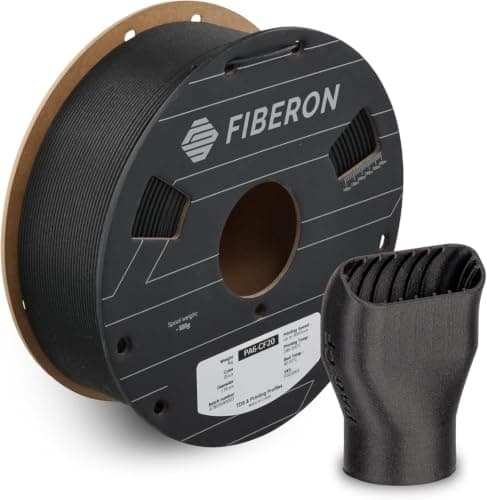
Polymaker Fiberon PA6-CF20Carbon-filled nylon is the strongest combination a consumer printer can produce, and it asks for a dryer, a hardened nozzle and an enclosure before it delivers any of it.240-285 C, hardened nozzle, enclosure
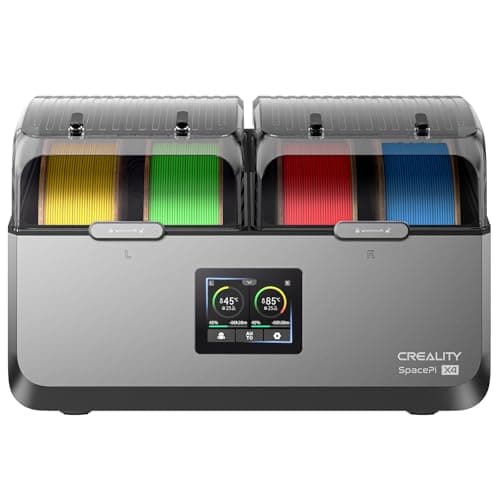
Creality Space Pi X4A wet nylon part is weaker than a dry PETG one. This is not an accessory to the material choice, it is part of it.45-85 C, four spools
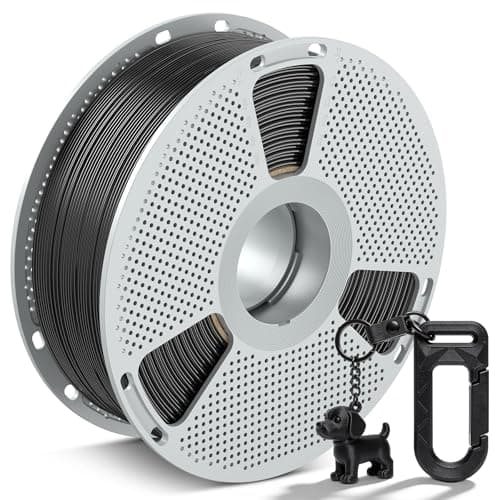
SUNLU Easy PA NylonA copolymer tuned to print at the low end of the nylon window. Cheapest route to nylon toughness, with no published data sheet behind the claims.Nylon 6/66 copolymer, 240-285 C range
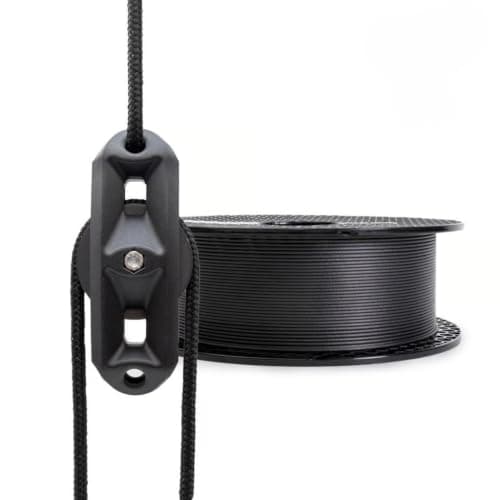
Prusament PC Blend Carbon FiberPolycarbonate is the only material here with real temperature headroom, and the only one that asks 275 C of your hotend to get it.270-275 C nozzle, 100-115 C bed
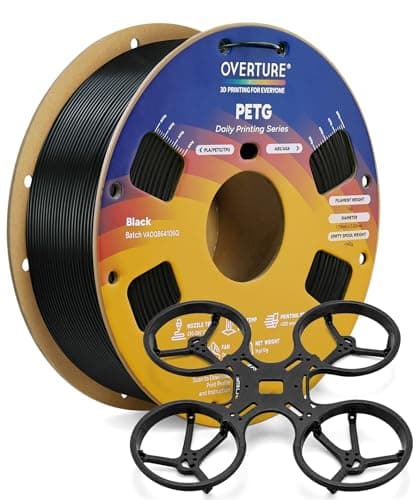
Overture PETGThe strongest material most people should actually buy: no enclosure, no hardened nozzle, no dryer, and it survives being dropped.215-270 C nozzle, noted for impact resistance
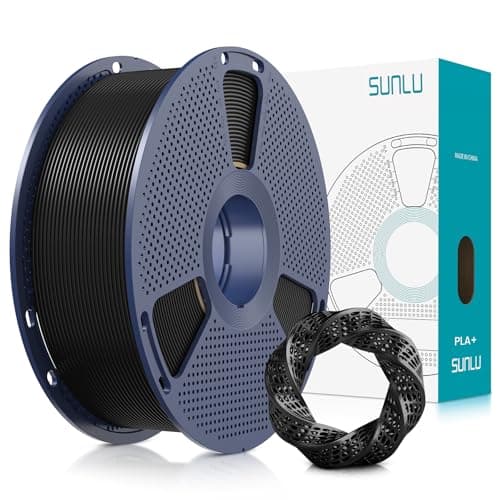
SUNLU PLA+PLA posts a high tensile number and then fails on impact, in heat and under sustained load. The tensile figure is why people buy it and the other three are why they come back.Softens above about 60 CSkip this
Live prices verified September 13, 2026. Scores are our own fit rating for the stated use, not a measurement and not a customer rating.
A broken plastic part after a stress test.
"Strongest" is four different questions
Ask which filament is strongest and you will get four answers, all defensible, because the word covers four properties that do not correlate. Deciding which one you meant takes a minute and saves a spool.
Tensile strength — how hard you can pull before it breaks. PLA scores surprisingly well here, which is why it wins spec-sheet arguments and loses real ones.
Impact resistance — whether it survives being dropped, hit or crashed. This is where PLA is worst and where PETG and nylon are transformative. Prusa list impact resistance as PETG's noted property Prusa Research.
Layer adhesion — how strongly each layer is welded to the one below. A printed part is never as strong across layers as along them, which is why orientation outranks material.
Stiffness — resistance to bending. Carbon fill raises this and lowers the others slightly, which is the trade covered on PLA-CF versus PETG-CF.
Orientation beats material, every time
This is the single most useful paragraph on the page. A printed part is an anisotropic stack of welded lines: strong along the layers, much weaker across them. A PETG bracket printed with the load running across the layer boundaries will fail before a PLA bracket printed the right way round.
Before buying a stronger spool, rotate the model so that the force runs along the layers rather than trying to peel them apart, and add perimeters rather than infill — walls carry load, infill mostly supports the walls. Doing both is free and often ends the problem without a new material.
Nylon and nylon composites: the actual answer
For mechanical parts, carbon-filled nylon is the strongest combination a consumer machine produces: nylon's toughness with the stiffness the base polymer lacks. Prusa publish 240 to 285 C at the nozzle for polyamide and recommend an enclosure Prusa Research.
The catch is moisture, and it is not a small one. Nylon absorbs water from ordinary room air fast enough to matter within hours of opening the bag, and a wet nylon print is weaker, uglier and stringier than a dry PETG one. Prusa's guidance for polyamide sits below 90 C Prusa Research, which is above what many consumer dryers reach — which is exactly why a dryer sits in the picks above rather than in a footnote. The full material page is best nylon filament.
Polycarbonate: strength that keeps working hot
Where nylon wins on toughness, polycarbonate wins on tenacity plus temperature. Prusa publish 270 to 275 C at the nozzle with a 100 to 115 C bed and recommend an enclosure Prusa Research, and that nozzle figure is the gate: plenty of hotends cannot hold 275 C reliably, and a PTFE-lined one should not try.
Buy it when the part is both loaded and warm — under a hood, near a motor, in an enclosure. For anything at room temperature it is a harder material to print for a benefit you will not use; the alternatives are on heat-resistant filament.
PETG: the strongest thing most people should buy
Every material above asks for hardware. PETG asks for nothing: no enclosure, no hardened nozzle, no dryer on day one, and Prusa's published window of 215 to 270 C at the nozzle with a 70 to 90 C bed is inside what a stock machine does Prusa Research.
It is not the strongest material on any single axis except the one that breaks real parts — impact. For brackets, clips, tool holders and anything that gets dropped, a PETG part printed in the right orientation outperforms an exotic material printed badly by someone fighting a warped first layer. That is not a consolation prize; it is the recommendation.
Why PLA keeps winning arguments and losing parts
PLA's tensile number is genuinely high. It is also brittle, it creeps under sustained load, and it softens above about 60 C Prusa Research. So it wins the number people quote and loses the three that decide whether a part survives.
The toughened PLA+ grades close part of the impact gap at almost no cost and are worth defaulting to — the difference is covered on PLA versus PLA+. What no grade of PLA changes is the heat ceiling.
What the strong materials cost you in hardware
A hardened nozzle for anything filled. E3D document brass wearing measurably within a few hundred grams of filled filament E3D.
A dryer that reaches the published figures. The maximum temperature is the specification that decides the purchase, not the number of spools — see best filament dryer.
An enclosure for nylon and polycarbonate, both of which Prusa list as recommending one Prusa Research.
A hotend that holds temperature. 275 C is not a number every machine can sustain, and a PTFE-lined hotend should not be asked to.
Which for what
Gears, bearings and sliding parts: carbon-filled nylon — see filament for gears.
Load plus heat: polycarbonate blend.
Dropped, thrown, crashed: PETG, or nylon if you have the dryer.
Stiff and dimensionally stable indoors: a carbon composite, understanding it is stiffer rather than tougher.
For mechanical parts, carbon-filled nylon — with the dryer, hardened nozzle and enclosure it requires. For strength that also survives heat, a polycarbonate blend. For most people, PETG is the strongest material they can actually print well, because it needs no new hardware.
+ − Is PLA stronger than PETG?
In tensile testing PLA often scores higher. In the failure modes that break real parts — impact, sustained load and heat — PETG wins, and Prusa list impact resistance as PETG's noted property. PLA also softens above about 60 C.
+ − Does carbon fiber make filament stronger?
It makes it stiffer and more dimensionally stable. Ultimate strength is usually unchanged or slightly lower, because chopped fibers interrupt the polymer and create stress concentrations. Stiffer parts deflect less and then break more suddenly.
+ − How do I make a printed part stronger without changing filament?
Rotate it so the load runs along the layers rather than across them, and add perimeters instead of infill. Printed parts are much weaker across layer boundaries, so orientation routinely matters more than the material on the spool.