Heat resistance is the property that most often forces a material change, and it is the one carbon fiber does not help with. Here is the honest ordering, and where each material stops being usable.
How this page is funded. Buy links go to Amazon and we earn a commission on qualifying purchases at no extra cost to you. Commission never decides an order or a score, we accept no free products or sponsored placements, and every roundup names something to skip. Full disclosure.
The picks, ranked
The picks, ranked
#
Product
Best for
Score
Price
1
Prusament PC Blend Carbon FiberPolycarbonate is the high-temperature answer on a consumer machine, and it asks for everything: enclosure, dryer, hardened nozzle.270-275 C nozzle, 100-115 C bed
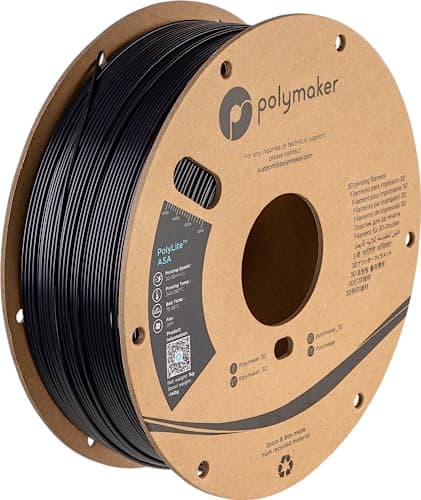
Polymaker PolyLite ASAEnough headroom for a car interior or an enclosure near a heat source, without polycarbonate's difficulty.220-275 C nozzle, enclosure recommended
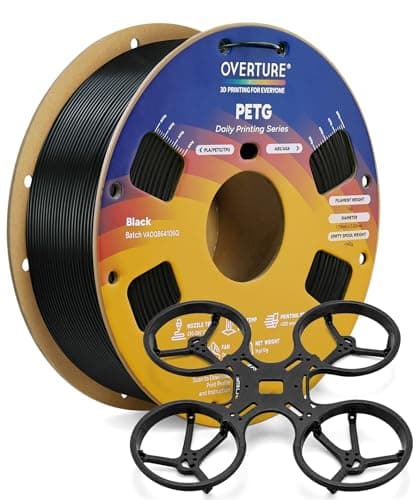
Overture PETGA real improvement over PLA with no new hardware. Enough for most warm indoor situations, not enough for a parked car.215-270 C nozzle, no enclosure
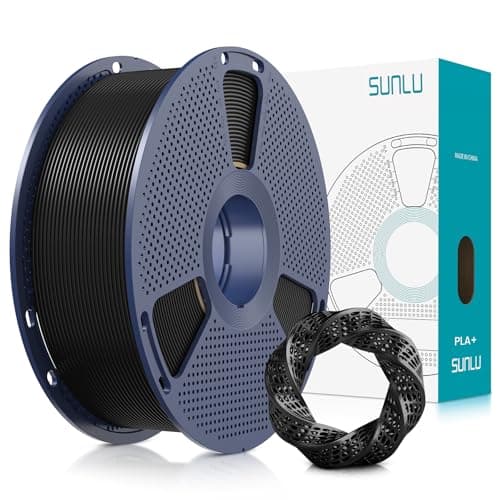
SUNLU PLA+PLA is the first thing to sag, and PLA+ does not change that. If heat is the problem, PLA is never the answer.Softens at the lowest temperature hereSkip this
Published printing parameters by material, from Prusa Research's filament material guide. Ranges are the manufacturer's published envelopes, not a recommendation for your specific spool — every brand publishes its own narrower window inside these. Figures from Prusa Research, retrieved 2026-09-01.
The ordering
Prusa's material guide gives the practical picture through its noted properties column: polycarbonate is listed for high tenacity and temperature resistance, ABS and ASA for impact and UV or chemical resistance respectively, PETG for impact resistance, and PLA for low warping Prusa Research. Read as a heat ranking, worst to best:
PLA — sags first, and by a wide margin. A dark PLA part in direct summer sun or in a parked car will deform.
PETG — a meaningful step up, printed on the same machine with no new hardware. Fine for warm indoor use.
ABS and ASA — real headroom. Prusa publish bed temperatures of 95 to 110 C for these Prusa ResearchPrusa Research, which is an indicator of the temperatures they tolerate.
Polycarbonate — the highest of the practical consumer options, published at 270 to 275 C nozzle and 100 to 115 C bed with an enclosure recommended.
Carbon fiber does not help
This is the most common misconception in this area. Carbon fill adds stiffness and dimensional stability; heat deflection is a property of the base polymer. A carbon-filled PLA softens at PLA's temperature. If the failure mode is sagging in a hot car, PLA-CF fails the same way PLA does.
The material that resists heat is polycarbonate, or nylon, or ASA. The carbon fill on top of those adds rigidity to a material that already had the heat tolerance.
Annealing: real, and not a free upgrade
Heating a finished PLA part slowly can increase its crystallinity and raise the temperature at which it softens. It genuinely works. It also shrinks and distorts the part, unpredictably and anisotropically, which means a dimensionally accurate annealed part requires designing for the shrinkage and testing it.
For a decorative or non-fitting part it is a reasonable trick. For anything that has to fit something else, changing material is far more reliable than annealing and re-fitting.
Design changes that buy heat tolerance
Thicker walls and more material. A part with more mass takes longer to reach the temperature at which it fails, which for intermittent heat exposure is often enough.
Light colors in sunlight. Surface temperature in direct sun varies enormously with color. A white part can run substantially cooler than an identical black one.
Remove the load. Materials sag under load at temperatures where they would hold their shape unloaded. A bracket that is not carrying anything survives conditions that would deform a loaded one.
Add a metal insert where a fastener bears. The plastic then does not have to hold the load at temperature.
Common cases
Car interior: ASA or polycarbonate. PLA will deform on a dashboard in summer, reliably. See filament for car parts.
Near a 3D printer hotend or a light fixture: ASA minimum, polycarbonate if it is close.
Dishwasher: nothing on this list is a confident yes. Heat plus water plus detergent is a harsh combination, and the food contact question applies separately — see is PETG food safe.
Outdoors in the sun: ASA, because UV matters as much as heat. Covered on the outdoor guide.
Every pick, in detail
01
Prusament PC Blend Carbon Fiber
Prusa Research
The highest temperature here · 8.2/10 our fit score
The high-temperature option in this list. Everything about it — nozzle, chamber, drying — is more demanding than any filament above.
Published specifications for Prusament PC Blend Carbon Fiber
UV resistance is the entire point and it is real — Prusa contrast it directly with ABS, whose outdoor parts "turn yellowish and more brittle over time"
Warps less and smells less than ABS at the same temperatures
What it does not
Needs an enclosure and a hot bed; this is not a material for an open printer in a cold room
More expensive per kilogram than the PETG that would do the job for many outdoor parts
Of the practical consumer options, polycarbonate. Prusa list it for high tenacity and temperature resistance and publish 270 to 275 C nozzle with 100 to 115 C bed and an enclosure recommended. It is also the most demanding to print.
+ − Will PLA melt in a car?
It will not melt but it will sag, which is worse in practice because the part deforms while keeping its shape enough to look intact. A parked car in summer reaches temperatures well above what PLA tolerates under load.
+ − Does annealing PLA make it heat resistant?
It raises the softening temperature and it also shrinks and distorts the part unpredictably. For decorative parts it is a useful trick; for anything that must fit something else, changing material is far more reliable.