Flexible filament is the specialty material that needs the least new hardware and the most patience. If your extruder is direct drive, TPU works today; if it is Bowden, no setting will save you.
How this page is funded. Buy links go to Amazon and we earn a commission on qualifying purchases at no extra cost to you. Commission never decides an order or a score, we accept no free products or sponsored placements, and every roundup names something to skip. Full disclosure.
The picks, ranked
The picks, ranked
#
Product
Best for
Score
Price
1
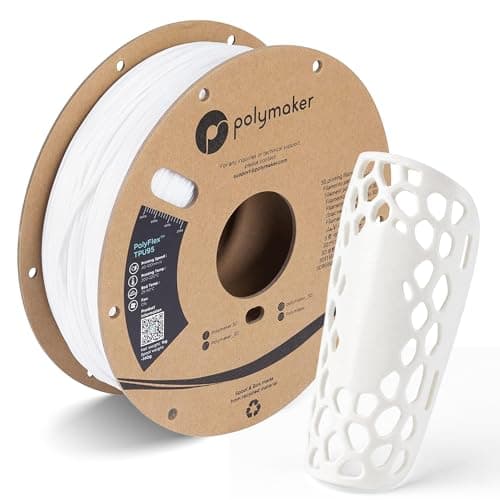
Polymaker PolyFlex TPU95The flexible filament with real documentation behind it. Buy this when the flexibility is a specification rather than a vibe.Shore 95A, published data sheet
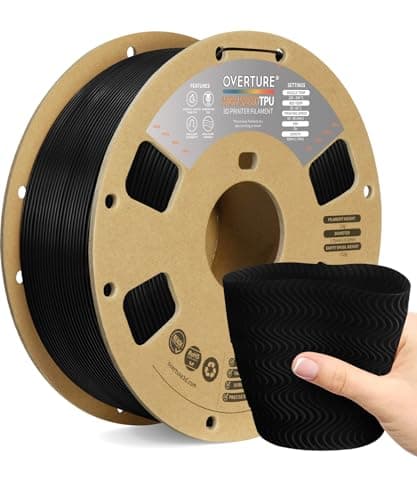
Overture TPU (High Speed)Worth the premium only if your direct-drive extruder can actually use the speed. On an older machine it buys nothing.High-speed TPU grade
Live prices verified October 17, 2026. Scores are our own fit rating for the stated use, not a measurement and not a customer rating.
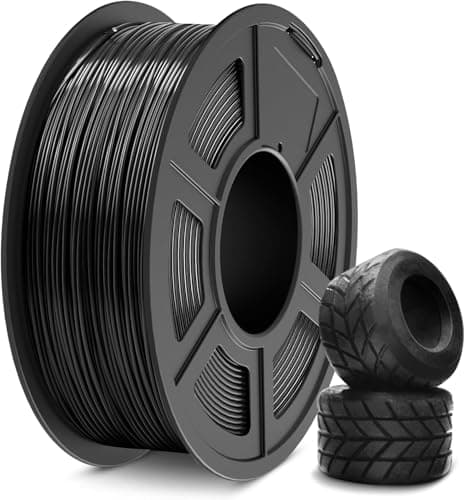
A flexible 3D printed part beside a spool of filament.
The one hardware question
Flexible filament fails on Bowden printers for a mechanical reason that no slicer setting addresses. The extruder pushes filament down a long PTFE tube to the hotend. Rigid filament transmits that push. Soft filament compresses and buckles inside the tube instead, so the motor turns and nothing comes out — then the compression releases all at once and you get a blob.
On a direct-drive extruder the distance from drive gear to melt zone is a few centimeters and there is nowhere for the filament to buckle. TPU prints straightforwardly.
Shore hardness is the spec that matters
Flexible filaments are sold by Shore hardness, usually on the A scale. Lower numbers are softer.
Shore 95A — the standard, and the only grade most printers handle comfortably. Firm and rubbery, like a shoe sole. Phone cases, gaskets, feet, drive belts.
Shore 85A — noticeably softer and much harder to print. Direct drive only, and slow.
Shore 70A and below — very soft, specialist equipment territory. Not a reasonable target for a stock consumer printer.
Buy 95A unless you have a specific reason not to. The difference in feel between 95A and 85A is smaller than the difference in printing difficulty.
Settings
Prusa publish 220 to 260 C at the nozzle and 40 to 85 C at the bed for flexible materials, with no enclosure required Prusa Research. The settings that matter are not temperature.
Slow down. 15 to 25 mm/s is a realistic starting point on most machines. This is the single biggest factor.
Retraction near zero. Retracting soft filament stretches it rather than pulling it back, and the stretch does not return where you expect. Expect some stringing and accept it.
Loosen the extruder tension. Over-tight idler pressure deforms soft filament and causes inconsistent feeding.
Print direct from a dry spool. TPU is hygroscopic — Prusa publish 60 C for four hours, Overture 70 C for seven Prusa ResearchOverture.
Designing for flexibles
Infill and wall count control flexibility more than the material grade does. A 95A part at 10 percent infill with two walls is far softer in the hand than the same part at 50 percent with four walls. This means you can tune stiffness in the slicer rather than buying multiple hardness grades, which is usually the better plan.
For gaskets and seals, print with 100 percent infill and enough walls that there is no internal void. Anything less leaks.
The other common use for a flexible spool is wearables: strap ends, joint gussets and the edge trim that stops a rigid plate from cutting into an arm. That build is covered on best filament for cosplay armor, helmets and props.
Sealing is the other job people buy TPU for, and it has its own rules — solid infill, overlapping walls and a designed-in squeeze. Those are on best filament for gaskets and seals.
The other one people buy a flexible spool for is a phone case, where rigid material is actively worse than none — the hardness, wall count and fit questions are on best filament for phone cases.
Every pick, in detail
01
Polymaker PolyFlex TPU95
Polymaker
Parts that must meet a number · 8.6/10 our fit score
The flexible filament with a real datasheet behind it. The one to buy when the part has to meet a number.
Published specifications for Polymaker PolyFlex TPU95
Shore 95A is sometimes possible at very low speed with a tightly constrained filament path. Softer grades are effectively impossible. The soft filament buckles inside the Bowden tube instead of being pushed through it, which no setting fixes.
+ − What Shore hardness should I buy?
95A for almost everything. It handles like a shoe sole and it is the only grade most consumer printers manage comfortably. Adjust perceived softness with infill and wall count rather than buying a softer grade.
+ − Why is my TPU under-extruding?
Almost always speed or extruder tension. Slow to 20 mm/s and loosen the idler. Over-tight tension deforms soft filament so the drive gear cannot grip it consistently.
+ − Does TPU need drying?
Yes, more than PLA. Prusa publish 60 C for four hours and Overture publish 70 C for seven. Wet TPU produces surface bubbling and inconsistent extrusion that looks like a feeding problem.