A phone case has one job: absorb the energy of a drop so the phone does not. That makes this the rare print where the material question has a single answer — flexible TPU — and the interesting decisions are hardness, wall thickness and whether your extruder can push it.
How this page is funded. Buy links go to Amazon and we earn a commission on qualifying purchases at no extra cost to you. Commission never decides an order or a score, we accept no free products or sponsored placements, and every roundup names something to skip. Full disclosure.
The picks, ranked
The picks, ranked
#
Product
Best for
Score
Price
1
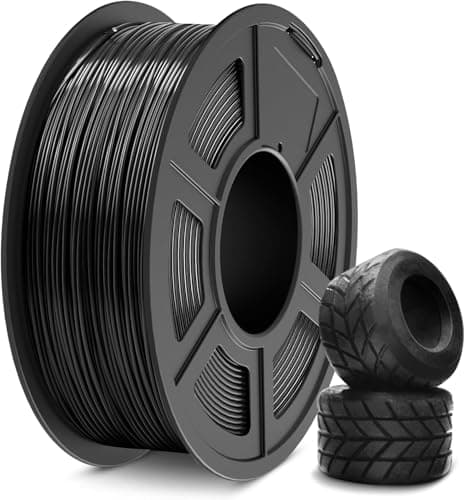
SUNLU TPU 95AThe cheapest TPU worth loading, and case-making is iterative — expect to print two or three before the fit is right.Shore 95A, 230-245 C nozzle
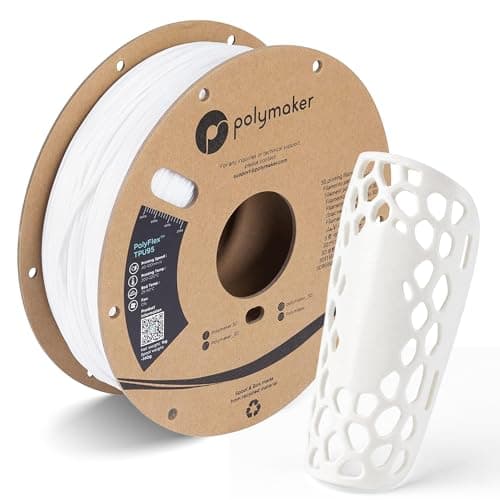
Polymaker PolyFlex TPU95The flexible filament with real documentation behind it, and noticeably more consistent winding, which matters on a long slow print.Shore 95A, published data sheet
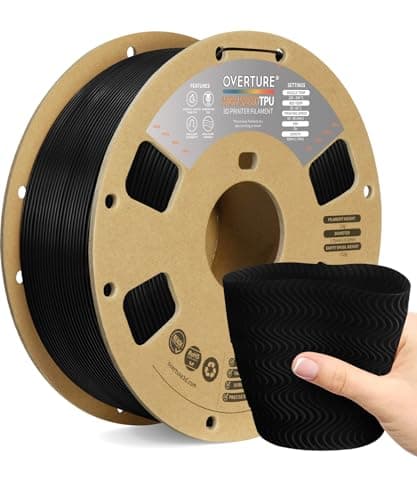
Overture TPU (High Speed)Worth the premium only on a capable direct-drive machine. Overture publish a drying schedule for their own TPU, which most brands do not.High-speed TPU grade, published drying figure
SUNLU PLA+A rigid case transmits the shock straight into the phone and cracks at the corners — the exact places that hit the ground first.Rigid, brittle on impactSkip this
Live prices verified September 13, 2026. Scores are our own fit rating for the stated use, not a measurement and not a customer rating.
A flexible printed part beside a rigid one.
Why the answer is flexible, and only flexible
A case protects a phone by turning kinetic energy into deformation. A flexible material squashes, spreads the impact over milliseconds and hands the phone a gentler pulse. A rigid material does almost none of that: it transmits the shock through to the frame and then cracks, usually at a corner, because corners land first.
There is a second, more mundane reason. A case has to stretch over the phone to go on, and it has to grip to stay there. A PLA case either does not fit or snaps while you fight it onto the device, and a case that fits loosely falls off in a pocket.
Which hardness to buy
Shore hardness is the number that matters, and 95A is the practical choice for almost everyone: it is the stiffest common TPU, which makes it the one consumer extruders handle most reliably, and it is soft enough to absorb a drop and stretch over a phone.
95A — the default. Stiff enough to push through an extruder, flexible enough for the job.
85A and softer — better shock absorption, far harder to print. On a Bowden machine they are effectively impossible, because soft filament buckles inside the tube instead of being pushed through it.
Tune feel in the slicer first. Wall count and infill change how a flexible part feels more than a few points of Shore hardness do. Print the same case at two and at four walls before deciding you need a softer spool. The full explanation is on best TPU filament.
The extruder question, answered honestly
Flexible filament needs a direct-drive extruder with a short, constrained filament path. If your printer pushes filament down a long Bowden tube, TPU is going to be a fight: the filament buckles in the tube, under-extrudes, and no setting fixes it.
Prusa's published guidance for flexible materials puts printing at roughly 20 mm/s with 30 to 40 mm/s as the ceiling Prusa Research, at 220 to 260 C at the nozzle with a 40 to 85 C bed and no enclosure needed Prusa Research. A phone case at 20 mm/s is a multi-hour print, which is worth knowing before you start rather than at hour two.
Settings that decide whether it fits
Slow, and steady. Flexible filament needs constant pressure. Sudden accelerations show up as blobs and gaps.
Retraction as low as you can tolerate. Long retractions pull soft filament into the cold zone, where it swells and jams. Print with minimal retraction and clean up strings by hand.
Two to three perimeters, minimal infill. A case is a shell. Walls give it the springiness; infill just makes it stiff and slow.
Dry the spool. Prusa list moisture absorption as an inherent property of flexible materials and publish 60 C for 4 to 6 hours as the drying schedule Prusa Research. Damp TPU prints with bubbles and a rough, weak surface.
First layer generously. A squashed first layer sticks; a shy one curls and the print peels while you are asleep.
Getting the fit right without printing five cases
Dimensional accuracy is the difference between a case and a frustration, and flexible material makes it harder because the part relaxes after printing.
Print a corner test first. One corner plus the adjacent button cutout takes twenty minutes and tells you everything about fit, cutout alignment and how tight the lip is.
Check the model against your exact phone. Camera islands and button positions change between variants of the same phone name — a case for one model year is a case for that model year.
Calibrate flow. Over-extrusion on a flexible part reads as a case that will not stretch over the phone. The calibration sequence is on print settings, and it transfers to TPU.
Leave clearance at the ports. A printed case is thicker than an injection-molded one; a charging port cutout that looks generous on screen can still block a chunky cable.
What a printed case will and will not do
Being straight about this saves disappointment. A well-printed TPU case gives real drop protection at the corners, grip, and a scratch-free back. It does not match a commercial case's finish: layer lines are visible and the surface is slightly rubbery rather than smooth.
It also will not protect the screen. No case does that on a face-down drop onto a hard edge; a raised lip helps and a screen protector does the rest. And it is not a waterproofing measure — printed parts are porous along layer boundaries, which is the same reasoning that governs whether PLA is waterproof.
The rigid-material question, asked properly
People ask about PETG cases because PETG is tough. It is — for brackets. As a case it is still rigid, so it transmits impact, and its toughness means it survives the drop while the phone does not. That is the wrong trade.
The one legitimate rigid use is a hybrid: a rigid shell for structure with TPU corner bumpers, printed separately and assembled. If you go that route, PETG is the right rigid half — its impact resistance is the property Prusa note for it Prusa Research — and the flexible half still does the protecting.
Every pick, in detail
01
SUNLU TPU 95A
SUNLU
A first case · 8.7/10 our fit score
The cheapest way to find out whether your extruder can handle flexible filament at all. Print it slowly.
TPU at Shore 95A. It absorbs the energy of a drop instead of passing it to the phone, and it stretches over the device without snapping. Softer grades protect better and are much harder to print, especially on a Bowden extruder.
+ − Can you print a phone case in PLA?
You can print it; it is a poor case. Rigid material transmits impact straight into the phone and cracks at the corners, and a PLA case often snaps while being fitted. It also deforms in a hot car, since PLA softens above about 60 C.
+ − Do I need a direct-drive printer to print TPU?
Effectively yes for a case-sized print. Shore 95A is sometimes possible on a Bowden machine at very low speed with a tightly constrained path, but soft filament buckles in a long tube and no setting fixes that.
+ − How long does a TPU phone case take to print?
Hours rather than minutes. Prusa's flexible guidance puts printing at roughly 20 mm/s with 30 to 40 mm/s as the ceiling, so a case-sized shell is a multi-hour job. Print a single corner first to check fit before committing to the whole thing.