These materials are not competing for the same job. The useful comparison is what TPU asks of your printer, because that is what decides whether the flexible option is available to you at all.
How this page is funded. Buy links go to Amazon and we earn a commission on qualifying purchases at no extra cost to you. Commission never decides an order or a score, we accept no free products or sponsored placements, and every roundup names something to skip. Full disclosure.
The picks, ranked
The picks, ranked
#
Product
Best for
Score
Price
1
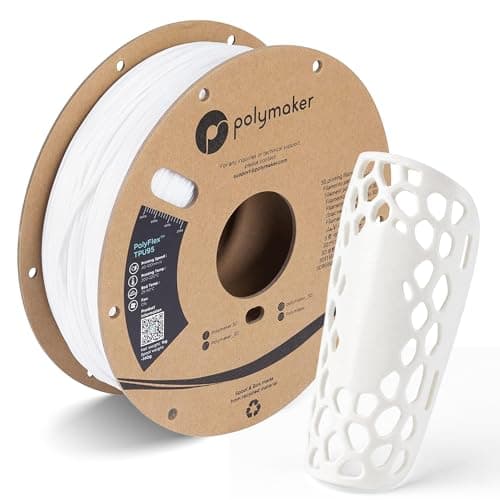
Polymaker PolyFlex TPU95The flexible filament with real documentation. Needs a direct-drive extruder.Shore 95A, published data sheet
Published printing parameters by material, from Prusa Research's filament material guide. Ranges are the manufacturer's published envelopes, not a recommendation for your specific spool — every brand publishes its own narrower window inside these. Figures from Prusa Research, retrieved 2026-09-01.
They are not alternatives
PLA is the stiffest common printing material. TPU is the most flexible. Nobody chooses between them on strength — they choose based on whether the part needs to bend.
So the real content of this comparison is what TPU requires, because for a lot of printers the answer determines whether TPU is an option.
The hardware question
Flexible filament needs a direct-drive extruder. On a Bowden setup the extruder pushes filament down a long PTFE tube, and soft filament compresses and buckles inside the tube rather than transmitting the push. The motor turns, nothing extrudes, then the compression releases at once and you get a blob.
Shore 95A is sometimes achievable on Bowden at very low speeds with a tightly constrained filament path. Softer grades are effectively impossible. This is a mechanical limit, not a settings problem — see the TPU page.
Printing differences
Prusa publish 220 to 260 C nozzle and 40 to 85 C bed for flexible materials, no enclosure required Prusa Research, against 185 to 235 C and 50 to 60 C for PLA Prusa Research. The temperature difference is not the hard part.
Speed. TPU wants 15 to 25 mm/s on most machines. This is the single biggest factor and the one people skip.
Retraction near zero. Retracting soft filament stretches it rather than pulling it back. Expect some stringing.
Drying. TPU is hygroscopic — Prusa publish 60 C for four hours, Overture 70 C for seven Prusa ResearchOverture.
Tune stiffness in the slicer, not the cart
Infill and wall count change how flexible a TPU part feels far more than the Shore grade does. A 95A part at 10 percent infill with two walls is dramatically softer in the hand than the same part at 50 percent with four.
This means you can usually get the feel you want from one spool of 95A, rather than buying multiple hardness grades — which is fortunate, since the softer grades are the ones most printers cannot handle.
What each is for
PLA: anything rigid, indoors, static. Display pieces, prototypes, brackets that do not take impact.
TPU: phone cases, gaskets, feet and bumpers, drive belts, hinges, anything that has to absorb a shock by deforming.
Neither: if it needs to be tough but rigid, that is PETG or nylon, not a compromise between these two.
One design note for seals
Gaskets and seals need 100 percent infill and enough walls that there is no internal void. A partially infilled TPU seal leaks through its own interior, which is a failure mode that surprises people because the outside surface looks perfect.
Every pick, in detail
01
Polymaker PolyFlex TPU95
Polymaker
Flexible parts with a spec · 8.6/10 our fit score
The flexible filament with a real datasheet behind it. The one to buy when the part has to meet a number.
Published specifications for Polymaker PolyFlex TPU95
Direct-drive printers, yes. Bowden printers can sometimes manage Shore 95A at very low speed with a tightly constrained path, and softer grades effectively not at all, because soft filament buckles inside the tube.
+ − Is TPU stronger than PLA?
Different property. TPU is far tougher under impact and deformation; PLA is far stiffer. Neither substitutes for the other, and if you want tough and rigid, that is PETG or nylon.
+ − How do I make a TPU part firmer?
Increase infill and wall count. Those change perceived stiffness far more than the Shore grade does, which usually means one spool of 95A covers the range you need.