Gaskets are a TPU job, and the material is the easy part. A printed gasket seals when it is printed solid, compressed properly and asked to hold something harmless. Fuel, brake fluid and pressure are where a molded seal wins.
How this page is funded. Buy links go to Amazon and we earn a commission on qualifying purchases at no extra cost to you. Commission never decides an order or a score, we accept no free products or sponsored placements, and every roundup names something to skip. Full disclosure.
The picks, ranked
The picks, ranked
#
Product
Best for
Score
Price
1
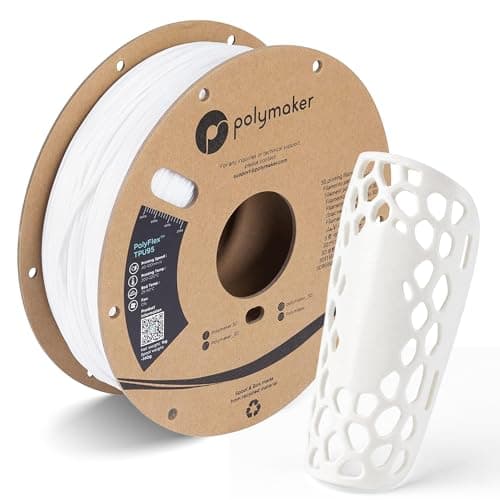
Polymaker PolyFlex TPU95The only flexible filament here with mechanical figures published behind it, which is what you need when the gasket has a requirement rather than a vibe.Shore 95A, published data sheet
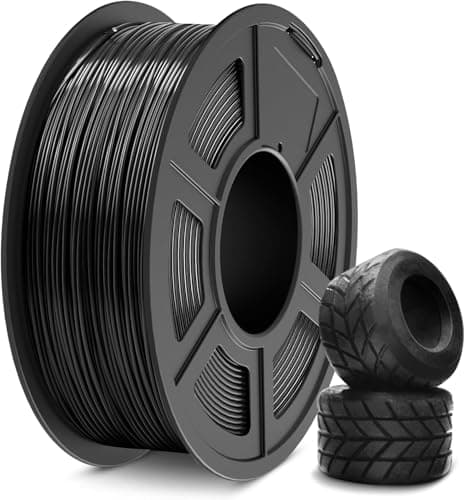
SUNLU TPU 95AGasket design is iterative and the first three attempts are usually wrong. Do the iterating on the cheapest spool that prints properly.Shore 95A, 230-245 C nozzle
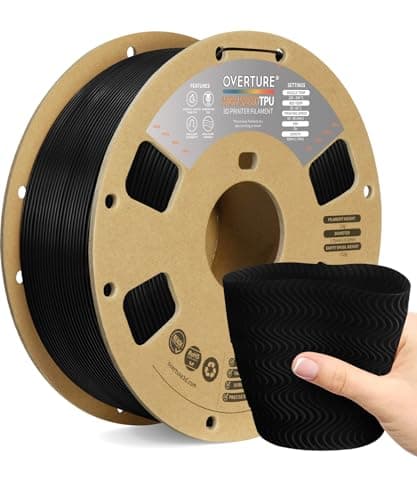
Overture TPU (High Speed)Overture publish a drying schedule for their own TPU, which matters because damp flexible filament prints with voids, and voids are what a gasket leaks through.Published 70 C / 7 h drying figure
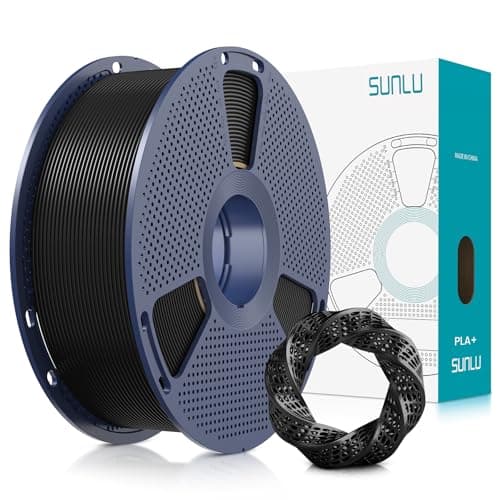
SUNLU PLA+PLA does not conform and does not spring back, so it cannot fill the gap it is meant to seal. A rigid printed ring is a spacer, not a gasket.Rigid, no elastic recoverySkip this
Live prices verified October 21, 2026. Scores are our own fit rating for the stated use, not a measurement and not a customer rating.
A flexible printed part beside a rigid one.
What a gasket actually has to do
A gasket is not a ring of plastic. It is a component that has to do four things at once, and printing changes how well it does three of them.
Conform. Under clamping load it has to flow into the microscopic roughness of both faces. A hard material bridges those valleys instead of filling them, and the gap is the leak.
Recover. Joints move, heat cycles, bolts relax. A gasket that takes a permanent set stops sealing the first time the joint opens and closes.
Resist what it holds. Chemical compatibility is a property of the specific polymer against the specific fluid, and almost no consumer filament brand publishes that data.
Survive the temperature. Which, for everything on this page, is a low bar. Nothing here is a high-temperature gasket.
Why TPU, and which grade
Elastic recovery is the property that separates a gasket from a washer, and among printable materials only the flexibles have it. Prusa list flexible filaments at 220 to 260 C at the nozzle with a 40 to 85 C bed and no enclosure required Prusa Research, which means any printer with a direct-drive extruder can make one today.
Shore 95A is the grade to buy. It is the stiffest common TPU, which makes it the one consumer extruders handle most reliably, and it is soft enough to seal. Softer grades — 85A and below — seal better and are considerably harder to print; on a Bowden machine they are effectively impossible, because soft filament buckles in the tube rather than being pushed through it. The hardware question is covered on best TPU filament.
Perceived softness can also be tuned in the slicer rather than bought. Wall count and infill change how a flexible part feels far more than a few points of Shore hardness do — though for a gasket specifically, that lever is unavailable, because the part has to be solid.
The settings that decide whether it seals
A gasket leaks for one reason: there is a continuous path through it. Every rule below closes one.
One hundred percent infill, no exceptions. Any infill pattern below solid leaves connected voids running through the part. This is the single most common reason a printed gasket weeps.
Enough perimeters that they overlap. On a thin gasket, set wall count high enough that the walls meet in the middle and the infill is decorative. Two walls with a sliver of infill between them is a leak path along the whole length.
Slow, and hot enough to fuse. Prusa's flexible guidance puts printing at roughly 20 mm/s with 30 to 40 mm/s as the ceiling Prusa Research. Fast flexible printing produces under-extruded, poorly bonded walls — porous, in other words.
Move the seam. Every layer has a start and stop point, and that column of seams is the weakest line in the part. Put it where the clamping force is highest, or set the slicer to randomize it so no single column runs through.
Dry the filament first. TPU is hygroscopic; Prusa list moisture absorption as an inherent property of flexibles and publish 60 C for 4 to 6 hours as the drying schedule Prusa Research. Damp TPU prints with steam bubbles through the wall, which is a leak path you cannot see.
Designing the squeeze
A gasket that exactly fills its groove does not seal, because sealing comes from compression. The gasket has to stand proud of the groove so that tightening the joint squeezes it, and the amount of squeeze is what turns a soft ring into a seal.
There is no universal figure to copy here, and we are not going to invent one: the right compression depends on the hardness of the material, the groove geometry and the clamping force available. Treat the first print as a measurement rather than a part. Print it, fit it, tighten the joint, and look at the witness marks — a gasket that comes out flattened across its whole face was compressed enough, and one that comes out looking untouched was not.
Print the profile, not just the outline. A domed or ridged cross-section concentrates the clamping force on a narrow line and seals at far lower bolt tension than a flat rectangle.
Keep it in one piece. A joined or glued gasket leaks at the joint. If the part is bigger than the plate, redesign the joint rather than splicing the seal.
Expect to iterate three times. This is normal, and it is the reason to prototype on cheap filament.
What a printed gasket is not for
The buyer-first answer on several of these is to spend four dollars on a molded O-ring instead. That is a genuine recommendation, not a hedge: an injection-molded nitrile or silicone seal is made of a material chosen for the fluid, has no layer lines, and costs less than the TPU you would spend failing.
Fuel, oil and brake fluid. Chemical compatibility for a specific TPU against a specific fluid is not published by filament brands, and a printed part is porous in ways a molded one is not. The same reasoning rules these out on filament for car parts.
Anything pressurized. Printed parts fail at layer boundaries without warning. A pressure seal failing is not a leak, it is a release.
Food, drink and potable water. The polymer is not the problem; the surface is. Layer lines are crevices that cannot be cleaned properly, which is the argument set out on is PETG food safe.
Heat. Nothing on this page is a high-temperature seal. If the joint gets hot, this is the wrong technology entirely.
When the part is not really a gasket
Plenty of things people call gaskets are actually spacers, shims, dust covers or vibration pads, and those have different right answers.
Spacers and shims want a rigid material that holds its dimension: PETG, or PLA if it stays cool. Elasticity is the wrong property here.
Dust and splash covers do not need to seal against pressure, so a 95A TPU cover printed solid is genuinely good at this job.
Vibration isolation feet are where flexible filament is unambiguously the right tool, and where softness helps rather than complicating the print.
Every pick, in detail
01
Polymaker PolyFlex TPU95
Polymaker
A seal that has to meet a number · 8.7/10 our fit score
The flexible filament with a real datasheet behind it. The one to buy when the part has to meet a number.
Published specifications for Polymaker PolyFlex TPU95
+ − Can you 3D print a gasket that actually seals?
Yes, for water, dust, air at low pressure and vibration. Print it in TPU 95A at 100 percent infill with overlapping perimeters, dry the filament first, and design the groove so the gasket is compressed rather than just filling the space.
+ − What is the best filament for gaskets?
TPU at Shore 95A. It is the stiffest common flexible grade, which makes it the most printable, and it still conforms and recovers. Softer grades seal better and are much harder to print, especially on a Bowden extruder.
+ − Why does my printed gasket leak?
Almost always internal voids. Anything below 100 percent infill leaves connected air paths through the part, and damp TPU adds steam bubbles inside the walls. Print solid, slow down, and dry the spool at the published 60 C for 4 to 6 hours.
+ − Can I print a gasket for fuel or oil?
No. Filament brands do not publish chemical compatibility data for specific fluids, and a printed part is porous in ways a molded seal is not. Buy a molded seal in a material chosen for the fluid; it costs less than the filament you would waste.