Two manufacturers publish per-material drying figures and they disagree by up to ten degrees. Both sets are below, unaveraged, because the gap between them is itself information about how wide the safe window is.
How this page is funded. Buy links go to Amazon and we earn a commission on qualifying purchases at no extra cost to you. Commission never decides an order or a score, we accept no free products or sponsored placements, and every roundup names something to skip. Full disclosure.
The picks, ranked
The picks, ranked
#
Product
Best for
Score
Price
1
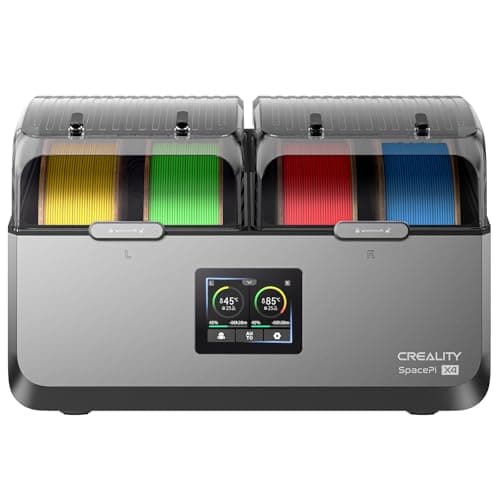
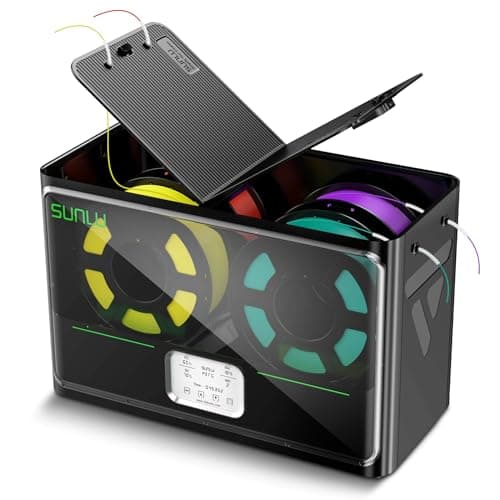
SUNLU FilaDryer S4Covers every published figure short of nylon, and the humidity readout tells you when to stop.Up to 70 C, humidity setpoint
Published drying temperatures and times. Prusa Research and Overture disagree on several materials; both figures are shown rather than averaged. A dash means that manufacturer does not publish a figure for that material. Where they differ, the lower temperature for longer is the safer starting point. Figures from Prusa Research, Overture, Prusa Research, retrieved 2026-09-06.
How long a freshly dried spool stays print-ready, by the humidity of the room it sits in.
Ambient humidity
How long it stays dry
What that means in practice
Below 20% RH (sealed box with desiccant)
2-7 days
The published storage target for most filaments
About 55% RH (ordinary indoor air)
2-12 hours
Enough moisture to affect print quality, depending on how hygroscopic the type is
How long a freshly dried spool stays print-ready, by the humidity of the room it sits in. Both figures are Bambu Lab's, published as ranges across filament types rather than per material. Figures from Bambu Lab Wiki, retrieved 2026-09-01.
The published figures
Prusa Research publish per-material drying temperatures and times Prusa Research. Overture publish their own set Overture. They agree on the general shape and disagree on specifics: Prusa say 45 C for six hours for PLA, Overture say 50 C for seven; Prusa say 55 C for PETG, Overture say 65 C.
We show both rather than averaging, because an average of two published figures is a number no manufacturer stands behind. The spread tells you the window is wider than either figure implies, and the lower temperature for longer is the safer starting point when you are unsure.
The method
Confirm it is actually wet. Popping at the nozzle, a rough matte surface, stringing that got worse over time. If prints were never good, that is a settings problem — see wet filament signs.
Look up the temperature for that material in the table below and use the lower published figure if two exist.
Run it for the published time, longer if the spool was badly stored. Extra time at the correct temperature does no harm; extra temperature does.
Watch the humidity readout if you have one. When the chamber reading stops falling, the spool has given up what it is going to at that temperature.
Bag it immediately or print it immediately. Bambu's published re-wetting figures give you 2 to 12 hours in ordinary room air Bambu Lab Wiki.
The mistakes that cost spools
The kitchen oven. Domestic ovens overshoot their setpoint and cycle widely around it. PLA's 45 C drying figure is far below what an oven set to its lowest mark will actually reach at the peak of a cycle.
Drying at the wrong material's temperature. Setting a PLA spool to nylon's temperature welds it.
Drying with the spool in a sealed bag. The water has to go somewhere. A dryer needs airflow, or at least an unsealed chamber, to carry moisture away.
Assuming it worked. Print the same test file you printed before drying. If it is unchanged, the problem was not moisture.
Drying during a long print
For nylon and TPU, drying before the print is not sufficient on its own. A 20-hour print draws from a spool that is sitting in room air the entire time, and the published re-wetting figures say that spool is compromised within hours.
The answer is to feed from a heated box during the print. Purpose-built dry boxes do this, Prusa publish a design for one Prusa Research, and Bambu's newer hardware adds an actively heated drying function to the material system for the same reason Bambu Lab Wiki. See dry boxes.
How often
There is no schedule. Dry when the symptoms appear, and store properly so they appear rarely. Drying on a routine wastes energy and puts spools through unnecessary heat cycles; the correct frequency for a well-stored spool is close to never.
If the only heated box in the house is the kitchen oven, read drying filament in an oven before using it. Prusa are explicit that home ovens do not hold temperature precisely enough for low-temperature filaments.
Every pick, in detail
01
SUNLU FilaDryer S4
SUNLU
Everyday drying · 8.7/10 our fit score
Four spools at once, 70 C, and a humidity setpoint rather than a bare timer. The right shape for someone who buys filament by the case.
Prusa publish 45 C for six hours and Overture publish 50 C for seven. Use the lower figure if you are unsure — PLA softens at temperatures not far above these, and a spool that welds to itself is scrap.
+ − How long should I dry filament for?
The published times run four to eight hours depending on material, and longer does no harm at the correct temperature. If you have a humidity readout in the chamber, the point where it stops falling is the point where further drying achieves nothing.
+ − Can I dry filament while printing?
You can feed from a heated dry box during the print, which is the correct approach for nylon and TPU. Published re-wetting figures show a dried spool in room air is compromised within hours, so a long print from an open spool finishes wet.
+ − Does drying filament damage it?
Not at the published temperatures. Above them, filament softens and a spool can weld to itself, which is unrecoverable. Extra time is safe; extra temperature is not.