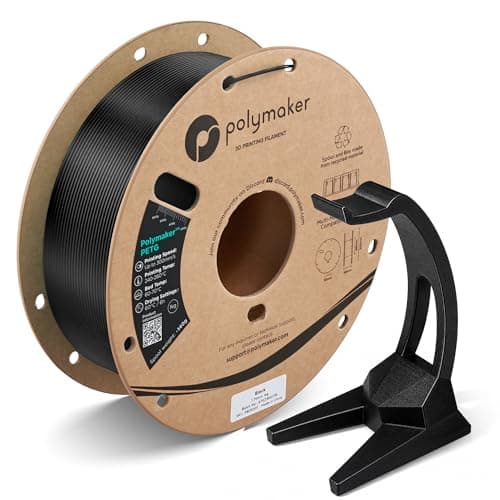
PETG is what you print when PLA keeps breaking. It takes impact far better, it survives outdoors for a season, and it costs you an evening of retraction tuning plus a real risk of bonding to your build plate. Overture PETG is where most people should start.
How this page is funded. Buy links go to Amazon and we earn a commission on qualifying purchases at no extra cost to you. Commission never decides an order or a score, we accept no free products or sponsored placements, and every roundup names something to skip. Full disclosure.
The picks, ranked
The picks, ranked
#
Product
Best for
Score
Price
1
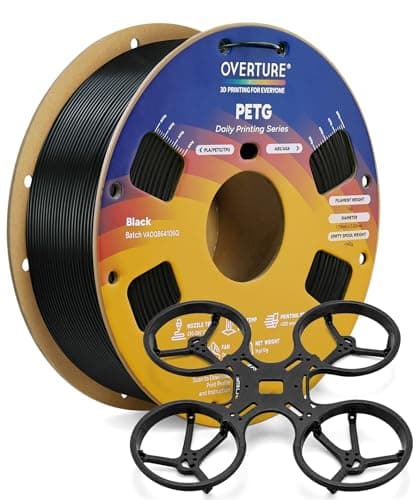
Overture PETGForgiving on temperature, widely stocked, and cheap enough that learning PETG on it does not hurt.215-270 C nozzle, 70-90 C bed
Polymaker PolyLite PETGConsistency is what the premium buys here, and in PETG consistency shows up as less time fighting strings.Published data sheet per grade
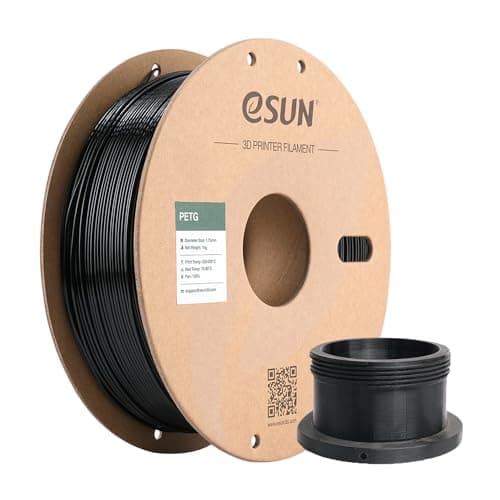
eSUN PETGCompetent, and usually a dollar behind or ahead of SUNLU. Buying it on anything other than price is buying it for no reason.Budget PETGSkip this
Published printing parameters by material, from Prusa Research's filament material guide. Ranges are the manufacturer's published envelopes, not a recommendation for your specific spool — every brand publishes its own narrower window inside these. Figures from Prusa Research, retrieved 2026-09-01.
What PETG is actually for
Prusa Research list PETG's noted property as impact resistance and PLA's as low warping Prusa Research. That single line is most of the decision. PETG is the material for the part that gets handled, dropped, clamped, or left on a windowsill. It deforms before it breaks, where PLA shatters.
The published printing window is wider and hotter: 215 to 270 C at the nozzle and 70 to 90 C at the bed Prusa Research, against PLA's 185 to 235 C and 50 to 60 C. There is also a high-temperature grade published at 270 C nozzle and 110 C bed. None of those numbers is out of reach for a stock printer, which is why PETG is the natural second material rather than the third or fourth.
The two problems PETG genuinely has
Stringing
PETG strings more than PLA and it does so for a reason you cannot tune away entirely: it is more hygroscopic, and it stays molten across a wider temperature band. Wet PETG strings dramatically. Dry PETG at a sensible temperature with tuned retraction strings a little, and a quick pass with a heat gun removes the wisps.
The order of operations matters. Dry the filament, then set temperature, then tune retraction. Tuning retraction on wet filament is tuning against a moving target, and it is the single most common reason people conclude PETG is difficult. Our PETG settings page has the full sequence.
Bonding to the build plate
This is the expensive one. PETG bonds chemically to smooth PEI. Not adheres — bonds. A first layer printed too close and too hot on a smooth PEI sheet can take a chunk of the sheet with it when you remove the part, and the plate is not repairable.
There are two reliable answers: print PETG on a textured surface, which mechanically keys rather than chemically bonding, or use a glue stick as a deliberate release layer on smooth PEI. A dollar of school glue is genuinely the correct engineering answer here, and it is why it appears in our bed adhesion roundup. The plate choice is covered on build plates.
PETG and moisture
PETG absorbs meaningfully more water than PLA, and wet PETG is obvious: popping and hissing from the nozzle, a rough matte surface where it should be glossy, and stringing that no retraction setting fixes. Prusa publish 55 C for six hours for PETG drying Prusa Research; Overture publish 65 C for seven Overture. Both are shown in our drying ledger rather than averaged into a number nobody published.
Practically: PETG is the material that makes a dryer worth buying. If you are printing PETG regularly and storing spools on an open shelf, you are printing wet filament some of the time whether you have noticed or not.
Outdoors, water and food
PETG handles a season outdoors far better than PLA, mostly because it does not soften in the sun the way PLA does. It is not UV-stable in the way ASA is, and a PETG part left in direct sun for a year will get brittle at the surface. Our outdoor filament guide works through where the line falls.
For water, PETG is the practical choice and the limits are about the print rather than the polymer. The food-contact question is more complicated than the label on the spool suggests, and we take it seriously on is PETG food safe.
The copolyester family extends past PETG itself. PCTG uses more of the ingredient that makes PETG tough, which buys impact resistance and chemical resistance at a higher price and a hotter nozzle — whether that is worth it is on best PCTG filament.
Every pick, in detail
01
Overture PETG
Overture
Most people, most of the time · 8.8/10 our fit score
The PETG most people should start with: forgiving on temperature, widely stocked, and cheap enough to learn on.
Tougher rather than stiffer. PLA is stiffer and comparable in tensile strength, but PETG absorbs impact far better and deforms before it fails. For parts that get handled or dropped, PETG is the better material.
+ − Why does my PETG string so much?
Almost always moisture first, temperature second, retraction third. PETG absorbs water more readily than PLA and wet PETG strings in a way no retraction setting corrects. Dry it, then set temperature, then tune retraction, in that order.
+ − Will PETG damage my build plate?
It can, on smooth PEI. PETG bonds chemically to smooth PEI and can pull material off the sheet when the part is removed. Print PETG on a textured surface, or use a glue stick on smooth PEI as a deliberate release layer.
+ − Does PETG need an enclosure?
No. Prusa's material guide lists no enclosure requirement for PETG, unlike ABS and ASA. An enclosure helps a little with large flat parts, but PETG prints fine on an open machine.