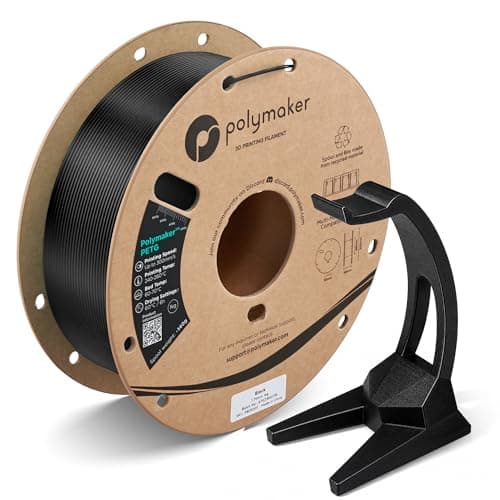
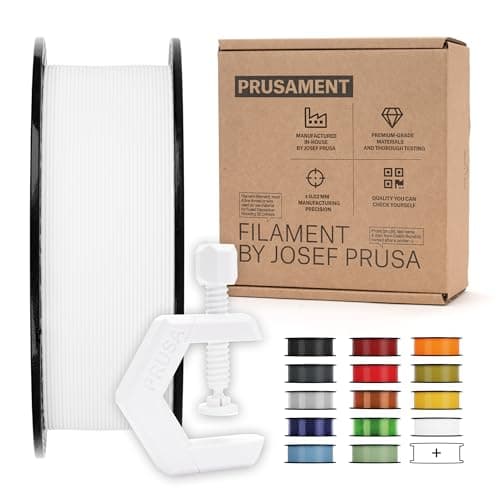
Prusament PETG's most useful property is not that it prints better. It is that Prusa publish the exact profile temperatures for it, so when a print fails you know the filament is not the variable.
How this page is funded. Buy links go to Amazon and we earn a commission on qualifying purchases at no extra cost to you. Commission never decides an order or a score, we accept no free products or sponsored placements, and every roundup names something to skip. Full disclosure.
The picks, ranked
The picks, ranked
#
Product
Best for
Score
Price
1
Prusament PETGWorth keeping one spool for this purpose even if you print budget PETG day to day.Published profile temperatures
Live prices verified October 16, 2026. Scores are our own fit rating for the stated use, not a measurement and not a customer rating.
Filament spools arranged on a shelf.
What a reference spool is for
Debugging a 3D printer is difficult because almost every symptom has three or four plausible causes and most of them are invisible. A part that under-extrudes could be a partial clog, a worn nozzle, wrong flow calibration, a slipping extruder, or filament that is slightly undersized.
A reference spool removes one variable permanently. If you print the same test file on a spool whose manufacturer publishes the exact profile temperature and it comes out clean, the filament is not your problem. If it comes out badly, the machine is. That is a genuinely valuable thing to own, and it is worth the price of one spool regardless of what you print the rest of the time.
The documentation behind it
Prusa Research publish the most complete public material documentation in consumer 3D printing. Their material guide gives published nozzle and bed ranges for every common material Prusa Research, their PETG page gives the specifics Prusa Research, and their drying article is one of only two published sources with per-material drying figures Prusa Research.
That is free and you benefit from it whether or not you buy their filament — which is worth saying, because a review that implies you have to buy the spool to get the information would be wrong.
Is it worth the price for routine printing?
For most people, no. The premium is real and the everyday printing benefit over Polymaker or a well-tuned budget spool is small. The honest recommendation is: buy one for the reference value, print something cheaper for volume.
The exception
If you own a Prusa printer and use their profiles, the calculation changes: the published profile is tuned end to end for that combination, and you get a genuinely zero-configuration result. That convenience has real value if you print occasionally and do not want a calibration hobby.
The per-spool record
As with Prusament PLA, every spool carries a code that resolves to its own measured diameter record. The same logic applies: it is insurance proportional to what a failed print costs you. On a long functional PETG print, that is not nothing.
Every pick, in detail
01
Prusament PETG
Prusa Research
Diagnosing print problems · 8.5/10 our fit score
The reference PETG. Prusa publish exact profile temperatures for it, which makes it the easiest spool to diagnose against when something goes wrong.
No. Any PETG prints on a Prusa machine. What Prusament gives you is a profile Prusa have tuned end to end for that exact filament, which removes configuration work rather than enabling anything.
+ − Is Prusament PETG worth buying if I print budget filament?
One spool, yes — as a diagnostic reference. When a print fails, being able to eliminate the filament as a variable is worth more than the spool costs. For volume printing, buy something cheaper.