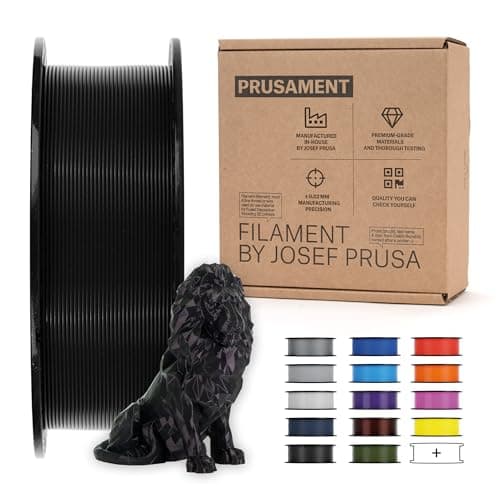
Prusament sells documentation. Every spool carries a code that resolves to the measured diameter trace for that exact spool, which nobody else does at consumer scale. Whether that is worth the premium comes down to one question.
How this page is funded. Buy links go to Amazon and we earn a commission on qualifying purchases at no extra cost to you. Commission never decides an order or a score, we accept no free products or sponsored placements, and every roundup names something to skip. Full disclosure.
The picks, ranked
The picks, ranked
#
Product
Best for
Score
Price
1
Prusament PLABuy it when a failure at hour 28 costs more than the whole spool did.Per-spool measurement record
Live prices verified October 17, 2026. Scores are our own fit rating for the stated use, not a measurement and not a customer rating.
Filament spools lined up on a shelf.
The one question that decides it
What does a failed print cost you?
That is genuinely the whole analysis. Prusament is not a better polymer than good PLA from Polymaker or SUNLU. It is a spool whose diameter was measured continuously during manufacture, with that trace published against the spool's own code. What you are buying is a reduced probability that a diameter excursion ruins a print, plus the ability to check afterwards whether that was what happened.
On a two-hour bracket, that probability reduction is worth almost nothing. On a 30-hour print in a color you cannot easily replace, it is worth considerably more than the price difference.
The wider reason Prusa matter here
Prusa Research publish the most complete public material documentation in consumer 3D printing, and it is free. Their filament material guide is the source we cite more than any other on this site Prusa Research, their per-material pages give published temperature windows for everything from PLA to nylon, and their drying article is one of only two published sources we have found with per-material drying figures Prusa Research.
You benefit from that whether or not you ever buy their filament. It is also why, when two manufacturers disagree on a figure, Prusa is usually one of the two we show.
How it prints
Exactly as documented, which is the point. Prusa publish profile temperatures for their own material, so if a print misbehaves you are debugging your machine against a known-good reference rather than debugging two unknowns at once. That diagnostic value is under-appreciated and is a real reason to keep one reference spool around even if you print budget filament day to day.
Who should not buy it
Anyone printing prototypes, drafts, or parts they expect to reprint. Anyone whose prints finish in under four hours. Anyone whose actual complaint is spool-to-spool variation rather than in-spool variation — that is the Polymaker case, and it costs less.
Every pick, in detail
01
Prusament PLA
Prusa Research
Long or expensive prints · 8.6/10 our fit score
You are buying a published per-spool measurement record, not a better polymer. Worth it exactly when a failed long print costs more than the spool.
+ − What does the Prusament spool code actually show?
A record for that individual spool, including the measured diameter through the extrusion run. It is a per-spool document rather than a batch specification, which is what makes it unusual.
+ − Does Prusament PLA print differently from other PLA?
Not materially. It sits in the same published PLA window of 185 to 235 C at the nozzle. Its advantage is that Prusa publish exact profile temperatures for it, so it makes a good known-good reference when you are trying to work out whether a problem is the filament or the machine.