Every material on this page asks something of your printer that PLA does not: an enclosure, a hardened nozzle, a dryer, or all three. The right specialty filament is the one whose requirements you can actually meet.
How this page is funded. Buy links go to Amazon and we earn a commission on qualifying purchases at no extra cost to you. Commission never decides an order or a score, we accept no free products or sponsored placements, and every roundup names something to skip. Full disclosure.
The picks, ranked
The picks, ranked
#
Product
Best for
Score
Price
1
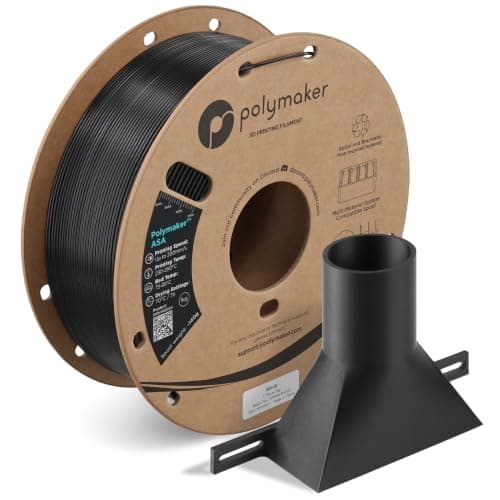
Polymaker PolyLite ASAThe best default engineering material for most people: ABS toughness without ABS going chalky in sunlight.220-275 C nozzle, enclosure recommended
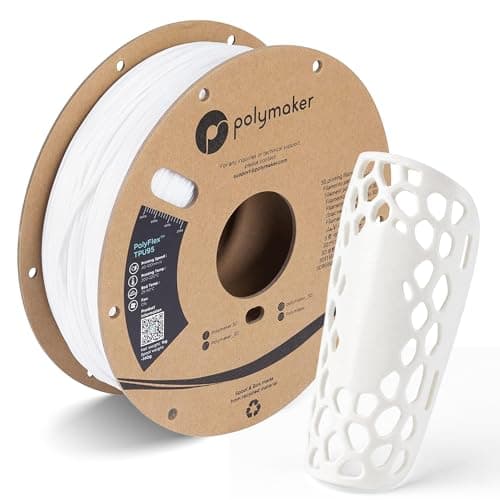
Polymaker PolyFlex TPU95The only flexible filament here with documentation you can design against. Needs a direct-drive extruder.Shore 95A, published data sheet
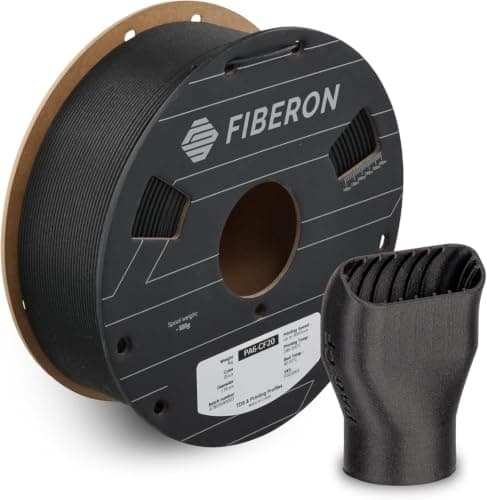
Polymaker Fiberon PA6-CF20A real engineering polymer with real requirements. Do not buy it until you have the dryer and the hardened nozzle.240-285 C, hardened nozzle, enclosure
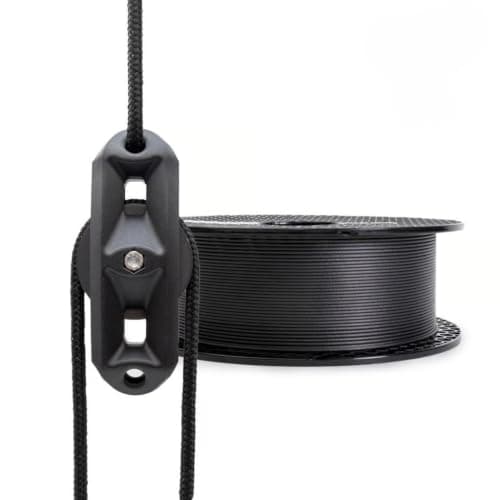
Prusament PC Blend Carbon FiberThe highest-temperature option here, and the most demanding on every axis. Buy it last, not first.270-275 C nozzle, 100-115 C bed
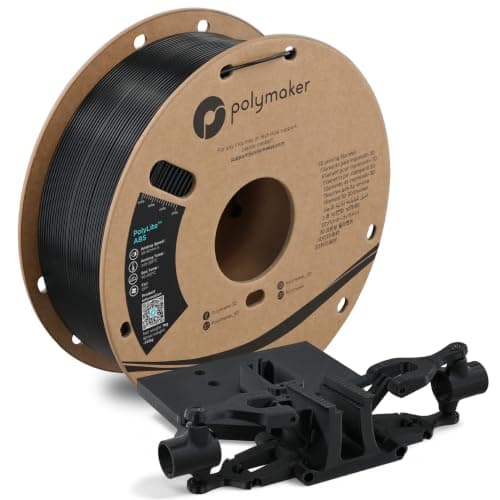
Polymaker PolyLite ABSASA does everything ABS does, plus UV stability, for the same printing effort. Buy ABS only when a specific process needs it.230-255 C, enclosure recommendedSkip this
Published printing parameters by material, from Prusa Research's filament material guide. Ranges are the manufacturer's published envelopes, not a recommendation for your specific spool — every brand publishes its own narrower window inside these. Figures from Prusa Research, retrieved 2026-09-01.
Start from your printer, not from the datasheet
The usual mistake with engineering filament is to compare mechanical properties, pick the strongest, and then discover the printer cannot make it. A nylon part printed wet is weaker than a PETG part printed dry. A carbon composite printed through a brass nozzle produces parts that drift dimensionally as the nozzle silently widens.
So the honest ordering is by requirement. Prusa's material guide publishes an enclosure column for exactly this reason: ABS, ASA, polycarbonate and polyamide are marked as recommending one, while PETG, PLA and flexibles are not Prusa Research.
Nothing extra: TPU on a direct-drive machine. Slower, but no new hardware.
Enclosure: ABS, ASA. Also ventilation, which is not optional.
Enclosure and a dryer: nylon, polycarbonate.
All of the above plus a hardened nozzle: anything carbon or glass filled.
Why ASA rather than ABS
ABS was the original engineering filament and it has been superseded for most purposes. ASA prints in a similar window, has similar toughness, and adds UV and chemical resistance Prusa Research — which means an outdoor part survives rather than going yellow and chalky. Both want an enclosure. Both want ventilation. Given that the requirements are the same, the material that also survives sunlight is the better default.
ABS remains the right choice for specific processes: acetone vapor smoothing works on ABS and not on ASA in the same way, and some existing designs specify it. Outside those, we would buy ASA. The full argument is on ABS versus ASA.
Two materials sit outside that ordering because they are bought for a property rather than for strength: polycarbonate, which is the highest-temperature material a desktop printer realistically makes — best polycarbonate filament — and the carbon-loaded static-control filaments, which are bought for an electrical specification rather than a mechanical one: best conductive filament.
Past those sit the materials bought for one specific property, each with its own gate: PPS for continuous service at 200 C, if your hotend reaches 350 C; PA12 for nylon parts that hold their dimensions in humid air; POM for low-friction gears and bushings, if you can solve its first layer; and PVB for prints you intend to smooth with alcohol rather than sandpaper.
Drying stops being optional here
PLA tolerates being slightly damp. Nylon does not. Prusa publish drying figures below 90 C for polyamide Prusa Research, Overture publish 95 C for seven hours Overture, and both exist because nylon absorbs water from ordinary room air fast enough to matter within hours of opening the bag.
Note the temperature: 95 C is above what several popular consumer dryers reach. This is the single most common way people buy the wrong dryer — see filament dryers, where the maximum temperature column is the one that matters.
TPU is the accessible one
Flexible filament is the specialty material that needs the least new hardware: no enclosure, ordinary temperatures, standard nozzle. What it needs is a direct-drive extruder and patience. A Bowden setup pushing soft filament down a long tube buckles it, and the result is under-extrusion no setting fixes.
Print it slowly. That is most of the technique. Full detail on the TPU page.
Filled composites and what they actually buy
Carbon and glass fiber fills make a part stiffer and improve dimensional stability. They do not, in the grades sold to consumers, make a part dramatically stronger, and they specifically do not make a PLA-based composite heat resistant. A PLA-CF part softens at the same temperature a PLA part does.
They also abrade nozzles. E3D document substantial wear on brass from filled filaments within a few hundred grams E3D, and the failure is invisible — the nozzle bore widens gradually and prints drift out of tolerance long before anything looks broken. The carbon fiber page has the detail.
Every pick, in detail
01
Polymaker PolyLite ASA
Polymaker
Outdoor and UV exposure · 8.9/10 our fit score
The right answer for a part that lives outside. It is ABS that does not go yellow and chalky in sunlight.
Published specifications for Polymaker PolyLite ASA
UV resistance is the entire point and it is real — Prusa contrast it directly with ABS, whose outdoor parts "turn yellowish and more brittle over time"
Warps less and smells less than ABS at the same temperatures
What it does not
Needs an enclosure and a hot bed; this is not a material for an open printer in a cold room
More expensive per kilogram than the PETG that would do the job for many outdoor parts
The question needs narrowing, because stiffness, tensile strength, impact resistance and heat resistance are different properties with different winners. For genuine mechanical duty, a carbon-filled nylon is the strongest thing most consumer printers can produce — and only if it is properly dried and printed in an enclosure.
+ − Do I need an enclosure for engineering filament?
For ABS, ASA, polycarbonate and nylon, Prusa mark an enclosure as recommended. For TPU and PETG they do not. Ventilation matters alongside the enclosure for ABS and ASA.
+ − Does carbon fiber filament make parts heat resistant?
No. Carbon fill adds stiffness and dimensional stability. The heat resistance comes from the base polymer, so a carbon-filled PLA softens at the same temperature plain PLA does. Only a carbon-filled high-temperature polymer is heat resistant.