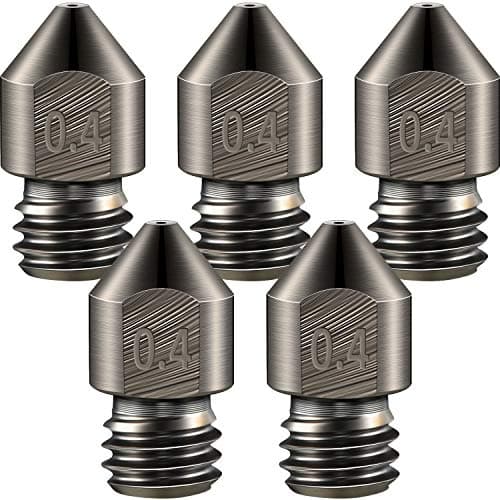
Carbon fiber filament makes parts stiffer and dimensionally stabler, and it wears out brass nozzles fast enough that E3D measure the damage in hundreds of grams. Fit the hardened nozzle before the first spool, not after.
How this page is funded. Buy links go to Amazon and we earn a commission on qualifying purchases at no extra cost to you. Commission never decides an order or a score, we accept no free products or sponsored placements, and every roundup names something to skip. Full disclosure.
The picks, ranked
The picks, ranked
#
Product
Best for
Score
Price
1
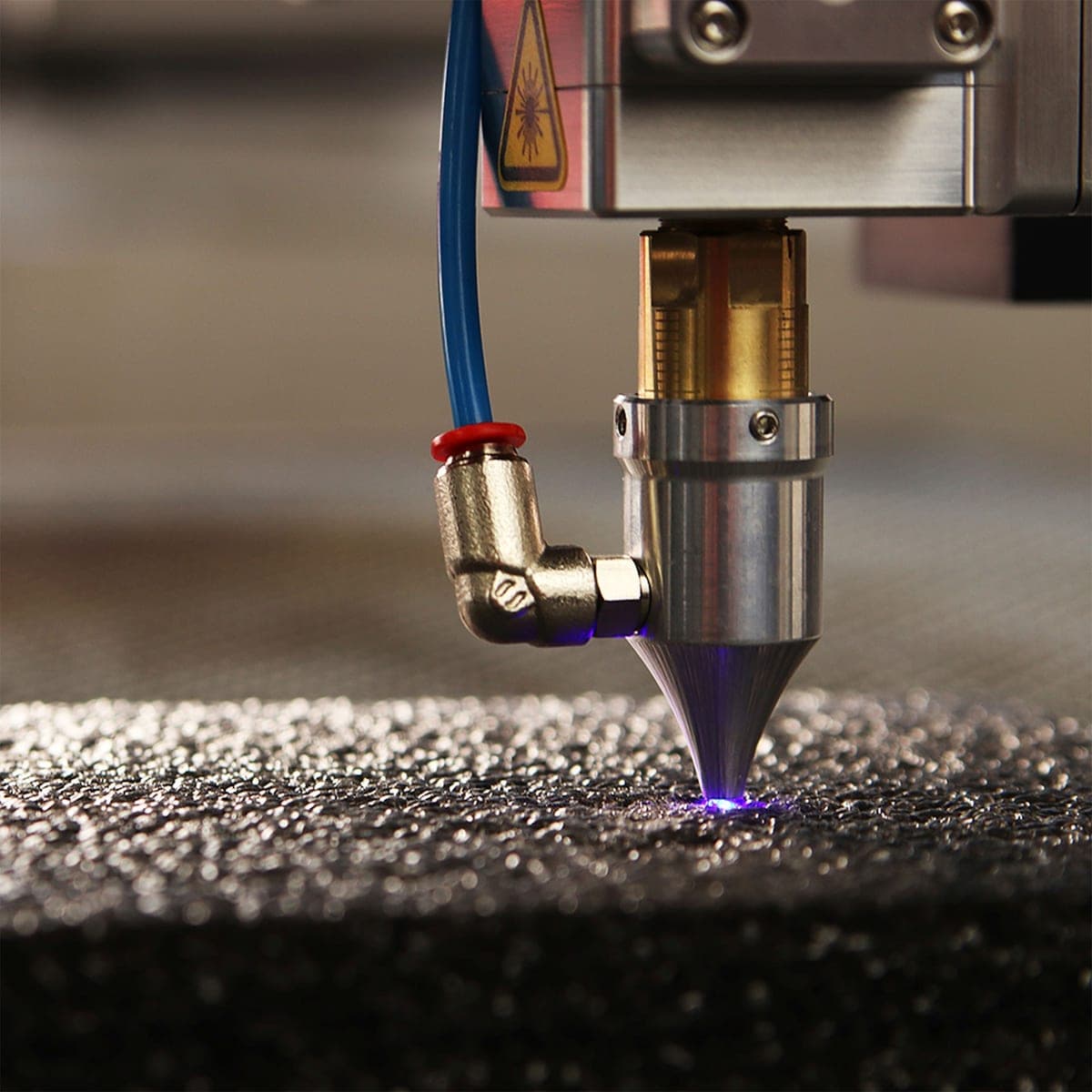
Hardened Steel NozzleNot optional. A brass nozzle printing carbon fill widens silently and your prints drift out of tolerance before anything looks wrong.Hardened steel, abrasion resistant
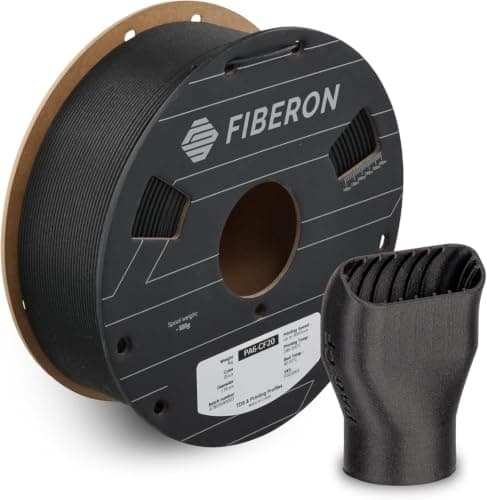
Polymaker Fiberon PA6-CF20The strongest combination here: nylon toughness with the stiffness the base polymer lacks.Carbon-filled nylon, enclosure recommended
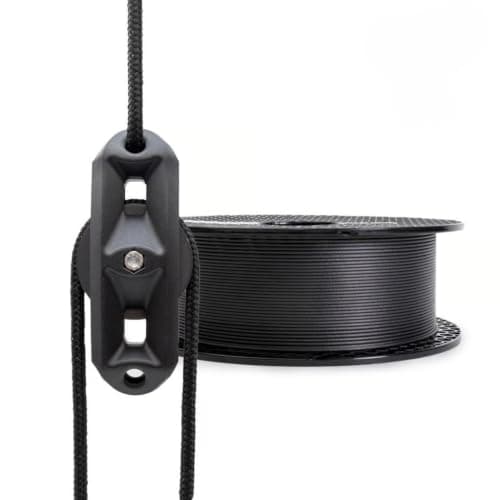
Prusament PC Blend Carbon FiberThe demanding option. Everything about it asks more of the printer than the alternatives above.270-275 C nozzle, 100-115 C bed
Live prices verified October 17, 2026. Scores are our own fit rating for the stated use, not a measurement and not a customer rating.
A disassembled 3D printer hotend during maintenance.
Nozzle material against filament type. The wear failure is invisible until dimensions start drifting.
Filament
Brass
Hardened steel
Why
PLA, PETG, ABS, ASA, TPU
Fine
Fine
Unfilled polymers do not abrade the bore
Carbon fiber filled
No
Required
E3D document substantial wear after 250 g
Glass fiber filled
No
Required
Same abrasion mechanism as carbon fiber
Glow in the dark
No
Required
The phosphorescent filler is abrasive
Metal filled
No
Required
Metal powder is the most abrasive filler in common use
Matte / silk PLA
Acceptable
Preferred
Matting agents are mildly abrasive over long runs
Nozzle material against filament type. The wear failure is invisible until dimensions start drifting. Figures from E3D, Prusa Research, retrieved 2026-09-01.
What carbon fill actually does
Chopped carbon fiber in a polymer matrix increases stiffness and reduces warping, because the fibers restrain the polymer as it contracts. It also produces a matte black finish that hides layer lines well.
Two things it does not do, both widely believed:
It does not add heat resistance. Heat deflection is a property of the base polymer. A carbon-filled PLA softens at the same temperature plain PLA does. If you need heat resistance, you need a different base polymer — see heat-resistant filament.
It does not reliably add strength. Chopped fiber at consumer loadings adds stiffness. Ultimate strength is often unchanged or slightly reduced, because the fibers interrupt the polymer continuity and create stress concentrations. Stiffer is not stronger.
The nozzle problem
E3D document that abrasive filaments cause substantial wear to brass nozzles, with measurable degradation after a few hundred grams of filled material E3D. Brass is soft; carbon fiber is not.
What makes this dangerous rather than merely annoying is that the failure is invisible. The nozzle does not break. Its bore widens gradually, so extrusion width creeps up, dimensional accuracy drifts, and first layers start behaving oddly — and every one of those symptoms looks like a calibration problem. People spend evenings re-tuning flow against a nozzle that is no longer the diameter the slicer thinks it is.
A hardened steel nozzle costs a few dollars. Fit it before the first filled spool. The full picture, including which filaments count as abrasive, is on the nozzle wear guide and the nozzle roundup.
Choosing the base polymer
Carbon-filled PLA
The accessible entry point. Prints like PLA at PLA temperatures, adds rigidity and a matte finish, needs only the hardened nozzle. Good for drone frames, tool holders, and anything where stiffness matters and heat does not.
Carbon-filled PETG
More temperature headroom than PLA-CF while still printing on an open machine. A reasonable middle option, and often the best value for functional parts that live indoors.
Carbon-filled nylon
The strongest realistic combination on a consumer printer: nylon's toughness with the stiffness the base polymer lacks. It also inherits nylon's moisture sensitivity, which means a dryer capable of the published temperatures is part of the purchase rather than an accessory — see nylon.
Carbon-filled polycarbonate
The high-temperature option, published at 270 to 275 C at the nozzle and 100 to 115 C at the bed with an enclosure recommended Prusa Research. Prusa publish 95 C for four hours for PCCF drying Prusa Research. Demanding on every axis.
Printing tips
Use a wider nozzle. 0.6 mm reduces the chance of fiber bundles bridging the orifice and clogging. 0.4 mm works but jams more.
Expect a rougher surface. Fibers at the surface are what produce the matte finish, and they also mean the part is slightly abrasive to handle.
Dry it. The base polymer's drying requirement applies unchanged; the fiber does not protect it.
Which base polymer to put the fiber in is the decision most people actually face, and heat settles it — the two mainstream options are compared on PLA-CF versus PETG-CF.
Every pick, in detail
01
Hardened Steel Nozzle
Creality / generic MK8
Buy this first · 9.2/10 our fit score
The five-dollar part that stops abrasive filament from quietly widening your nozzle mid-print. Buy one before your first carbon fiber spool, not after.
Published specifications for Hardened Steel Nozzle
Common size
0.4 mm
Required for
Carbon fiber, glass filled, glow in the dark, metal filledE3D
Trade-off
Lower thermal conductivity than brass
What it does well
E3D document substantial wear on a brand new brass nozzle after only 250 g of carbon-fiber-filled filament
Cheap enough to keep a spare in the drawer
What it does not
Conducts heat worse than brass, so very high flow rates need a few degrees more
Hardened steel tempers and softens at extreme temperatures — E3D make this point explicitly
+ − Do I need a hardened nozzle for carbon fiber filament?
Yes. E3D document substantial brass nozzle wear from abrasive filaments within a few hundred grams. The failure is invisible — the bore widens and prints drift dimensionally long before anything looks broken.
+ − Is carbon fiber filament stronger?
Stiffer rather than stronger. Chopped fiber at consumer loadings increases rigidity and dimensional stability; ultimate strength is often unchanged or slightly lower because the fibers interrupt polymer continuity.
+ − Does carbon fiber PLA resist heat better?
No. Heat deflection is a property of the base polymer, so carbon-filled PLA softens at the same temperature plain PLA does. Only a carbon-filled high-temperature polymer resists heat.
+ − What nozzle size for carbon fiber?
0.6 mm is the practical default. Fiber bundles bridge a 0.4 mm orifice more readily, and clogs on filled filament are harder to clear than on unfilled.