Polyphenylene sulfide is the highest-temperature material a good desktop printer can realistically run. It needs a hotend that reaches 310 to 350 C and a hardened nozzle, and the carbon-filled grades need no heated chamber at all - which is what makes it a serious alternative to polycarbonate rather than a lab curiosity.
How this page is funded. Buy links go to Amazon and we earn a commission on qualifying purchases at no extra cost to you. Commission never decides an order or a score, we accept no free products or sponsored placements, and every roundup names something to skip. Full disclosure.
The picks, ranked
The picks, ranked
#
Product
Best for
Score
Price
1
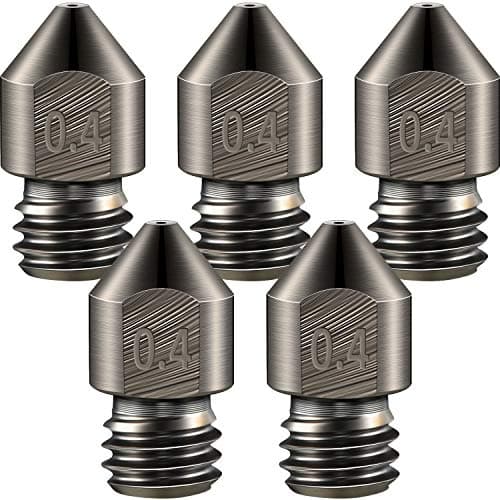
Hardened Steel NozzlePolymaker require a hardened nozzle for carbon-filled PPS. Every spool on this page is filled, so this is not optional.Hardened steel, fits most hotends
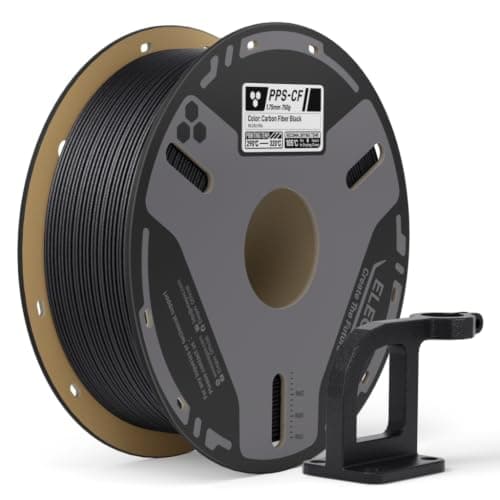
ELEGOO Carbon Fiber PPSRoughly half the price of the industrial spools for the same material class. ELEGOO publish far less data than Polymaker do, which is the trade.Carbon-filled PPS, 750 g
QIDI Carbon Fiber Reinforced PPSSold by a printer manufacturer, which usually means a tested profile exists for at least one machine. Premium price for a small spool.Carbon fiber reinforced PPS, 750 g
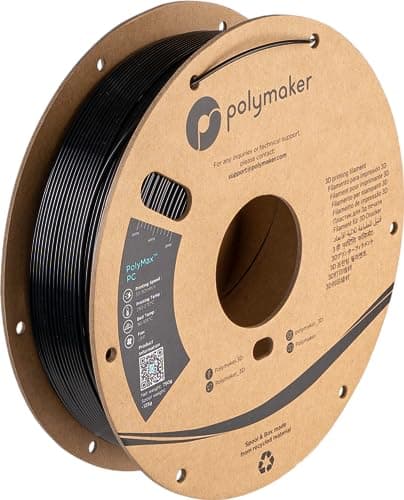
Polymaker PolyMax PCPolycarbonate gives you 101 to 114 C of heat resistance for a hotend most people already own. PPS is the upgrade beyond that, not the starting point.250-270 C, chamber 70-100 C
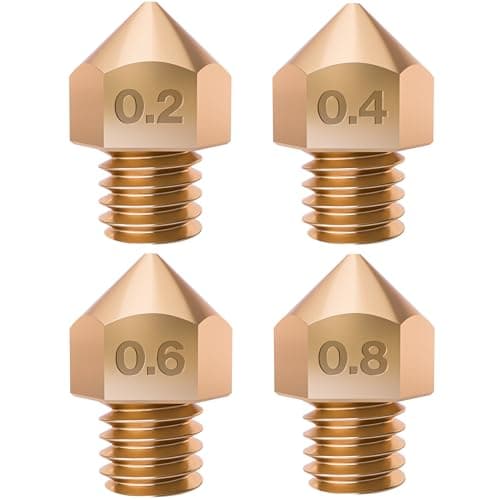
Brass Nozzle AssortmentThe right nozzle for PLA and the wrong one here. E3D document measurable brass wear within a few hundred grams of filled filament.Brass, wears fast on filled filamentSkip this
Live prices verified September 27, 2026. Scores are our own fit rating for the stated use, not a measurement and not a customer rating.
A dark high-temperature printed part on a workbench.
PPS as published: the generic material figures against Polymaker's carbon-filled grade.
Source
Nozzle (C)
Bed (C)
Chamber
Drying
Polymaker, PPS generally
300-330
120-140
Above 70 C ambient
120 C, 4-6 h
Polymaker Fiberon PPS-CF10
310-350
80-90
Not needed, 25-80 C
Minimal
Polymaker PolyMax PC (for scale)
250-270
90-105
Needed, 70-100 C
75 C, 6 h
PPS as published: the generic material figures against Polymaker's carbon-filled grade. Those first two rows are the same company describing the same polymer family. The carbon-filled compound is formulated to drop the bed temperature by 40 C and remove the heated chamber entirely, which is the single most useful fact on this page. Figures from Polymaker, Polymaker, Polymaker, retrieved 2026-09-27.
What PPS actually is
Polyphenylene sulfide is a semi-crystalline engineering thermoplastic used in aerospace, automotive and electronics. Polymaker describe a melting point of 280 to 290 C, decomposition above 430 to 460 C in air, sustained long-term use at 200 to 220 C and short-term exposure up to 260 C Polymaker.
Those numbers put it in a different class from everything else this site ranks. Our polycarbonate page tops out at a published 114 C heat deflection temperature; PPS is rated for continuous service above that. It also resists acids, alkalis, solvents and fuels, and Polymaker note it outperforms nylon and POM on chemical resistance Polymaker.
What decides whether you can print it
Hotend temperature, first and absolutely. Polymaker publish 310 to 350 C for Fiberon PPS-CF10 and state the material requires a hotend that reaches it Polymaker. Generic PPS guidance is 300 to 330 C with an all-metal hotend Polymaker. A 300 C machine is not close enough.
A hardened nozzle. Polymaker require one for the carbon-filled grade because of abrasiveness Polymaker, and E3D document measurable brass wear within a few hundred grams of filled filament E3D.
Whether you need the chamber. This is where the composite earns its price. Polymaker’s generic PPS guidance calls for an enclosure holding above 70 C ambient and a 120 to 140 C bed Polymaker; their PPS-CF10 prints with an 80 to 90 C bed, an ambient range of 25 to 80 C, and explicitly no heated chamber Polymaker.
Cooling off, speed moderate. Polymaker specify 0 percent fan and 30 to 300 mm/s for PPS-CF10 Polymaker; generic PPS guidance is 30 to 50 mm/s for layer adhesion Polymaker. Start slow.
Whether you will anneal. Polymaker recommend annealing PPS-CF10 at 125 C for 16 hours for the best layer adhesion and temperature resistance Polymaker. Skipping it leaves performance on the table.
The part that makes PPS unusually pleasant
Nylon and PVA punish you for leaving a spool out. PPS does not. Polymaker describe low molding shrinkage of 0.15 to 0.3 percent and minimal water absorption of 0.05 percent for the polymer Polymaker, and describe PPS-CF10 as moisture insensitive, performing reliably without extensive pre-drying Polymaker.
Their generic guidance still lists 120 C for 4 to 6 hours as a drying regime Polymaker, which is above what any consumer dryer on this site reaches — see best filament dryer. The practical reading: the composite is formulated so that you do not need an oven, and a nylon-grade drying habit is not required. If a spool has been open in humid air for months, an oven is the only tool that meets the published figure.
What you get for it
Continuous service temperature. 200 to 220 C long-term, 260 C short-term for the polymer Polymaker. Under-hood parts, sterilizable fixtures, anything near an element.
Chemical resistance that beats nylon and POM. Acids, alkalis, solvents, fuels Polymaker. For a workshop part cleaned in solvent daily this matters more than strength.
V0 flame retardancy. Polymaker rate PPS-CF10 V0 Polymaker, which is why it appears in electrical housings.
Dimensional stability. Low shrinkage plus minimal moisture uptake means a part that measures the same next month Polymaker.
Minimal warping without a chamber, which Polymaker claim for the carbon-filled grade specifically Polymaker and which is the reason this material is worth a page at all.
The documentation gap between spools
Only one maker in this category publishes a full set of figures. The spools that are actually cheap — the ELEGOO and third-party carbon-filled PPS filaments on Amazon — publish a heat claim and little else, and none of them publishes a resistivity, a shrinkage figure or an annealing schedule.
That is not a reason to avoid them; PPS is PPS, and the compounds are broadly similar. It is a reason to start from Polymaker’s published window rather than guessing, and to treat the annealing step as part of the process regardless of whose spool you bought. Where a product here has no published figure, its entry says so.
PPS against polycarbonate, honestly
For most people polycarbonate is the right answer and PPS is the answer to a specific problem. PC needs 250 to 270 C and a closed chamber at 70 to 100 C, and delivers a published heat deflection temperature around 101 to 114 C Polymaker. PPS needs 310 to 350 C and no chamber, and runs continuously at 200 C PolymakerPolymaker.
So the trade is chamber against hotend. If you have an enclosed printer with a 300 C hotend, PC is cheaper and easier. If you have an open printer with a 350 C hotend — which describes a lot of current machines — PPS is the one that works. The ABS and PC comparison is on ABS versus polycarbonate, and the cross-material heat ranking is on most heat resistant filament.
What not to buy it for
Anything a cheaper material already does. PPS costs several times what PETG or ASA costs per kilogram and ships in 500 to 750 g spools. Use it where the temperature or the chemistry demands it.
Printers with a 300 C ceiling. The bottom of Polymaker’s range for the filled grade is 310 C Polymaker.
Fine cosmetic detail. Filled, dark, printed hot with the fan off: this is a functional finish, not a display one.
Food contact. A printed part is not food-safe packaging whatever the polymer — the reasoning is on is PETG food safe.
Every pick, in detail
01
Hardened Steel Nozzle
Creality / generic MK8
Buy this before the spool · 8.7/10 our fit score
The five-dollar part that stops abrasive filament from quietly widening your nozzle mid-print. Buy one before your first carbon fiber spool, not after.
Published specifications for Hardened Steel Nozzle
Common size
0.4 mm
Required for
Carbon fiber, glass filled, glow in the dark, metal filledE3D
Trade-off
Lower thermal conductivity than brass
What it does well
E3D document substantial wear on a brand new brass nozzle after only 250 g of carbon-fiber-filled filament
Cheap enough to keep a spare in the drawer
What it does not
Conducts heat worse than brass, so very high flow rates need a few degrees more
Hardened steel tempers and softens at extreme temperatures — E3D make this point explicitly
Polymaker publish 310 to 350 C at the nozzle for their carbon-filled PPS, with an 80 to 90 C bed and no heated chamber. Their generic PPS guidance is 300 to 330 C with a 120 to 140 C bed and an enclosure above 70 C ambient. Either way it needs an all-metal hotend and a hardened nozzle.
+ − Is PPS more heat resistant than polycarbonate?
Substantially. Polymaker describe PPS as sustaining long-term use at 200 to 220 C with short-term exposure to 260 C, where the polycarbonate spools we rank publish heat deflection figures of 101 to 114 C. The catch is the 310 to 350 C hotend PPS needs to print.
+ − Does PPS need a heated chamber?
Polymaker say their carbon-filled PPS-CF10 does not, quoting an ambient range of 25 to 80 C and minimal warping without a heated chamber. Their generic PPS guidance does call for an enclosure above 70 C, so the filled compound is the one to buy if you print on an open machine.
+ − Does PPS filament need drying?
Far less than nylon. Polymaker describe the polymer as absorbing about 0.05 percent water and describe PPS-CF10 as moisture insensitive, needing no extensive pre-drying. Their generic figure for a soaked spool is 120 C for 4 to 6 hours, which needs an oven rather than a filament dryer.