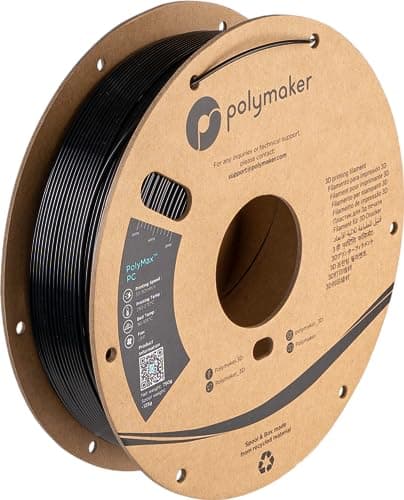
These two look like neighbors on a requirements list — enclosure, hot bed, warping — and they are not neighbors on a temperature chart. PC holds its shape past 100 C where ABS is already softening, and it asks for a hotend 40 C hotter to get there.
How this page is funded. Buy links go to Amazon and we earn a commission on qualifying purchases at no extra cost to you. Commission never decides an order or a score, we accept no free products or sponsored placements, and every roundup names something to skip. Full disclosure.
The picks, ranked
The picks, ranked
#
Product
Best for
Score
Price
1
Polymaker PolyMax PCThe upgrade is heat resistance and toughness. Everything else about printing it is harder than ABS, and the annealing step is part of the job.250-270 C nozzle, chamber 70-100 C
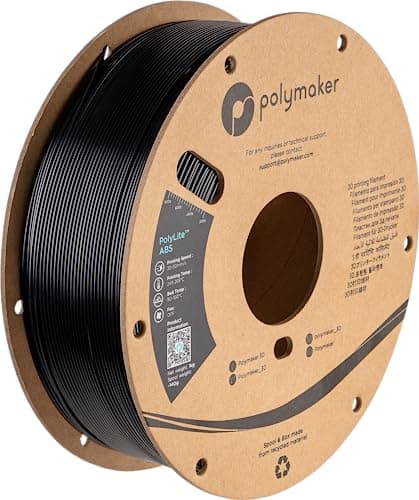
Polymaker PolyLite ABSCheaper, easier and smoothable in acetone vapor, which PC is not. If the part never gets hot, the upgrade buys you nothing.230-255 C nozzle, 95-110 C bed
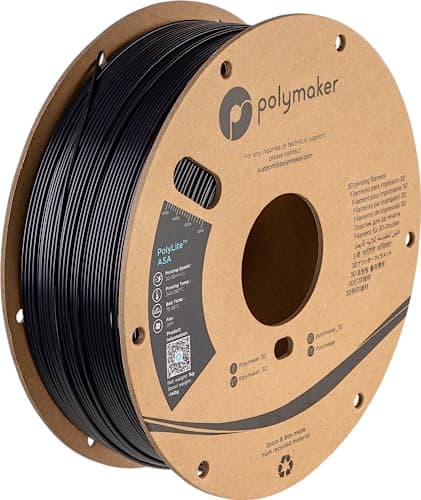
Polymaker PolyLite ASAABS requirements, ABS toughness, plus sunlight resistance. Most parts people consider PC for are really ASA parts.220-275 C, UV and chemical resistance
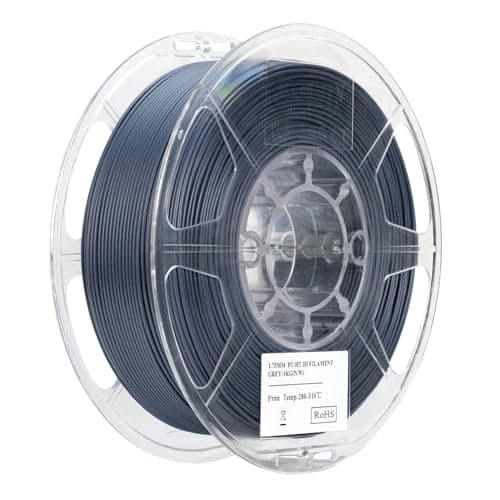
eSUN PC-HTIf the deciding number is the heat deflection temperature, this is the one with the highest published figure. It needs a 300 C hotend to print.114 C heat deflection
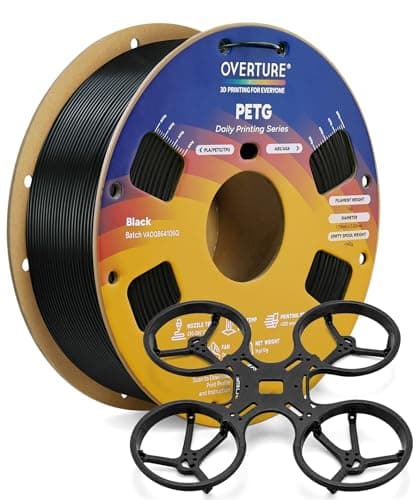
Overture PETGNeither material on this page works in a draft. A PETG part printed properly beats an ABS or PC part that warped off the plate.No enclosure requiredSkip this
Live prices verified September 21, 2026. Scores are our own fit rating for the stated use, not a measurement and not a customer rating.
Two printed engineering parts side by side for comparison.
The short answer
Buy polycarbonate when the part has to survive above roughly 90 C or take repeated impact. Buy ABS when you want acetone smoothing or the cheapest enclosed-printer material. Buy ASA instead of either when the part goes outside, which is more often than people expect.
Heat: the only gap that matters
Prusa publish 230 to 255 C at the nozzle for ABS with an enclosure recommended Prusa Research. SUNLU publish a 101 +/- 2 C heat deflection temperature for their polycarbonate SUNLU and eSUN publish 114 C for PC-HT eSUN. ABS softens meaningfully below that, which is why a dashboard bracket or a part near a motor is a PC job and a bookshelf bracket is not.
Hotend. ABS runs at 230 to 255 C Prusa Research, within reach of most stock hotends. PC starts at 250 C and runs to 300 C for the high-temperature grades, and Polymaker require an all-metal hotend PolymakereSUN.
Chamber. Prusa mark an enclosure as recommended for ABS Prusa Research. Polymaker mark a 70 to 100 C chamber as needed for PC Polymaker. The difference between recommended and needed is the difference between a bad print and no print.
Bed. 95 to 110 C for ABS Prusa Research, 90 to 110 C for PC, with an adhesive that Polymaker and SUNLU both name explicitly PolymakerSUNLU.
Post-processing. ABS smooths in acetone vapor. PC does not, and instead wants annealing at 90 C for 2 hours to relieve print stress Polymaker.
Ventilation. Prusa’s ABS page names styrene and calls a well-ventilated room important Prusa Research. Neither material belongs in a closed bedroom.
Both warp; one punishes you harder
Warping comes from uneven contraction as a part cools Prusa Research, and both materials shrink enough to lift corners. The difference is recovery: an ABS part that lifts can often be rescued with a brim, a slower first layer and a clean plate. A PC part that lifts usually also delaminates, because the same cold draft that pulled the corner up weakened every layer bond above it.
That is why Polymaker’s advice to preheat the chamber through the bed for 10 to 15 minutes before printing matters more on PC than the equivalent advice does on ABS Polymaker.
Strength, and the direction nobody measures
PC is the tougher material: SUNLU publish 50 +/- 3 MPa tensile and 35 +/- 5 kJ/m2 impact in the X-Y plane SUNLU. But eSUN publish both directions for PC-HT — 13.6 kJ/m2 in X-Y against 2.4 kJ/m2 in Z eSUN — and that ratio applies to ABS too.
A PC part loaded across its layers is not five times stronger than an ABS part loaded along them. Orientation outranks material more often than the spec sheet suggests, which is the argument made at length on strongest filament.
Why ASA keeps interrupting this comparison
ASA prints in a 220 to 275 C window with the same enclosure expectation as ABS, and Prusa list UV and chemical resistance as its noted properties Prusa Research. For the outdoor bracket, the mower part, the antenna mount — the jobs people reach for ABS or PC to do — ASA is usually the right answer, and it is easier than either.
The ABS side of that argument is on ABS versus ASA. The PC side is simpler: if the part is not going to exceed ASA’s roughly 93 C rating Prusa Research, polycarbonate is a harder print for no benefit.
Cost and what you will actually use
PC spools cost noticeably more per kilogram than ABS, and the failure rate while you learn the material is part of the price. Budget for at least one warped part and one delaminated one. If that prospect is unappealing, the honest move is ASA now and PC when a part genuinely needs it.
UV resistance is the entire point and it is real — Prusa contrast it directly with ABS, whose outdoor parts "turn yellowish and more brittle over time"
Warps less and smells less than ABS at the same temperatures
What it does not
Needs an enclosure and a hot bed; this is not a material for an open printer in a cold room
More expensive per kilogram than the PETG that would do the job for many outdoor parts
Tougher and far more heat resistant, yes. SUNLU publish 50 +/- 3 MPa tensile and 35 +/- 5 kJ/m2 impact strength for their PC, and heat deflection figures of 101 C against ABS softening well below that. The caveat is that layer direction still dominates: eSUN publish 13.6 kJ/m2 in X-Y against 2.4 kJ/m2 in Z.
+ − Can I print polycarbonate on the same printer as ABS?
Only if the hotend is all metal and reaches 250 C or more, and the chamber can hold 70 to 100 C. Polymaker list both as requirements rather than suggestions. A printer that manages ABS in an enclosure is often one hotend away from PC.
+ − Which is easier to print, ABS or PC?
ABS, clearly. It runs cooler, tolerates a merely recommended enclosure, and smooths in acetone if the surface disappoints. PC needs a hotter hotend, a genuinely closed chamber, a bed adhesive and an annealing step afterward.
+ − Should I just use ASA instead?
For most parts, yes. ASA has ABS's requirements, adds UV resistance, and is rated to about 93 C. Polycarbonate earns its place when the part exceeds that, or when impact toughness is the whole point.