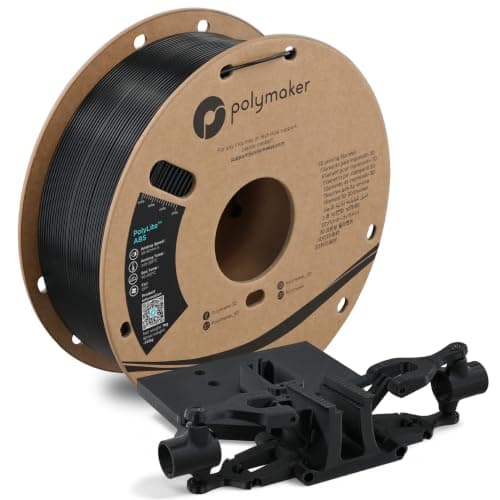
ABS asks for an enclosure and real ventilation, and in exchange gives you a tough, machinable, acetone-smoothable part. ASA asks for the same and adds UV resistance, which is why most people should buy that instead.
How this page is funded. Buy links go to Amazon and we earn a commission on qualifying purchases at no extra cost to you. Commission never decides an order or a score, we accept no free products or sponsored placements, and every roundup names something to skip. Full disclosure.
The picks, ranked
The picks, ranked
#
Product
Best for
Score
Price
1
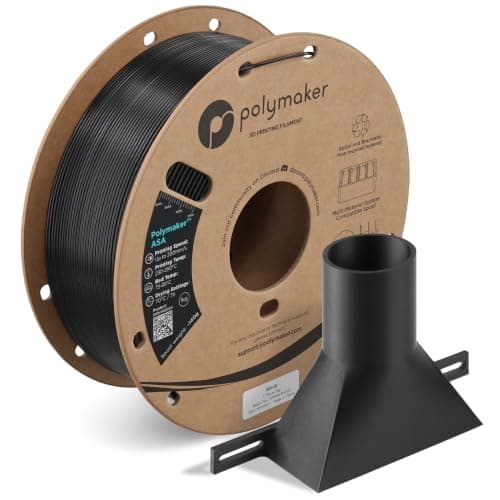
Polymaker PolyLite ABSA well-documented ABS from a brand that publishes data sheets. Buy it when the process specifically needs ABS.230-255 C nozzle, 95-110 C bed
Polymaker PolyLite ASASame printing requirements, plus it does not degrade in sunlight. For most ABS use cases this is simply the better material.UV and chemical resistance
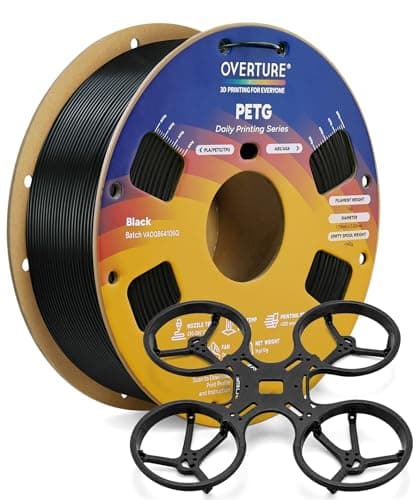
Overture PETGPETG printed well beats ABS printed badly. If you cannot meet ABS's requirements, this is the honest fallback.No enclosure requiredSkip this
Published printing parameters by material, from Prusa Research's filament material guide. Ranges are the manufacturer's published envelopes, not a recommendation for your specific spool — every brand publishes its own narrower window inside these. Figures from Prusa Research, retrieved 2026-09-01.
The requirements, stated first
Prusa publish 230 to 255 C at the nozzle and 95 to 110 C at the bed for ABS, with an enclosure recommended Prusa Research. Two of those three are things a stock open printer cannot do well.
The enclosure is not optional in practice. ABS shrinks significantly as it cools, and a draft across a cooling part causes uneven contraction — which lifts corners off the plate and splits layers partway up tall prints Prusa Research.
Ventilation is a health requirement, not a comfort one. ABS produces styrene and ultrafine particles while printing. Print it in a ventilated space, not a closed bedroom.
The bed runs hot. 95 to 110 C is above what some older printers reach reliably.
What ABS is genuinely good at
Acetone vapor smoothing
ABS dissolves in acetone, which means a printed part can be smoothed to a glossy, sealed finish by exposure to acetone vapor. This closes the layer channels and produces a surface no other common material reaches without sanding. If this is why you want ABS, ABS is the right answer and ASA is not a substitute.
Machinability and heat
ABS drills, taps and sands well, and it holds up at temperatures where PLA and PETG have long since softened. For an under-hood automotive part or an enclosure near a heat source, it is a real option — see filament for car parts.
Dissolvable supports
ABS is also the natural partner for HIPS, a support filament that dissolves in limonene and leaves the ABS part behind. On a dual-nozzle or multi-material printer that makes internal cavities printable. The pairing, the solvent handling and the breakaway alternative are on soluble support filament.
Why we still point most people at ASA
ASA prints in an overlapping window (220 to 275 C nozzle, 90 to 110 C bed, enclosure recommended) Prusa Research. The requirements are effectively the same. The difference is that Prusa list ASA's noted properties as UV and chemical resistance Prusa Research, and ABS's as impact resistance without a UV claim.
Since ABS's headline weakness is that sunlight turns it yellow and brittle, and since a large fraction of the parts people print in ABS end up outdoors or near a window, ASA is the better default. The detailed comparison is on ABS versus ASA.
Printing it without fighting it
Close the enclosure and leave it closed for the whole print. Opening the door mid-print is how tall parts split.
Turn part cooling almost off. ABS wants heat retention; a cooling fan is working directly against layer adhesion.
Use a brim. ABS lifts at corners, and a brim gives those corners more to hold onto.
Prepare the plate deliberately. ABS slurry or a glue stick both work; a bare plate is optimistic. See bed adhesion.
Avoid large flat bottoms where the design allows. Contraction scales with area, so a footprint change is often more effective than any setting.
Every pick, in detail
01
Polymaker PolyLite ABS
Polymaker
Acetone smoothing and legacy designs · 7.8/10 our fit score
ABS worth printing only if you already have an enclosure and ventilation. Without both, buy ASA or PETG instead.
Published specifications for Polymaker PolyLite ABS
UV resistance is the entire point and it is real — Prusa contrast it directly with ABS, whose outdoor parts "turn yellowish and more brittle over time"
Warps less and smells less than ABS at the same temperatures
What it does not
Needs an enclosure and a hot bed; this is not a material for an open printer in a cold room
More expensive per kilogram than the PETG that would do the job for many outdoor parts
Small parts, sometimes. Large or tall parts, reliably not. ABS shrinks enough that a draft causes corner lift and layer splitting. Prusa mark an enclosure as recommended for ABS and not for PETG, which is the practical difference between the two.
+ − Is ABS dangerous to print?
It produces styrene and ultrafine particles while printing, so it needs ventilation. That is a real requirement rather than a caution: print it in a ventilated space, not a closed room you sleep in.
+ − Should I use ABS or ASA?
ASA, unless you specifically need acetone vapor smoothing or the design calls for ABS. The printing requirements are essentially the same and ASA adds UV resistance, which is ABS's main weakness.