The real question is not which material is better. It is whether the enclosure and ventilation ABS requires are worth what ABS gives you over PETG, and for most people printing at home the answer is no.
How this page is funded. Buy links go to Amazon and we earn a commission on qualifying purchases at no extra cost to you. Commission never decides an order or a score, we accept no free products or sponsored placements, and every roundup names something to skip. Full disclosure.
The picks, ranked
The picks, ranked
#
Product
Best for
Score
Price
1
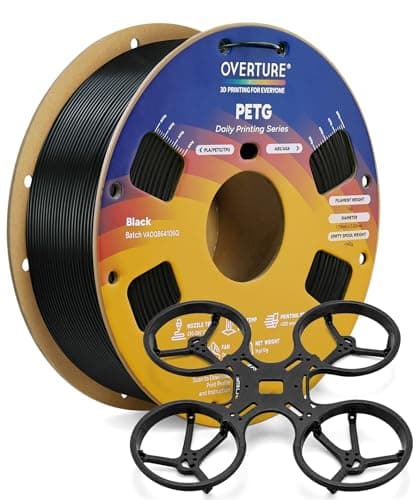
Overture PETGThe pragmatic answer for anyone without an enclosure, and that is most people.215-270 C, no enclosure required
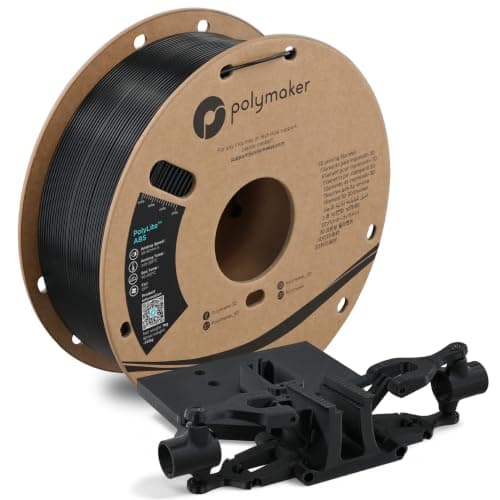
Polymaker PolyLite ABSThe one thing ABS does that nothing else here does. Otherwise ASA is the better use of an enclosure.230-255 C, enclosure recommended
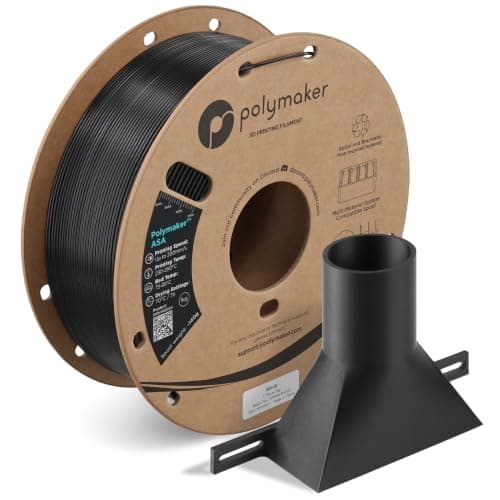
Polymaker PolyLite ASASame printing requirements as ABS plus UV stability. If you built an enclosure, build it for this.UV resistant, similar requirements
Published printing parameters by material, from Prusa Research's filament material guide. Ranges are the manufacturer's published envelopes, not a recommendation for your specific spool — every brand publishes its own narrower window inside these. Figures from Prusa Research, retrieved 2026-09-01.
The real question
Prusa publish 215 to 270 C nozzle and 70 to 90 C bed for PETG with no enclosure requirement Prusa Research, and 230 to 255 C nozzle with 95 to 110 C bed and an enclosure recommended for ABS Prusa Research.
So the comparison is really: what does ABS give you that justifies an enclosure, ventilation and a hotter bed?
What ABS gives you
Acetone vapor smoothing. ABS dissolves in acetone, so a part can be smoothed to a sealed glossy finish without sanding. Nothing else here does this.
Machinability. ABS drills, taps and sands more predictably than PETG, which tends to smear.
Heat tolerance, somewhat above PETG.
Stiffness, a little higher than PETG.
What it costs you
An enclosure. ABS shrinks enough that a draft causes corner lift and layer splitting Prusa Research.
Ventilation. ABS produces styrene and ultrafine particles. This is a health requirement rather than a preference.
A bed reaching 95 to 110 C, which some older printers do not.
UV stability. ABS yellows and goes chalky in sunlight, so outdoor parts fail. PETG does better here, and ASA better still.
Why ASA keeps coming up
Prusa publish 220 to 275 C nozzle and 90 to 110 C bed for ASA with an enclosure recommended Prusa Research — essentially the same requirements as ABS. And they list ASA's noted properties as UV and chemical resistance Prusa Research, which is exactly ABS's weakness.
Given identical printing requirements, the material that also survives sunlight is the better one to spend an enclosure on. That comparison is on ABS versus ASA.
Which to choose
Open printer, indoors: PETG.
Open printer, outdoors: PETG for a season, and plan for an enclosure if you need years.
Enclosure, and you want acetone smoothing: ABS.
Enclosure, everything else: ASA.
Both PETG and ABS need drying attention; the published figures are on how to dry filament, and Overture publish 75 C for seven hours for ABS Overture.
Every pick, in detail
01
Overture PETG
Overture
Open printers · 8.8/10 our fit score
The PETG most people should start with: forgiving on temperature, widely stocked, and cheap enough to learn on.
UV resistance is the entire point and it is real — Prusa contrast it directly with ABS, whose outdoor parts "turn yellowish and more brittle over time"
Warps less and smells less than ABS at the same temperatures
What it does not
Needs an enclosure and a hot bed; this is not a material for an open printer in a cold room
More expensive per kilogram than the PETG that would do the job for many outdoor parts
Slightly stiffer and somewhat more heat tolerant. PETG is comparable under impact and far easier to print. The difference is small enough that the enclosure requirement usually decides it.
+ − Can I print ABS without an enclosure?
Small parts sometimes, large or tall parts reliably not. ABS shrinks enough that a draft lifts corners and splits layers, which is why Prusa mark an enclosure as recommended.
+ − Should I use ABS or ASA in my enclosure?
ASA, unless you need acetone vapor smoothing. The printing requirements are essentially the same and ASA adds the UV resistance that ABS lacks.