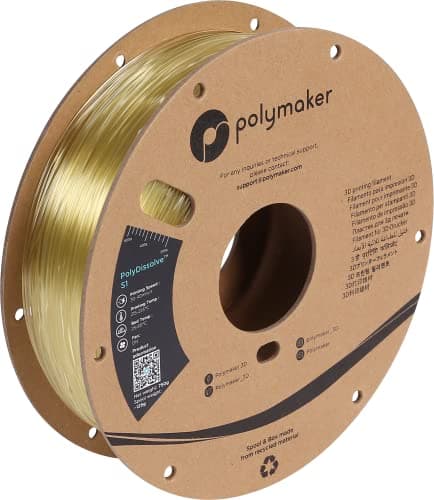
The model filament picks the support filament, not the other way around. PVA dissolves in water and belongs under PLA; HIPS dissolves in limonene and belongs under ABS. Most PLA prints are better served by a breakaway interface, and none of them work without a second nozzle or a multi-material system.
How this page is funded. Buy links go to Amazon and we earn a commission on qualifying purchases at no extra cost to you. Commission never decides an order or a score, we accept no free products or sponsored placements, and every roundup names something to skip. Full disclosure.
The picks, ranked
The picks, ranked
#
Product
Best for
Score
Price
1
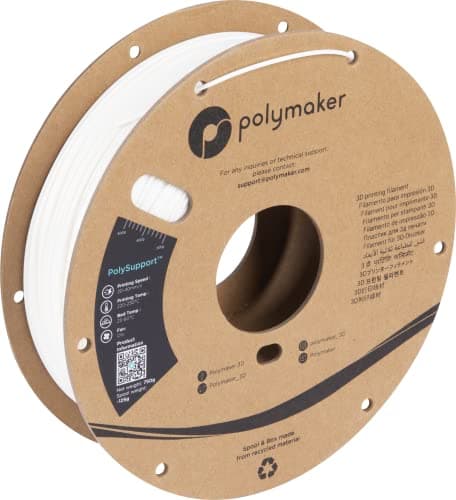
Polymaker PolyDissolve S1The PVA that publishes an adhesion table, including the materials it will not hold. That table is the whole buying decision for a soluble support.215-225 C, dry at 80 C for 12 h
Polymaker PolySupport for PLANot soluble, and for most PLA prints that is the better trade: a clean supported face, removed by hand, with a far gentler drying regime than PVA.Breakaway, 220-230 C, dry at 55 C for 6 h
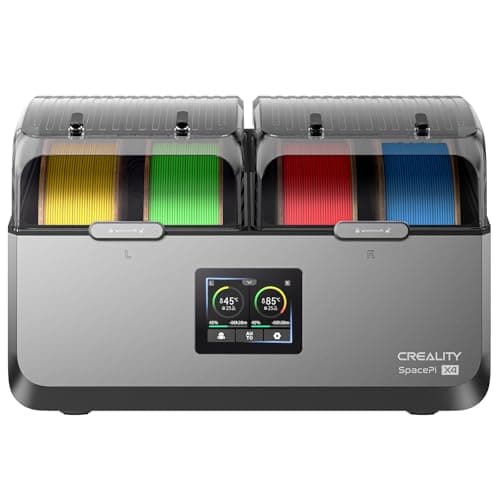
Creality Space Pi X4PVA's published drying figures sit at 80 C. A dryer that stops at 70 C cannot meet them, and damp PVA clogs nozzles rather than just printing badly.45-85 C, 4 spools
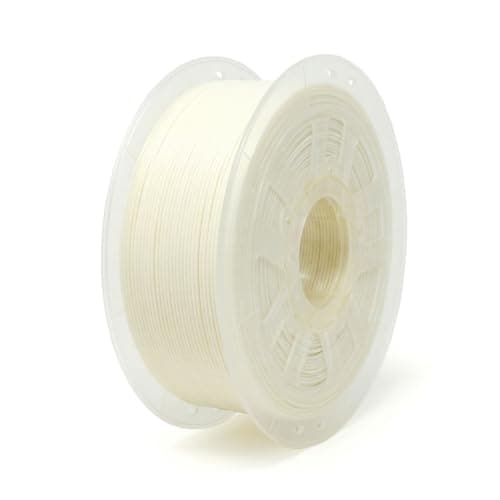
Gizmo Dorks HIPSPrints in the ABS window and dissolves in limonene, which leaves the ABS part behind. The solvent is the part that needs respect.230-250 C, 110 C bed, limonene
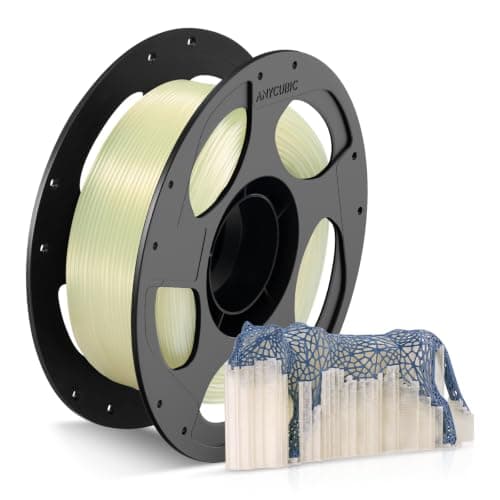
ANYCUBIC PVAA reasonably documented PVA that is fine under PLA. Skip it for PETG or ABS: Bambu list PVA as not compatible under PETG, and Polymaker rate their PVA as not holding ABS.Sold as working with ABS and PETGSkip this
Live prices verified September 17, 2026. Scores are our own fit rating for the stated use, not a measurement and not a customer rating.
A spool of specialty filament beside a printed part.
Support filament by model material, from each manufacturer's published figures.
Support filament
Removed with
Nozzle (C)
Drying
Holds well
PVA (PolyDissolve S1)
Water, 6-12 h
215-225
80 C, 12 h
PLA, TPU, PVB, nylon
PVA (ANYCUBIC)
Water
220-240
75-85 C, 8-12 h
PLA, nylon
Breakaway (PolySupport)
Hands
220-230
55 C, 6 h
PLA
HIPS (Gizmo Dorks)
Limonene
230-250
Rarely needed
ABS
Support filament by model material, from each manufacturer's published figures. ANYCUBIC also state their PVA works with ABS and PETG; that claim is left out of the table because Bambu list PVA as not compatible under PETG and Polymaker rate their own PVA as not supporting ABS or PC. The HIPS drying entry reflects Bambu's description of their HIPS-based support as not moisture sensitive. Figures from Polymaker, Polymaker, ANYCUBIC, Polymaker, Gizmo Dorks, Bambu Lab Wiki, retrieved 2026-09-17.
What decides the support filament
A support filament is a second material printed only where the model needs holding up, chosen because it does not bond to the model — or because it disappears afterward. That makes it a pairing decision before it is a brand decision. Five criteria settle it, in this order.
Can your printer lay down two materials in one print? A single-nozzle printer with no multi-material system has no practical way to use any of these. Polymaker go further and recommend an IDEX or tool-changer printer for both of their support materials, because swapping two materials through one nozzle raises the clog risk PolymakerPolymaker.
What is the model printed in? This is the decisive criterion. PVA holds PLA; HIPS holds ABS; neither is a universal answer, and Bambu warn that an incompatible pairing can cause extrusion problems or a clogged nozzle Bambu Lab Wiki.
How does the support have to come off? Supports buried inside a cavity or a moving joint have nothing to grab, and only a soluble material reaches them. Supports under an open overhang come off by hand, which is faster than any bath.
Can you keep it dry? Bambu class PVA as extremely moisture-sensitive, a step beyond their other support filaments Bambu Lab Wiki. Without a dryer that reaches its published temperature and a sealed feed, it will clog.
Is the part worth the waste? Every material swap purges filament, and Prusa list the larger purge volume and the high price as disadvantages of water-soluble filament in their own guide Prusa Research.
Match the support to the model material
The best evidence on pairing comes from the manufacturers that publish an adhesion table rather than a compatibility slogan. Polymaker rate PolyDissolve S1 as supporting PLA, TPU, PVB and nylon very well, PETG only depending on geometry, and ABS and polycarbonate not at all Polymaker. Bambu list their PVA for PLA and carbon or glass filled PLA, and state directly that PVA is not compatible as support for PETG Bambu Lab Wiki.
Prusa reach the same answer from the temperature side: the best combination is PLA with PVA or BVOH, because the printing temperatures are similar Prusa Research. Polymaker make the same point from the failure side: the clog risk of a shared nozzle is highest when the support is paired with a material that prints at a different temperature, such as nylon Polymaker.
PLA: PVA if the supports are internal, a breakaway material if they are not.
TPU and nylon: PVA, where the manufacturer rates the pairing. Nylon adds its own drying burden on top — see best nylon filament.
ABS: HIPS, dissolved in limonene.
PETG: none of the soluble materials on this page. Bambu rule PVA out, and Polymaker rate their breakaway PLA support as generally not holding PETG either Polymaker.
PVA: the water-soluble choice for PLA
PVA is the material people mean when they search for dissolvable filament. After the print, the part goes into water and the supports go away. Polymaker put that at 6 to 12 hours for PolyDissolve S1, and say it goes faster with warmer water, moving water and a change of water every few hours Polymaker.
Warmer has a ceiling. Bambu warn that for a PLA model the water should not exceed 50 C, or the part deforms while its supports dissolve, and they note that most FDM prints are porous enough for water to get inside during a long soak Bambu Lab Wiki. For a sealed display piece that is harmless; for a part with electronics going into it, dry it thoroughly before assembly.
How much PVA a print actually uses
Bambu recommend printing both the support body and the contact interface in PVA, not the interface alone, and using standard rather than tree supports so tall PVA structures do not collapse Bambu Lab Wiki. That is why PVA disappears from the spool faster than people expect — it is the whole support, not a skin on top of one. Prusa also list larger purge volumes as a cost of soluble filament Prusa Research, so budget for waste on every tool change.
PVA or BVOH
BVOH is the other water-soluble support. Prusa describe PVA as usually cheaper but more prone to nozzle clogging, and BVOH as sticking slightly better, with 195 C recommended for their PVA+ and 215 C for BVOH Prusa Research. The only BVOH we found on Amazon when we checked was a 2.85 mm spool listed as shipping in five to six weeks, so none is featured here.
PVA’s real price is moisture
The spool is the cheap part. Bambu’s figures show how little margin PVA gives: in a typical 55% RH room, freshly dried PVA can absorb enough moisture to affect print quality within 1 to 3 hours, and even at 20% RH it stays dry for only about 1 to 3 days. They recommend keeping it below 20% RH for the whole print Bambu Lab Wiki.
Damp PVA does not just print ugly. Bambu explain that the water in it flashes to steam inside the hot nozzle and the bubbles cause extruder clogs Bambu Lab Wiki. Polymaker give the audible symptom: popping or crackling, or bubbling filament at the nozzle, means dry it, and they recommend feeding PolyDissolve S1 from a heated dryer on its lowest setting for the entire print and printing no faster than 60 mm/s Polymaker.
Published drying figures: Polymaker 80 C for 12 hours Polymaker, Bambu 80 C for 8 to 12 hours in a convection oven Bambu Lab Wiki, ANYCUBIC 75 to 85 C for 8 to 12 hours ANYCUBIC.
That rules out many consumer dryers. A box that tops out at 70 C cannot reach any of those figures. The Creality Space Pi X4 publishes a 45 to 85 C range Creality, which clears them — the detail is in the Space Pi X4 review and the full ranking on best filament dryer.
Open feeders are a problem. Bambu do not recommend PVA through the open AMS Lite for exactly this reason, and suggest keeping prints under about an hour if you do Bambu Lab Wiki.
Store it the moment it comes out of the dryer. Bambu say not to wait for it to cool Bambu Lab Wiki. The container options are on dry boxes.
HIPS: the limonene-soluble choice for ABS
HIPS is to ABS what PVA is to PLA. Gizmo Dorks describe it as close to ABS in character, dissolved by limonene where ABS is dissolved by acetone, and commonly printed as the support for ABS parts on dual-extruder machines; they publish 230 to 250 C at the nozzle and a 110 C bed Gizmo Dorks. That overlaps the ABS window closely, which is why the pairing works.
It also means HIPS inherits every ABS requirement: a hot bed, an enclosure and ventilation. Bambu, whose own ABS support is mainly HIPS, recommend an enclosed printer and good ventilation, and describe it as not moisture sensitive, so it needs none of PVA’s drying regime Bambu Lab Wiki. If you are not already printing ABS properly, start at best ABS filament, and weigh ABS versus ASA before buying a support for either. Neither Gizmo Dorks nor Bambu name ASA as a HIPS partner, so treat that pairing as undocumented.
Handling limonene
Limonene is sold as the citrus-derived solvent, and that framing undersells it. Bambu’s guidance for dissolving their HIPS support is specific Bambu Lab Wiki:
It is flammable. Bambu give a flash point of about 48 C (118 F) and say never to use it near open flames or hot surfaces, including a heated build plate.
Latex gloves do not work. Limonene penetrates and swells latex; Bambu specify fluororubber (FKM) or laminated film gloves and a mask.
Ventilate and dispose properly. Work in a ventilated space, keep limonene away from children, and dispose of the waste solution, which now contains dissolved support, properly.
Purge generously. Bambu note that HIPS residue left in the nozzle mixes into the ABS and can weaken the model layers printed at the same height as the support, and they raise the purge volume to compensate.
Breakaway supports: what most PLA prints need instead
If the supports sit under an open overhang, dissolving them is overkill. A breakaway support material is chosen to bond weakly to the model, so the support prints solidly and then peels off by hand without scarring the face it held up. Polymaker’s PolySupport for PLA prints at 220 to 230 C, needs no enclosure, dries at 55 C for 6 hours, and does not dissolve in water Polymaker.
The practical advantages over PVA are large. There is no bath and no 12-hour wait. The drying regime is roughly what a standard dryer already does. And in Bambu Studio, every Bambu support filament except PVA can be set as the interface material alone Bambu Lab Wiki, so the bulk of the support prints in the model filament and the specialty spool lasts far longer.
The limits are equally clear. Breakaway supports cannot reach an enclosed cavity. And Polymaker rate PolySupport as holding PLA very well, PETG and ABS generally not, and nylon not at all Polymaker — this is a PLA material, and it is sold as one.
If you have one nozzle and no multi-material system
Do not buy any of these spools. A second material only helps when the printer can place it in the same layer as the model. What helps instead is support design in the slicer.
Orient the part to need fewer supports. A rotation that turns an overhang into a slope removes the problem rather than managing it.
Try tree supports for cosmetic faces. Polymaker explain that tree supports touch the model at fewer points, which generally means less surface damage and easier removal, at the cost of less backing under the overhang Polymaker.
Tune the support gap before changing materials. Bambu describe the trade directly: a larger gap between support and model makes removal easier and the supported face rougher; a smaller gap does the opposite Bambu Lab Wiki.
Print settings still matter. Clean overhangs start with temperature and cooling — see PLA print settings.
What not to buy
Any PVA for a PETG part. Bambu state PVA is not compatible as support for PETG Bambu Lab Wiki, whatever a listing promises.
PVA for ABS or polycarbonate. Polymaker rate their PVA as not supporting either Polymaker. ABS takes HIPS.
HIPS under PLA. HIPS wants a 110 C bed Gizmo Dorks, far past the roughly 60 C at which Prusa say PLA begins to soften Prusa Research.
A soluble spool before a dryer. Without a dryer that reaches 80 C and a sealed feed, PVA is a clog you paid a premium for.
Soluble supports for an open overhang. A breakaway interface does that job with less waste, less time and no bath.
Every pick, in detail
01
Polymaker PolyDissolve S1
Polymaker
Water-soluble supports under PLA, TPU and nylon · 8.7/10 our fit score
The PVA with a published adhesion table. It says plainly which model materials it holds and which it does not, and that is the question that decides a soluble support.
Published specifications for Polymaker PolyDissolve S1
Buying PVA for PETG or ABS parts · 4.5/10 our fit score
A reasonably documented PVA sold with a compatibility promise that two other manufacturers contradict for their own PVA. Fine under PLA; do not buy it for PETG or ABS parts.
PVA if the supports are inside a cavity or joint where nothing can reach them, and a breakaway support such as Polymaker PolySupport for PLA if they sit under an open overhang. Prusa call PLA with PVA or BVOH the best combination because the printing temperatures are similar.
+ − Can you use PVA supports with PETG?
Not reliably. Bambu state that PVA is not compatible as support for PETG, and Polymaker rate their own PVA as supporting PETG only depending on the geometry. Some listings claim PETG compatibility; the manufacturers that publish adhesion data do not back it.
+ − What dissolves HIPS support material?
Limonene, which leaves ABS intact. It is flammable, with a flash point Bambu give as about 48 C (118 F), and it penetrates latex gloves, so use fluororubber or laminated film gloves, work in a ventilated space and dispose of the used solution properly.
+ − How long does PVA take to dissolve?
Polymaker give 6 to 12 hours for PolyDissolve S1. Warm, moving water and changing the water every few hours speed it up, but Bambu warn against going above 50 C for a PLA part, which will deform.
+ − Do I need a dual extruder for soluble supports?
You need some way to print two materials in one layer: a dual extruder, a tool changer or a multi-material feeder. Polymaker recommend IDEX or tool-changer printers because swapping materials through a single nozzle raises the clog risk. With one nozzle and no feeder, soluble supports are not an option.