The specification that decides a filament dryer is its ceiling, and Creality publish 85 C for this one. That single number is what moves nylon and polycarbonate from theory into something you can actually print, and it is the whole case for buying this rather than a cheaper box.
How this page is funded. Buy links go to Amazon and we earn a commission on qualifying purchases at no extra cost to you. Commission never decides an order or a score, we accept no free products or sponsored placements, and every roundup names something to skip. Full disclosure.
The picks, ranked
The picks, ranked
#
Product
Best for
Score
Price
1
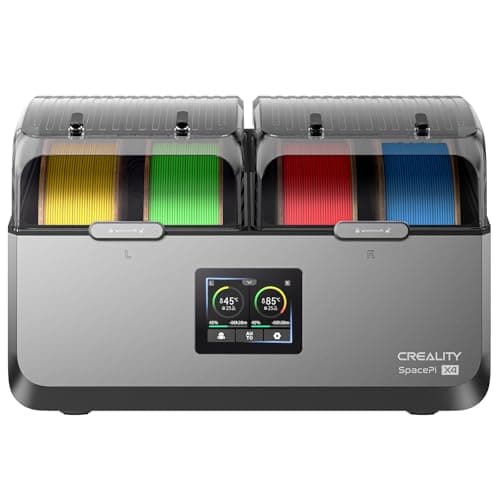
Creality Space Pi X4The published ceiling is the product. If you print nylon, polycarbonate or composites, this is the cheapest honest way to dry them properly.45-85 C, four spools, dual chambers
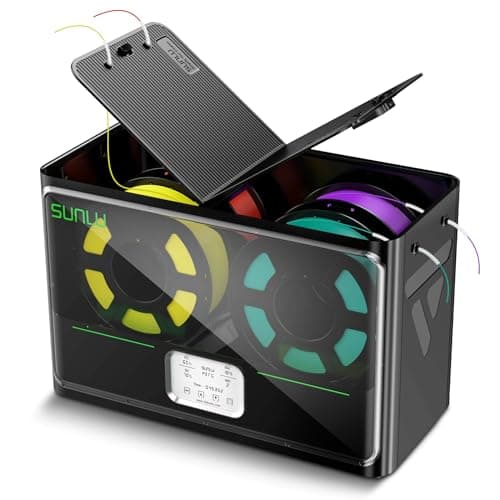
SUNLU FilaDryer S4Cheaper, with a humidity readout and a pass-through the X4 does not emphasize. Buy this instead if your hottest material is PETG.Humidity setpoint, pass-through, four spools
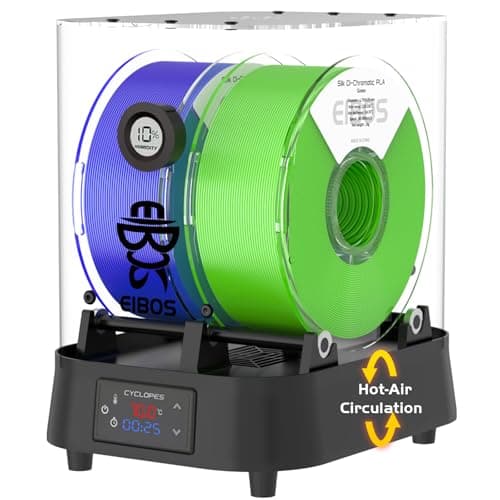
EIBOS CyclopesLess capacity and less ceiling, at a price that suits someone drying occasionally rather than as part of the workflow.Fan-assisted, two-spool format
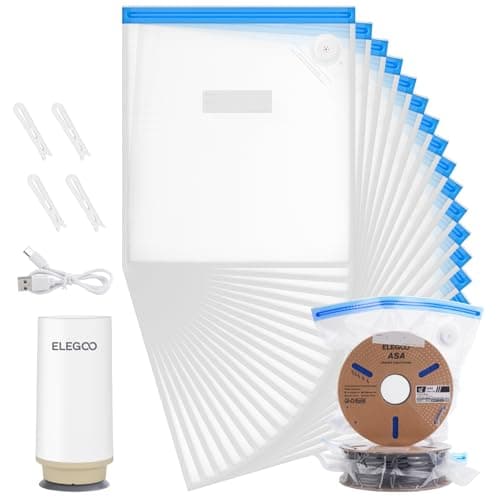
ELEGOO Filament Vacuum Storage BagsA dryer is a repair; sealed storage is the fix. If your spools are not sealed between prints, this costs a fraction as much and prevents the problem.20 sealed bags, pump, clips
Live prices verified September 13, 2026. Scores are our own fit rating for the stated use, not a measurement and not a customer rating.
A filament dryer on a workshop bench.
What Creality actually publish
The Space Pi X4 is a four-spool filament dryer with two independently controlled chambers. Creality's published figures are the reason it is worth a page of its own Creality:
Temperature range 45 to 85 C, driven by two 200 W PTC heaters, with a 360 W rated power draw.
Four spools at once, up to 200 mm diameter and 150 mm width, in 1.75 or 2.85 mm.
Two chambers with independent temperature control, so PLA at 45 C and nylon at 85 C can run at the same time.
360-degree hot air circulation with active dehumidification via dual fans, plus automatic desiccant regeneration.
A 3.2-inch touchscreen with drying recommendations and an auto mode.
382 x 290 x 270 mm, 5 kg — bench furniture, not a box you tuck behind the printer.
Why 85 C is the number that matters
Filament dryers are bought on capacity and sold on convenience, and both are the wrong criterion. The one that decides whether a dryer can do its job is the ceiling, because a unit that cannot reach a material's published drying temperature cannot dry it however long it runs.
Prusa's published figures run 45 C for PLA, 55 C for PETG, 60 C for TPU, 80 C for ASA, and 85 to 90 C for the polycarbonate and nylon composites Prusa Research. Overture publish their own, consistently higher numbers for several materials, including 95 C for seven hours for nylon Overture.
Read the X4's 85 C against that list and the picture is clear: it covers everything up to and including polycarbonate blends and Prusa's PA-CF figure, and it still falls short of Overture's 95 C nylon recommendation. That is an honest limitation rather than a disqualification — no consumer dryer we know of reaches 95 C — and it is why a spool that has been left open for months may need a longer cycle rather than a hotter one.
Two chambers is the underrated feature
Independent temperature control across two chambers sounds like a spec sheet flourish and is actually the most useful thing here. Drying is slow — cycles run four to eight hours depending on material Prusa Research — so a single-chamber dryer serializes your work: PLA today, nylon tomorrow.
Two chambers means the PETG you print weekly and the nylon you print occasionally can share one appliance without one of them waiting. For anyone who keeps more than two material types on the shelf, that halves the practical wait, which matters more day to day than the 85 C figure does.
What it does not do
It is not a dry box for printing from. Creality's own guidance recommends drying filament thoroughly before printing rather than printing through the unit Creality. If you want to print straight from a heated box, that is a different product category — see dry boxes.
It does not publish a humidity readout. Creality document active dehumidification and desiccant regeneration, but no humidity percentage on the display. If you want to watch the number fall, a competitor with a humidity setpoint suits you better.
It does not replace storage. Bambu Lab publish that a freshly dried spool sitting in ordinary room air of about 55 percent humidity is affected again within hours, where one sealed below 20 percent holds for days Bambu Lab Wiki. Drying without sealed storage is a cycle you pay for repeatedly.
It does not fit every spool. The published limit is 200 mm diameter and 150 mm width. Most 1 kg spools fit comfortably; some 2 kg and refill-cardboard formats do not.
It is not small. At 382 x 290 x 270 mm and 5 kg it wants permanent bench space next to the printer.
What it costs to run
Rated at 360 W, though a PTC heater draws its rated power only while heating and far less while holding temperature. The arithmetic is the same one we use for printers: average kilowatts times hours times your own rate per kilowatt-hour. The U.S. Energy Information Administration publishes average residential electricity prices by state U.S. Energy Information Administration — use your own bill rather than an average, because regional variation is large enough to change the answer.
Against that, weigh what a moisture failure costs: the filament, the electricity, and the eighteen hours of print that failed at hour seventeen. The full break-even, and the case for spending on storage first, is on is a filament dryer worth it.
Who should buy it, and who should not
Buy it if you print nylon, polycarbonate, or carbon and glass composites; if you keep several material types on the go and the serialized wait of a single chamber annoys you; or if you live somewhere humid enough that drying is routine rather than a rescue.
Buy something else if your hottest material is PETG — a cheaper four-spool unit covers 55 C comfortably and often adds a humidity readout and a pass-through. If you dry twice a year, a food dehydrator does the same job for less, with the trade-offs set out on filament dryer versus food dehydrator. And if your spools are not currently sealed between prints, buy bags and desiccant first: that is the purchase that stops the problem rather than fixing it, and it is covered on desiccant and vacuum bags.
Using it well
Dry to the published figure for the material, not to the maximum. More heat is not faster in any useful sense; it is the point at which the spool deforms.
Seal the spool the moment the cycle ends. The re-wetting figures make leaving it out a same-day loss Bambu Lab Wiki.
Use the second chamber deliberately. Running two materials at their own correct temperatures is the feature you paid for.
Weigh a wet spool before and after. Water leaving the filament is mass leaving the spool, and a kitchen scale turns drying from a belief into a measurement.
Do not use it as a warm cupboard. Repeated heat cycles on filament that was already dry are wear without benefit — the frequency question is on how to dry filament.
Every pick, in detail
01
Creality Space Pi X4
Creality
Drying engineering materials · 8.9/10 our fit score
The only mainstream consumer dryer here that reaches the temperature nylon actually needs. That single number is the whole argument for it.
Creality publish a range of 45 to 85 C, heated by two 200 W PTC elements with a 360 W rated draw. That covers every common filament drying figure Prusa publish, up to and including the polycarbonate and nylon composites at 85 to 90 C.
+ − Can you print while drying with the Space Pi X4?
Creality's own guidance recommends drying filament thoroughly before printing rather than printing through the unit. If printing from a heated, sealed box is the feature you want, look at dry boxes and at dryers that advertise a pass-through.
+ − Is the Space Pi X4 worth it over a cheaper dryer?
If you print nylon, polycarbonate or composites, yes — the 85 C ceiling and the two independently controlled chambers are what those materials need. If your hottest material is PETG at 55 C, a cheaper four-spool unit does the same job and often adds a humidity readout.
+ − What spool sizes fit the Space Pi X4?
Creality publish a limit of 200 mm diameter and 150 mm width, for 1.75 or 2.85 mm filament, four spools at a time. Standard 1 kg spools fit; some oversized 2 kg formats do not.