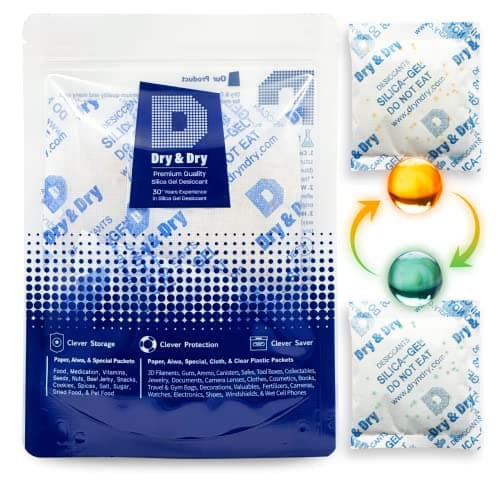
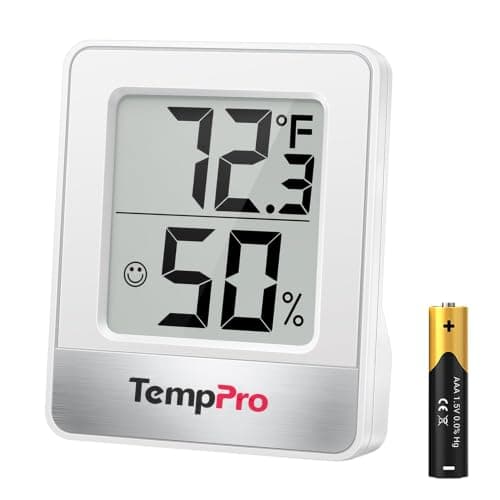
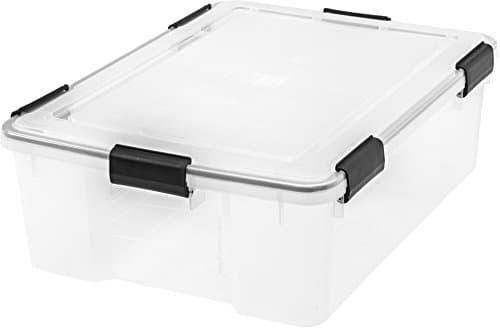
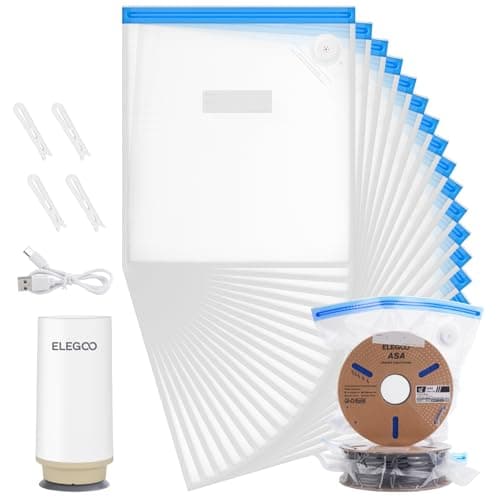
This is the cheapest genuinely worthwhile purchase in 3D printing. A bag, a scoop of indicating silica gel and a hygrometer costs less than one failed spool and prevents a whole category of problem.
How this page is funded. Buy links go to Amazon and we earn a commission on qualifying purchases at no extra cost to you. Commission never decides an order or a score, we accept no free products or sponsored placements, and every roundup names something to skip. Full disclosure.
The picks, ranked
The picks, ranked
#
Product
Best for
Score
Price
1
ELEGOO Filament Vacuum Storage BagsBuy more than you think. Every spool off the printer should be in one within the hour.Vacuum bags with one-way valve
Indicating Silica Gel Desiccant PacketsNon-indicating desiccant is a guess. The color change is the only reason you will ever regenerate it.Color-indicating, regenerable
Live prices verified October 17, 2026. Scores are our own fit rating for the stated use, not a measurement and not a customer rating.
Storage containers with desiccant packets on a shelf.
How long a freshly dried spool stays print-ready, by the humidity of the room it sits in.
Ambient humidity
How long it stays dry
What that means in practice
Below 20% RH (sealed box with desiccant)
2-7 days
The published storage target for most filaments
About 55% RH (ordinary indoor air)
2-12 hours
Enough moisture to affect print quality, depending on how hygroscopic the type is
How long a freshly dried spool stays print-ready, by the humidity of the room it sits in. Both figures are Bambu Lab's, published as ranges across filament types rather than per material. Figures from Bambu Lab Wiki, retrieved 2026-09-01.
Why this comes before a dryer
Bambu Lab's published figures give a dried spool 2 to 7 days below 20 percent relative humidity and 2 to 12 hours at around 55 percent Bambu Lab Wiki. A dryer moves a spool from wet to dry; only storage keeps it there. Buying a dryer and storing spools on an open shelf means re-drying the same spool repeatedly, forever.
Vacuum bags
A vacuum bag does two things. It removes most of the air, so there is very little moisture in the bag to begin with, and it seals so no more gets in. Adding a desiccant pack handles what is left and whatever leaks past the valve over months.
Do not over-compress. The goal is air removal, not crushing. A hard vacuum can deform a cardboard spool.
Put desiccant in every bag, not just some of them. The pack is the difference between storage and a sealed container with humid air in it.
Check the valve seals after a few uses. A leaking valve is invisible until you check the bag months later.
Label the bag, because vacuum-packed spools are harder to identify at a glance than loose ones.
Choosing desiccant
Indicating versus plain
Indicating silica gel changes color as it saturates. Plain silica gel does not, which means the only way to know its state is to weigh it or to guess — and in practice everyone guesses, which means everyone runs saturated desiccant for months without knowing.
The cost difference is trivial and the behavioral difference is the whole ballgame. Buy indicating.
How much
More than you think. The sachet that shipped with a spool was sized for that sealed bag, not for a tub with several spools and a lot of headspace. Buy desiccant by weight and be generous, especially in a humid climate.
Regeneration
Silica gel is dried out with heat and reused indefinitely. The temperature and time vary by product, so follow the manufacturer's instructions rather than a general figure — and do it away from your filament, since you are deliberately driving moisture into the air.
The hygrometer is the part that makes it a system
Without a reading, storage is faith. With one, it is a loop: you can see whether the box is holding below the published target, you can see when the desiccant has stopped working, and you can tell whether your climate is a real problem or a theoretical one.
Buy several. They cost very little and one per container is not extravagant.
When to switch to boxes
Vacuum bags scale badly past a dozen or so spools — the handling gets tedious and you stop bagging things, which defeats the purpose. At that point one gasketed tub holding the working set, with generous desiccant and a visible hygrometer, is less effort and gets used.
The best storage system is the one you keep using. See how to store filament for the full setup and dry boxes for the version you print from.
Every pick, in detail
01
ELEGOO Filament Vacuum Storage Bags
ELEGOO
Every spool not in use · 9.2/10 our fit score
The cheapest thing on this site that will measurably improve your print quality. Buy these before you buy a dryer.
Published specifications for ELEGOO Filament Vacuum Storage Bags
For spools you are not using, yes — less air in the container means less moisture to begin with. Past a dozen spools a sealed box with generous desiccant is easier to maintain, and the system you keep using beats the one you abandon.
+ − How often do I regenerate desiccant?
When the indicating color changes, which is the reason to buy the indicating kind. Frequency depends entirely on your climate and how often the container is opened, so a schedule is less useful than simply looking at it.
+ − Do I need desiccant inside a vacuum bag?
Yes. Vacuuming removes most of the air but not all of it, and valves leak slowly over months. The desiccant handles what is left and what gets in.