For most people the honest answer is: buy the storage first. A dryer fixes a spool that has already gone wet, and sealed bags with desiccant stop that from happening at a fraction of the price. The dryer earns its keep on specific materials and in specific climates.
How this page is funded. Buy links go to Amazon and we earn a commission on qualifying purchases at no extra cost to you. Commission never decides an order or a score, we accept no free products or sponsored placements, and every roundup names something to skip. Full disclosure.
The picks, ranked
The picks, ranked
#
Product
Best for
Score
Price
1
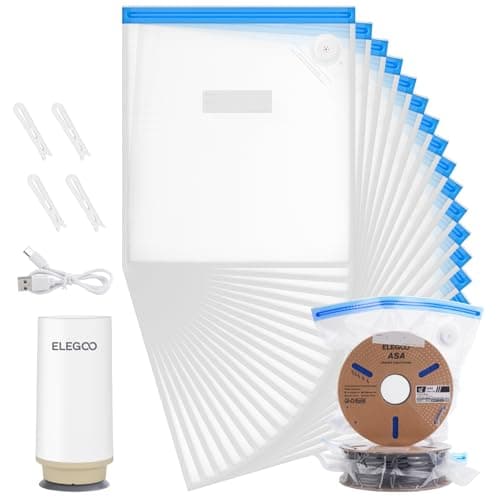
ELEGOO Filament Vacuum Storage BagsThe highest-return purchase in this category. A spool that never gets damp never needs drying, and a bag costs a fraction of what a dryer does.Sealed bags for whole spools
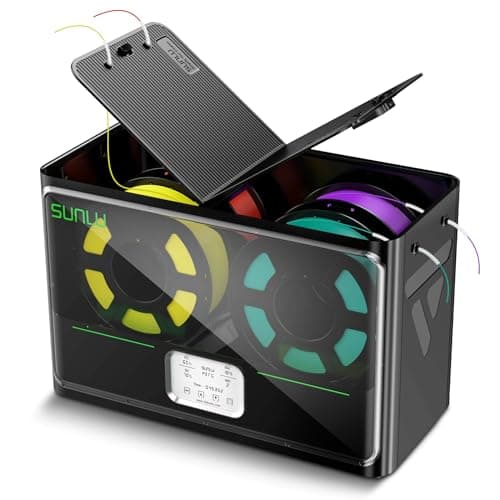
SUNLU FilaDryer S4Worth it if you print hygroscopic materials, live somewhere humid, or run long jobs where a mid-print moisture failure costs a day.Humidity setpoint, pass-through, 4 spools
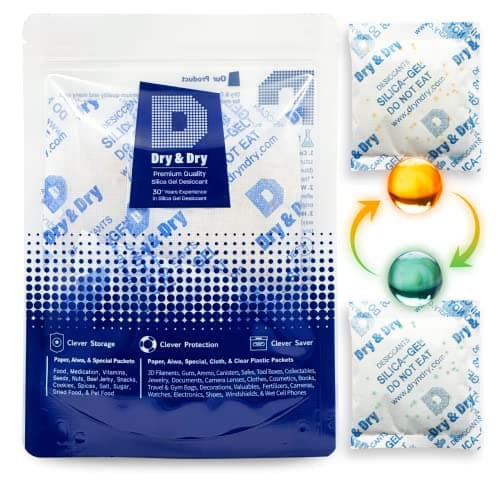
Indicating Silica Gel Desiccant PacketsIndicating beads tell you when they are saturated, which is the difference between storage that works and storage you believe in.Color-changing, rechargeable
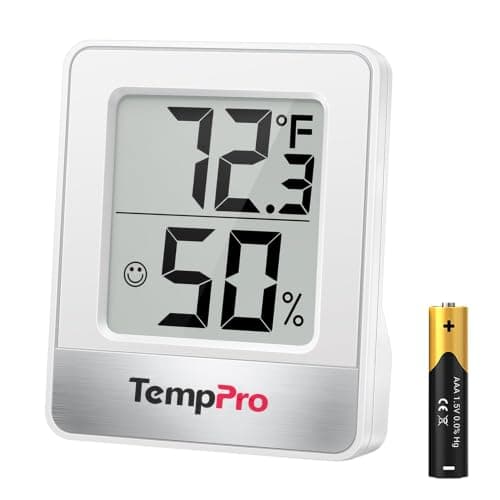
Digital HygrometerTwo dollars of sensor answers the whole question for your house. Below 20 percent in the box and you have a storage system, not a hope.Reads relative humidity in the box
Live prices verified October 20, 2026. Scores are our own fit rating for the stated use, not a measurement and not a customer rating.
A calculator and notebook on a desk.
How long a freshly dried spool stays print-ready, by the humidity of the room it sits in.
Ambient humidity
How long it stays dry
What that means in practice
Below 20% RH (sealed box with desiccant)
2-7 days
The published storage target for most filaments
About 55% RH (ordinary indoor air)
2-12 hours
Enough moisture to affect print quality, depending on how hygroscopic the type is
How long a freshly dried spool stays print-ready, by the humidity of the room it sits in. Both figures are Bambu Lab's, published as ranges across filament types rather than per material. Figures from Bambu Lab Wiki, retrieved 2026-09-01.
These are two different problems
Almost everyone who asks whether a dryer is worth it has just had a print fail on a spool that has been open for months. That is one problem with two separate solutions, and buying the wrong one first is how people end up owning a dryer they run every week.
Drying is a repair. It removes moisture a spool has already absorbed. It works, it takes hours, and it has to be repeated every time the spool sits out again.
Storage is the fix. It stops absorption happening. It costs less, it takes no time, and it is the only one of the two that changes the situation permanently.
Bambu Lab publish figures that make the relationship concrete: a freshly dried spool sitting in ordinary indoor air of about 55 percent relative humidity is back to affecting print quality within hours, while the same spool sealed below 20 percent holds for days Bambu Lab Wiki. Drying without storage is a cycle you pay for repeatedly.
What owning a dryer actually costs
Three costs, and the first one is the smallest surprise.
The purchase. Dryers span a wide bracket, from single-spool boxes to four-spool units with humidity setpoints and pass-throughs. The ceiling temperature is the specification that decides which bracket you need, and it is set by the materials you print, not by your budget.
Electricity. A dryer is a small heater that runs for hours. The arithmetic is the same as for a printer: average draw in kilowatts, times hours, times your own rate. The U.S. Energy Information Administration publishes average residential prices by state U.S. Energy Information Administration — use your own bill rather than an average, because regional variation is large. Read the rating plate on the unit you are considering and multiply; a plug-in power meter measures it exactly for a few dollars. The method is the same one on cost per print.
Time and attention. A drying cycle is measured in hours: Prusa publish 6 hours for PLA, 6 hours for PETG, 4 to 6 hours for TPU and 4 hours for ASA Prusa Research. If drying is your storage strategy, that cycle is a recurring tax on every print you did not plan a day ahead.
What a wet spool costs
The other side of the ledger, and the reason a dryer is sometimes an easy yes. A moisture failure rarely wastes only filament.
The filament. The obvious part, and usually the smallest.
The print. A failure at hour eighteen costs the material, the electricity and the eighteen hours. This is the term that dominates the cost of the hobby, which is the standing argument on is cheap filament worth it.
The diagnosis. Wet filament produces symptoms that look like other problems — stringing, rough surfaces, weak layers, popping — and people spend evenings tuning retraction to fix a moisture problem. The symptom list is on wet filament signs.
The break-even, in one line
Divide the price of the dryer by the delivered price of a spool. That is how many spools it has to save before it has paid for itself, and it is usually a smaller number than people expect — two or three spools for a mid-range unit.
Then ask the honest question: would sealed storage have saved those same spools? For PLA and PETG in a dry house, the answer is normally yes, and the storage costs a fraction as much. For nylon in a humid climate, the answer is no — nylon absorbs moisture from room air fast enough that storage alone is not sufficient, which is the argument on best nylon filament.
When a dryer is worth it
Four situations, and if none of them describes you, spend the money on bags and desiccant instead.
You print hygroscopic materials. Nylon, TPU, polycarbonate and the composites take up water fast enough that active drying is part of the workflow rather than a rescue.
You live somewhere humid. Ordinary indoor air at around 55 percent relative humidity is enough to affect print quality within hours of drying Bambu Lab Wiki, and a coastal or tropical summer is well above that.
You run long prints. The longer the job, the more expensive a moisture failure is, and the more a guaranteed-dry spool is worth paying for up front.
You want to print from the box. A dryer with a pass-through keeps the spool at its setpoint during the print, which is the one thing storage cannot do.
When it is not worth it
You print PLA and PETG in a dry house. Sealed storage covers it. Whether PLA needs drying at all is a real question with a nuanced answer on does PLA need drying.
You print occasionally. A few spools, opened, printed and resealed, do not justify an appliance.
You were going to use the oven instead. That is a different decision with its own problems, covered on drying filament in an oven. The short version is that Prusa warn home ovens do not hold temperature precisely enough for low-temperature filaments Prusa Research.
If the answer is yes, buy on temperature
The specification that matters is the ceiling, because it decides which materials the unit can actually serve. Prusa's published figures run from 45 C for PLA up to 85 and 90 C for polycarbonate and nylon composites Prusa Research, and a unit that tops out below your material's figure cannot dry it however long you leave it. Overture publish their own, higher figures for several materials Overture, which is another reason to buy headroom.
If you print nylon, TPU, polycarbonate or composites, or you live somewhere humid, yes. If you print PLA and PETG in a dry house, sealed bags with indicating desiccant solve the same problem for a fraction of the price. Buy the storage first either way.
+ − How many spools does a dryer have to save to pay for itself?
Divide its price by your delivered price per spool — usually two or three for a mid-range unit. The follow-up question matters more: would sealed storage have saved those same spools for a tenth of the cost?
+ − Can vacuum bags replace a dryer?
For preventing moisture, yes, and that is the majority of the problem. They cannot remove moisture a spool has already absorbed. Bambu Lab publish that a spool sealed below 20 percent humidity stays print-ready for days where one in ordinary room air is affected within hours.
+ − How much does it cost to run a filament dryer?
Read the wattage off the unit, multiply by the cycle length in hours, and multiply by your own electricity rate. Cycles are long — Prusa publish 4 to 8 hours depending on material — so the number is small per cycle and adds up if drying is your storage strategy.