A kitchen oven can dry filament and frequently damages it instead. The problem is not heat, it is control: Prusa state plainly that home ovens do not measure temperature precisely enough for low-temperature filaments like PLA.
How this page is funded. Buy links go to Amazon and we earn a commission on qualifying purchases at no extra cost to you. Commission never decides an order or a score, we accept no free products or sponsored placements, and every roundup names something to skip. Full disclosure.
The picks, ranked
The picks, ranked
#
Product
Best for
Score
Price
1
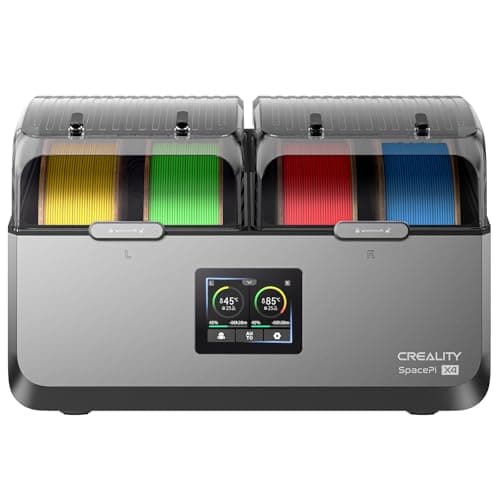
Creality Space Pi X4The materials with published drying temperatures of 80 C and above are exactly the ones an oven is worst at. A unit with a verified ceiling removes the guessing.Reaches nylon drying temperatures
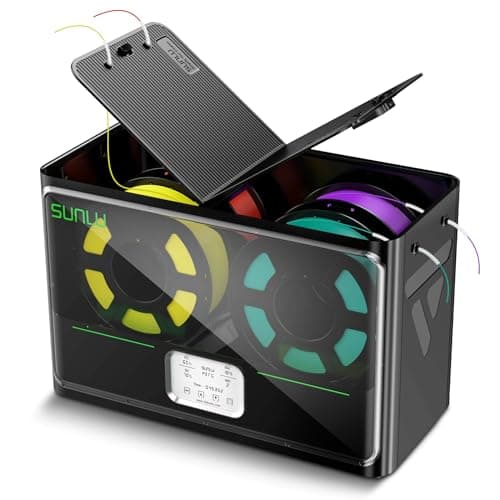
SUNLU FilaDryer S4Holds a setpoint the way an oven does not, and prints straight from the box through a pass-through, which an oven obviously cannot do.Humidity setpoint, pass-through, 4 spools
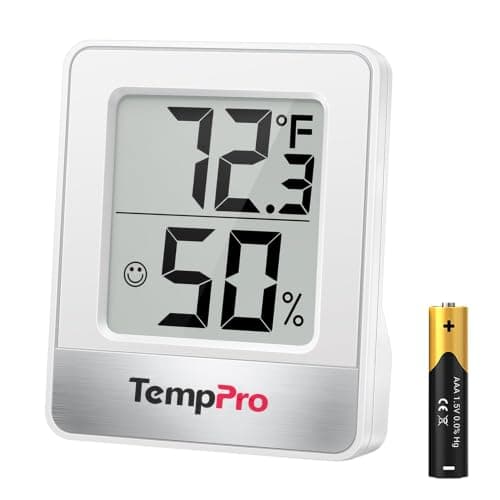
Digital HygrometerDrying without measuring is guessing. A two-dollar sensor in the storage box tells you whether the drying held, which is the part people skip.Reads relative humidity in the box
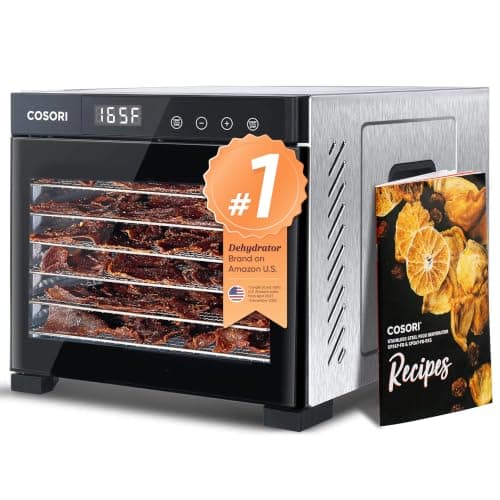
COSORI Food DehydratorUnlike an oven, a dehydrator is designed to hold low temperatures for hours. It is the honest budget answer for PLA and PETG.Food dehydrator, tray removal required
Published drying temperatures and times. Prusa Research and Overture disagree on several materials; both figures are shown rather than averaged. A dash means that manufacturer does not publish a figure for that material. Where they differ, the lower temperature for longer is the safer starting point. Figures from Prusa Research, Overture, Prusa Research, retrieved 2026-09-06.
The short answer
You can, and for PLA you probably should not. Prusa Research address the method directly in their drying guidance: home ovens do not have very precise temperature measurement, and the fluctuations that do not affect food can damage filament, especially low-temperature materials like PLA Prusa Research. That is the entire problem in one sentence, and no technique fixes it — it is a property of the appliance.
Why an oven is the wrong instrument
A kitchen oven is built to average the right temperature over a large cavity across a long bake. Nothing about that goal requires precision at the moment-to-moment level, and three consequences follow.
The dial is a request, not a measurement. The thermostat cycles the element on and off around the setpoint, so the actual air temperature swings above and below it. For a casserole that is invisible. For PLA, whose published drying temperature is 45 C Prusa Research, a swing of ten degrees is the difference between drying a spool and softening it.
The element radiates. Air temperature is not the whole story: a spool with line of sight to a glowing element receives radiant heat far above ambient on the side facing it. This is how people end up with a spool that is fine on one side and fused on the other.
Spools deform before filament does. Prusa document that their own older black spools expand above 45 C and stay deformed after cooling, to the point of publishing a mechanical fix Prusa Research. A warped spool that no longer turns freely ruins prints just as thoroughly as damp filament.
There is a fourth reason that has nothing to do with the filament: an oven you cook in is an oven you cook in. Heating plastics in it is not something we would do in a kitchen, and it is the main argument for keeping a cheap dedicated appliance in the workshop instead.
The numbers you are aiming at
Every decision here is downstream of the published drying figures, and they are lower than people expect. Prusa publish 45 C for 6 hours for PLA, 55 C for 6 hours for PETG, 60 C for 4 to 6 hours for TPU, 80 C for 4 hours for ASA, and 85 to 90 C for the polycarbonate and nylon composites Prusa Research. Overture publish their own, consistently higher figures for several of the same materials Overture.
Two things follow. First, most domestic ovens do not go low enough to be safe for PLA at all — many will not hold anything under about 70 C, which is above the point at which PLA starts to soften. Second, the materials that need the high figures are the ones where an oven's imprecision matters least in percentage terms and most in consequence: a spool of nylon that reaches 110 C instead of 90 C is not dried, it is annealed into a solid block.
The full per-material table, with both manufacturers' figures shown unaveraged, is on how to dry filament.
If you are going to use the oven anyway
Sometimes there is a wet spool, a deadline and no dryer. These are the rules that make it survivable.
Not PLA. Ever. The margin between the published 45 C drying figure and the point at which Prusa say PLA softens and deforms — about 60 C Prusa Research — is smaller than a typical oven's swing.
Put a thermometer inside. An independent oven thermometer sitting next to the spool, checked before the spool goes in and again during the cycle. The dial's number is not evidence.
Set below the target, not at it. Aim ten degrees under the published figure and accept a longer cycle. Drying is a slow diffusion process; a lower temperature for longer costs nothing but time.
Prop the door open. A sealed oven traps the moisture you just drove out of the filament. A gap of a couple of centimeters lets it leave, and lowers the peak temperature at the same time.
Keep the spool away from the element and off the floor of the oven. Middle shelf, centered, nothing below it.
Never in a fan-assisted grill or air fryer mode. Air fryers are small, high-power convection ovens with coarse thermostats and short cycles. They are worse at this than a full-size oven, not better.
The dehydrator middle ground
A food dehydrator is the appliance an oven is pretending to be for this job: it is designed to hold a low temperature steadily for hours, which is exactly the requirement. Pull the trays out, stand the spool inside, and it covers PLA and PETG comfortably.
What it gives up is a humidity readout, a pass-through so you can print from the box, and a reliable ceiling for the high-temperature materials. Those trade-offs are compared in detail on filament dryer versus food dehydrator.
How to know whether it worked
Drying is one of the few things in this hobby with an objective test, and almost nobody runs it.
Weigh the spool before and after. Water leaving the filament is mass leaving the spool. A kitchen scale that reads to a gram is enough to see it on a wet 1 kg spool.
Listen and look at the first extrusion. Popping, steam and a rough surface mean moisture is still coming out. The full symptom list is on wet filament signs.
Measure the box afterwards. A hygrometer in the storage container tells you whether the dry spool is staying dry, which is the part that actually determines whether you have to do this again next month.
Drying is the repair; storage is the fix
A dried spool left on an open shelf takes moisture straight back out of the room air, and in a humid house that happens in days rather than months. Sealed storage with desiccant is what makes drying a one-time event instead of a routine — the arithmetic and the gear are on how to store filament and desiccant and vacuum bags.
Every pick, in detail
01
Creality Space Pi X4
Creality
Reaching the high figures · 8.9/10 our fit score
The only mainstream consumer dryer here that reaches the temperature nylon actually needs. That single number is the whole argument for it.
You can, with care, for PETG and above. Prusa warn that home ovens do not measure temperature precisely enough and that the fluctuations can damage filament, particularly low-temperature materials like PLA. Use an independent oven thermometer, set below the published figure, and prop the door open.
+ − What temperature should I dry PLA at?
Prusa publish 45 C for 6 hours; Overture publish 50 C for 7 hours for their own PLA. Both are below the temperature at which PLA starts to soften, which is why an appliance that holds a setpoint matters more here than for any other material.
+ − Can I dry filament in an air fryer?
No. An air fryer is a small, high-powered convection oven with a coarse thermostat and a short duty cycle — every problem a kitchen oven has, amplified, in a cavity too small to keep the spool away from the element.
+ − How long does filament stay dry after drying?
It depends entirely on where you put it. On an open shelf in a humid room, days. Sealed with fresh desiccant and a hygrometer to prove it, months. Drying is the repair; storage is the fix.