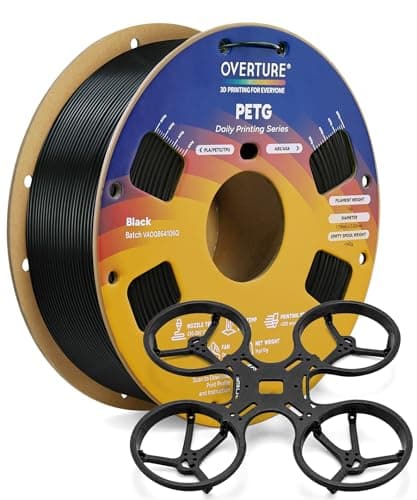
Yes, and the reason is the same reason you should not: PLA and PETG barely bond to each other. In one part that has to carry load, that weak interface is a built-in fracture line. Across two materials in a multi-material print, it is the cheapest breakaway support you can buy — a second spool of Overture PETG under your PLA, with no dedicated support filament needed.
How this page is funded. Buy links go to Amazon and we earn a commission on qualifying purchases at no extra cost to you. Commission never decides an order or a score, we accept no free products or sponsored placements, and every roundup names something to skip. Full disclosure.
The picks, ranked
The picks, ranked
#
Product
Best for
Score
Price
1
Overture PETGThe cheap half of the trick. A PETG interface layer under PLA overhangs peels off cleanly and costs a fraction of a dedicated support spool, because you will use it for printing too.215-270 C, no enclosure
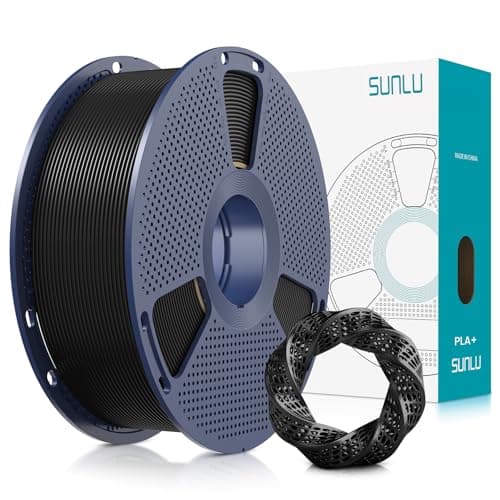
SUNLU PLA+The same trick in reverse, and the direction more people need: PETG models are harder to support cleanly, and PLA releases from them.185-235 C, no enclosure
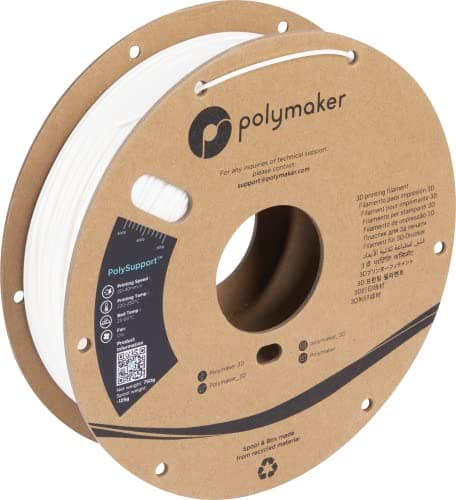
Polymaker PolySupport for PLAA purpose-made breakaway material. Polymaker rate it as holding PLA very well and PETG and ABS generally not, so buy it for PLA models specifically.220-230 C, PLA models only
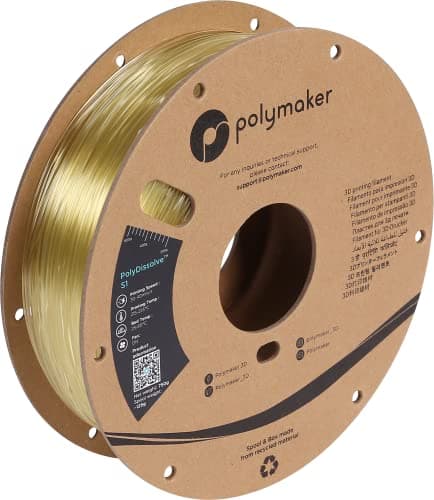
Polymaker PolyDissolve S1The only option when the support cannot be reached by hand. It is also the most demanding to store, so read the drying requirement before buying.Water-soluble PVA
SUNLU PETGListed as the thing not to do rather than a thing not to buy. Switching materials part way up a structural print puts a deliberate fracture plane in it — a bad idea with a good spool.Weak PLA-to-PETG interfaceSkip this
What the support-material makers publish about which model materials their products hold. "Generally not" is Polymaker's own rating, and it is the reason the ordinary-PETG trick below exists at all: weak adhesion is the feature. Figures from Polymaker, Polymaker, Prusa Research, retrieved 2026-09-17.
One fact explains every version of this question
PLA and PETG do not stick to each other well. That is the whole answer, and both halves of it follow directly.
In one part, that is a defect. A print that is PLA for forty layers and PETG for the next forty has a plane in the middle where the two barely fused. Under any load that tries to pull the layers apart, that is where it goes.
Across two materials in one print, that is the feature. Support material is chosen to bond weakly to the model so that it prints solidly and then peels away without scarring the surface it held up. PETG under PLA does that for free.
The support trick, set up properly
This needs a printer that can switch materials — a second extruder, or an automatic material system. With one nozzle and no switching hardware, none of this is available to you and the soluble support page covers what to do instead.
Given the hardware, the setting that matters is interface only. You do not print the entire support structure in the second material; you print the bulk of it in the model filament and only the one or two layers that actually touch the model in the other one. Bambu Studio exposes this directly: every Bambu support filament except PVA can be set as the interface material alone Bambu Lab Wiki, and the same idea exists in the other mainstream slicers as a separate interface filament setting.
Load your model material and the second material in the slicer.
Enable supports, then set the support interface filament to the other material and leave the support body as the model filament.
Give the interface one or two layers. More does not improve release and burns the second spool for nothing.
Keep an interface gap of zero. The point of a weakly bonding interface is that you no longer need an air gap to get release, and closing the gap is what buys you the clean underside.
The economics are the real argument. A dedicated breakaway spool costs what it costs and only gets used for supports. A spool of PETG you already keep for outdoor parts does the interface job and remains a printing material.
Which direction, PLA under PETG or PETG under PLA?
PETG interface under a PLA model
The common direction, and the easier one. PETG prints hotter than PLA, so the interface layers go down at a temperature PLA tolerates being near, and the release is clean.
The caveat is the build plate rather than the model: PETG bonds aggressively to smooth PEI and can tear a chunk out of the sheet. Our build plate page opens with that failure for a reason. On a textured plate, or with a glue-stick release layer on smooth PEI, it is a non-issue.
PLA interface under a PETG model
The more useful direction and the less discussed one, because PETG overhangs are genuinely harder to support cleanly than PLA ones. PLA interface layers release from PETG just as readily.
The thing to watch is the temperature mismatch in the other direction: you are now laying PETG at up to 270 C onto PLA that softens well below that Prusa Research. Keep the interface thin, and expect the PLA face to look slightly glossy where the hot material touched it.
When to buy a dedicated support material instead
Two cases, and they are both about reach rather than about adhesion.
If the support is inside an enclosed cavity, no breakaway material helps, because you cannot get a hand or a tool to it. That is the case PVA exists for: it dissolves in water and leaves the cavity empty. Polymaker publish PolyDissolve S1 as water-soluble and rated for PLA, TPU and nylon Polymaker, and Prusa cover the same ground for PVA and BVOH Prusa Research. The cost is storage: a water-soluble polymer in a humid room is being slowly destroyed, which is why our shelf-life page treats PVA as the extreme case.
If a PETG interface still bonds too well for the surface finish you need, a purpose-made breakaway material is formulated for a cleaner release. Polymaker’s PolySupport for PLA prints at 220 to 230 C, needs no enclosure and does not dissolve Polymaker — but read their compatibility rating before buying, because they rate it as holding PLA very well and PETG and ABS generally not Polymaker. It is a PLA-model product and is sold as one.
The same question for the other material pairs
PLA as support under ABS or ASA. Does not work, for a mundane reason: ABS and ASA print 230 to 275 C with a 95 to 110 C bed Prusa Research, and PLA will not survive that chamber. HIPS in limonene is the ABS answer — see the ABS page for the enclosure and ventilation that come with it.
PETG as support under ABS or ASA. Same temperature problem, slightly less severe. Possible on paper and not worth the tuning.
PLA or PETG as support under TPU. The adhesion is fine; the difficulty is that TPU is hard enough to print on its own that adding a material switch rarely helps. Our TPU page covers the direct-drive requirement that dominates this decision.
PLA and PLA+ together. Completely fine, and not the same question — these are both PLA and they fuse normally. What differs is toughness, which we cover on PLA versus PLA+.
Multi-color prints are a different question
Printing a PLA body with PETG lettering, or vice versa, is the borderline case. It works, in that the print completes and looks right, and the lettering is mechanically attached by very little. For a decorative sign that nobody flexes, that is acceptable. For a functional part with an inlaid feature that has to stay put, use two colors of the same material instead — the finish options within PLA are wide enough that you rarely need to cross materials for appearance.
The verdict
Keep both on the shelf, use them together as model and support interface, and never stack them inside one wall that has to hold something. If you have a multi-material printer, the second spool you already own is a better support material than most of what is sold as support material — and if the support is somewhere your fingers cannot reach, that is the one case worth buying PVA for.
Every pick, in detail
01
Overture PETG
Overture
Best support interface under a PLA model · 8.9/10 our fit score
The PETG most people should start with: forgiving on temperature, widely stocked, and cheap enough to learn on.
Best for supports inside an enclosed cavity · 8.1/10 our fit score
The PVA with a published adhesion table. It says plainly which model materials it holds and which it does not, and that is the question that decides a soluble support.
Published specifications for Polymaker PolyDissolve S1
Yes, as model and support interface. They bond to each other poorly, which makes a PETG interface layer under a PLA model peel away cleanly — and makes stacking them inside one load-bearing wall a built-in fracture plane. You need a second extruder or a multi-material system either way.
+ − Can I use PETG as support for PLA?
Yes, and it is the cheapest good support option if you already keep PETG on the shelf. Set PETG as the support interfacefilament only, give it one or two layers, and close the interface gap to zero — the weak bond does the releasing, so you no longer need an air gap. Watch the build plate rather than the model: PETG bonds hard to smooth PEI.
+ − Can I use PLA as support for PETG?
Yes, and this is the more useful direction because PETG overhangs are harder to support cleanly. The thing to manage is the temperature mismatch — you are laying PETG at up to 270 C onto PLA that softens far below that, so keep the interface to one or two layers and expect a slightly glossy mark on the PETG face.
+ − Is a PLA and PETG part weaker than a single-material part?
Yes, at the junction. The two materials barely fuse, so a part that transitions from one to the other has a plane that will separate under load long before the surrounding material fails. Use the same material throughout for anything structural.
+ − Do I need a dedicated support filament at all?
Only in two cases. If the support sits inside an enclosed cavity you cannot reach, you need a soluble material such as PVA. And if a PETG interface still leaves a mark you cannot accept, a purpose-made breakaway material releases more cleanly — but check the compatibility rating, because Polymaker rate PolySupport as holding PLA very well and PETG generally not.