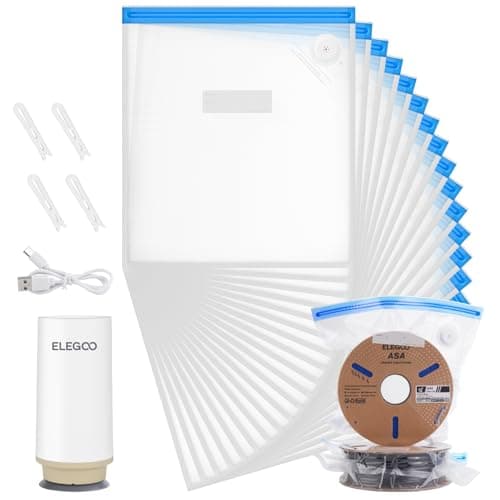
No. Filament has no expiry date, and no manufacturer publishes one — what it has is a humidity ceiling, and a spool kept under it stays usable for years. If you want one purchase to make that true, it is a box of vacuum bags with desiccant in them; that is the whole answer for most people.
How this page is funded. Buy links go to Amazon and we earn a commission on qualifying purchases at no extra cost to you. Commission never decides an order or a score, we accept no free products or sponsored placements, and every roundup names something to skip. Full disclosure.
The picks, ranked
The picks, ranked
#
Product
Best for
Score
Price
1
ELEGOO Filament Vacuum Storage BagsThe one purchase that actually stops the clock. A sealed spool with desiccant is the condition every published storage figure assumes.Sealed bag plus desiccant
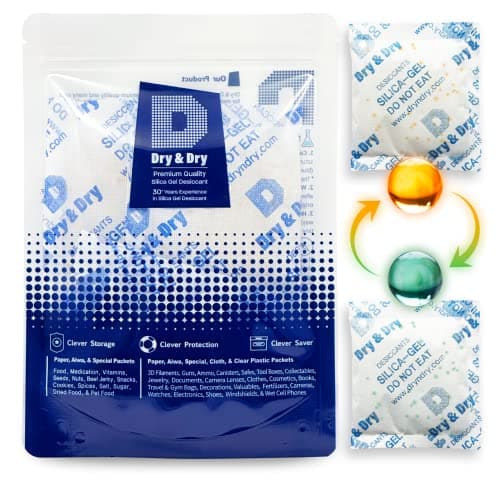
Indicating Silica Gel Desiccant PacketsPrusa's instruction is to replace or regenerate the gel once humidity passes your material's limit. Indicating gel is how you see that without a meter in every bag.Color-change indicating gel
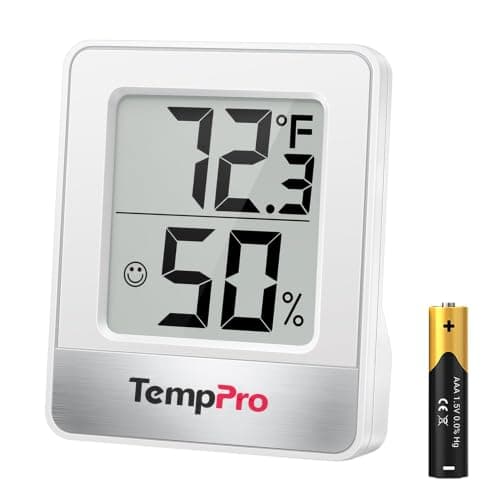
Digital HygrometerEvery figure on this page is a humidity percentage. Without a hygrometer you are guessing at the only variable that matters.Reads %RH in the box
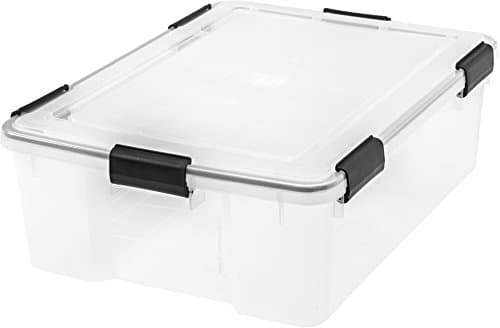
Airtight Weathertight Storage BoxCheaper per spool than bags once you pass about six spools, and you can put one large desiccant pack in with the lot.Gasketed, latching tub
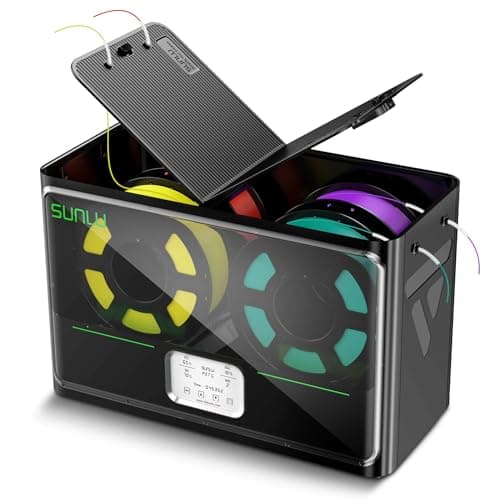
SUNLU FilaDryer S4Storage prevents; a dryer recovers. If a spool is already snapping or hissing, this is the fix, and then the bags stop it recurring.70 C, four spools
COSORI Food DehydratorA dehydrator is a drying appliance. It has no seal and no humidity sensor, so it cannot hold a spool below a published ceiling — it is the wrong tool for shelf life even though it is a reasonable tool for drying.No humidity readout, no sealSkip this
Maximum recommended relative humidity by filament type, as published for the Prusa Drybox. These are the numbers a hygrometer in your storage box has to beat. They are humidity ceilings, not dates. Figures from Prusa Research, retrieved 2026-10-30.
The answer, and why the question is shaped wrong
Nobody publishes an expiry date for 3D printing filament, and the reason is that there is nothing to put a date on. A spool of PLA is a thermoplastic wound onto a reel. Left sealed, dark and dry, it is the same material in three years that it was on the day it was wound.
What manufacturers publish instead is a humidity ceiling. Prusa give a maximum recommended relative humidity per material for storage, and the numbers are in the table above: below 30% for PLA, below 20% for PETG, TPU, PC and the soluble supports, and below 15% or even 10% as the ideal for ABS and ASA Prusa Research. That is the specification. Age is not.
What actually changes while a spool sits
Three things, in descending order of how often they are the problem.
1. Moisture, which is almost always the answer
Filament absorbs water from the air. How fast depends on the polymer and on the room: the drying tables every manufacturer publishes exist precisely because this happens to filament sitting on a shelf, not because of anything you did to it Prusa Research. Our drying and storage hub carries the figure that makes the case: a dried spool left in ordinary indoor air is back to being a problem in hours, not weeks.
This is why “is my two-year-old spool still good?” has no general answer. A two-year-old spool that never left its vacuum bag is fine. A two-month-old spool that sat open on a bench in a humid summer may not be.
2. Sunlight, which is rarer and worse
A spool stored where daylight falls on it is being bleached and, over a long enough exposure, degraded. There is no recovering a sun-bleached spool with a dryer. This is the one failure mode on this page that drying does not fix, and it is also the easiest to avoid: an opaque tub solves it completely.
3. The spool and the packaging, not the filament
Cardboard spools shed. Tape fails and a loose coil tangles into a figure-eight that will not feed. Neither is the filament aging; both end with a spool you cannot print. Rewinding is possible — see joiners and respoolers — but prevention is a latching tub.
Why your filament is brittle, which is the real question
Most people who ask whether filament expires are holding a spool that snaps when they bend it, or that snapped inside the extruder. That symptom is worth separating properly, because the three causes have three different fixes.
It snaps and prints badly — stringing, pops, rough surfaces. That combination is wet filament, and the six symptoms page separates it from a settings problem with one diagnostic question. Dry it to the published temperature for the material and it comes back.
It snaps but prints normally. Dry, brittle PLA that still lays down clean layers is usually a cheap or filled grade rather than a damaged one. Glow-in-the-dark, wood-filled and metal-filled compounds are brittle by formulation because the filler interrupts the polymer — that is not aging, and no dryer changes it.
It snaps and it has been in daylight. See above. This one is not recoverable.
Does a sealed, unopened spool go bad?
Practically, no. A factory spool arrives vacuum sealed with a desiccant sachet, and that is the same arrangement the storage guidance asks you to recreate. The failure cases are specific rather than general: a bag that was punctured in shipping, a sachet that was already spent when it was packed, or a spool stored somewhere hot enough to matter.
The honest caveat is that a desiccant sachet has a finite capacity and nobody tells you how much of it was used up before the spool reached you. If an unopened spool has been in a cupboard for two years, the sensible move is to check it rather than trust it — bend a hand-length off the end, and look at what wet filament looks like on the first print.
The storage system, in the order that pays
This ordering is the same one our how to store filament page argues for, and it is worth repeating here because the shelf-life question usually gets answered with the most expensive item first.
Vacuum bags with desiccant. The cheapest intervention and the one that does nearly all of the work. A sealed spool under its ceiling is the condition the published figures assume.
Indicating desiccant. Silica gel that changes color when it is saturated. Prusa’s instruction is to replace or regenerate the gel once the reading passes the material’s limit Prusa Research, which you cannot act on if you cannot see it.
A hygrometer. One meter in the box you open most often converts this entire topic from folklore into a number. Note that a freshly closed box takes up to about an hour for the reading to drop and settle Prusa Research, so do not panic at the first number you see.
An airtight tub, once you have more spools than bags are convenient for.
A dryer, last. It is a recovery tool, not a storage tool.
Which materials have the shortest patience
Read the ceiling column in the table as a ranking of how little margin you have. PETG, TPU, PC and the soluble supports are all held to below 20% Prusa Research, and PVA is the extreme case — it is a water-soluble polymer, so humid air is actively dissolving it. Our soluble support page treats the dryer as part of the purchase for that reason.
PLA is the forgiving end, with a stated short-term tolerance up to 40% Prusa Research, which is why a bench spool of PLA usually survives casual treatment and a bench spool of nylon does not. It is also why does PLA need drying has a more nuanced answer than most materials.
So: buy it in bulk, or not?
Buy in bulk, and store it properly. There is no shelf-life argument against ordering six spools of a color you use constantly — the argument against it is cash and shelf space, which we work through on buying filament in bulk. What there is an argument against is ordering six spools and leaving them in the shipping box with the bags slit open, because at that point the clock the published ceilings describe starts running on all six at once.
Every pick, in detail
01
ELEGOO Filament Vacuum Storage Bags
ELEGOO
Best for any spool you are not printing this week · 9.2/10 our fit score
The cheapest thing on this site that will measurably improve your print quality. Buy these before you buy a dryer.
Published specifications for ELEGOO Filament Vacuum Storage Bags
No. No manufacturer publishes an expiry date for filament, because there is nothing to date — what they publish is a maximum recommended storage humidity per material. A spool kept sealed with desiccant below that ceiling stays usable for years. A spool left open in a humid room degrades in weeks.
+ − How long does an unopened spool of filament last?
Indefinitely, in practice, if the vacuum seal held and the included desiccant was not already spent. The caveat is that nobody tells you how much of that sachet’s capacity was used up before the spool reached you, so an unopened spool that has sat for a couple of years is worth checking rather than trusting. Dry it if the first test print shows the usual wet-filament symptoms.
+ − Why is my PLA filament brittle and snapping?
Three different causes, with three different fixes. If it also strings, pops and prints rough, it is wet and drying fixes it. If it snaps but prints cleanly, it is probably a filled or budget grade that is brittle by formulation, and no dryer changes that. If it has been sitting where daylight reached it, it is degraded and not recoverable.
+ − What humidity should filament be stored at?
Below 30% relative humidity for PLA, ABS and ASA, and below 20% for PETG, TPU, PC, PVA and BVOH, with ABS and ASA ideally held below 15% and 10% respectively. Those are Prusa’s published figures for their own storage box and they are the numbers a hygrometer in your container has to beat.
+ − Will a dry box dry out wet filament?
No, and Prusa say so about their own product: the Drybox does not dry filament, and damp filament has to be dried first. A sealed box with desiccant keeps a dry spool dry. Recovering a wet one needs heat, which means a dryer or one of the alternatives on our how to dry filament page.