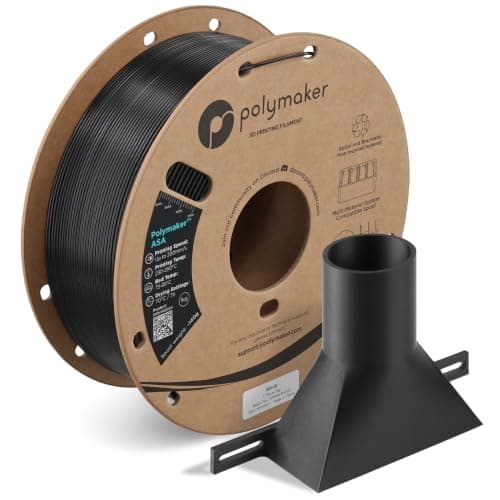
Two things destroy printed parts outdoors and neither is rain: heat and ultraviolet light. PETG handles the first well and the second poorly. ASA handles both, which is the reason it exists.
How this page is funded. Buy links go to Amazon and we earn a commission on qualifying purchases at no extra cost to you. Commission never decides an order or a score, we accept no free products or sponsored placements, and every roundup names something to skip. Full disclosure.
The picks, ranked
The picks, ranked
#
Product
Best for
Score
Price
1
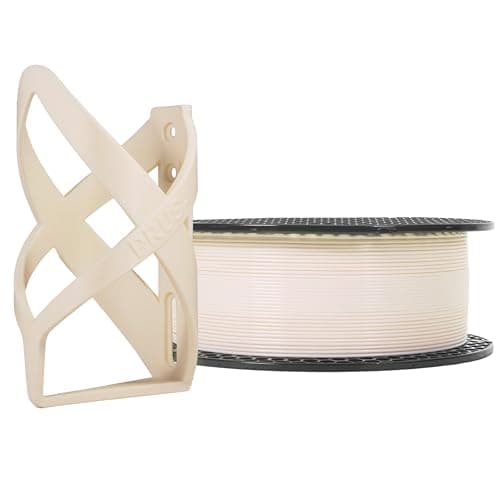
Polymaker PolyLite ASAThe right answer for anything staying outdoors. It is ABS that does not go yellow and chalky in sunlight.UV and chemical resistance, per Prusa
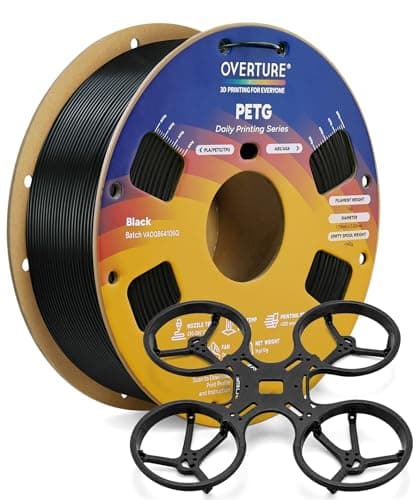
Overture PETGPrints on any machine with no enclosure. Good for a season, and good enough if the part is shaded or replaceable.215-270 C nozzle, no enclosure
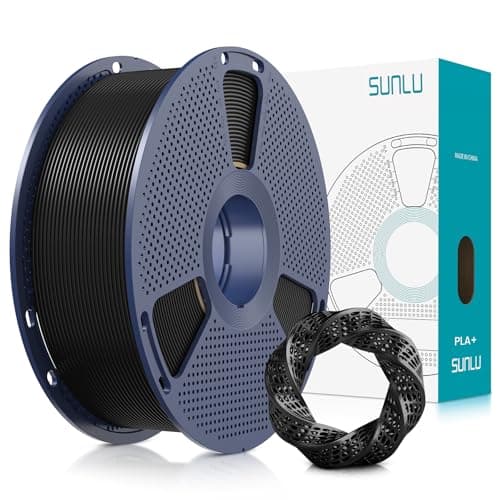
SUNLU PLA+PLA in direct sun sags from heat and goes chalky from UV. It is the most common outdoor 3D printing mistake.Softens at low temperatureSkip this
Live prices verified October 17, 2026. Scores are our own fit rating for the stated use, not a measurement and not a customer rating.
A weathered plastic part in direct sunlight outdoors.
What actually destroys an outdoor part
People ask which filament is waterproof, and water is the least of it. Three mechanisms account for essentially all outdoor failures.
Heat. A dark part in direct summer sun runs far hotter than the air around it. PLA softens first, and it does so at a temperature ordinary sunlight reaches on a dark surface.
Ultraviolet light. UV breaks polymer chains at the surface. The visible result is chalking, discoloration and a part that snaps where it used to flex. Nothing you coat it with stops UV reaching the surface indefinitely.
Thermal cycling. Day-night expansion and contraction works on the layer bonds. This is why an outdoor part often fails along a layer line months after it looked fine.
Why ASA is the answer
Prusa list ASA's noted properties as UV and chemical resistance Prusa Research. It is, functionally, ABS reformulated so that sunlight does not turn it yellow and brittle — which is exactly the failure that makes ABS a poor outdoor material despite its toughness.
The cost is printing difficulty. ASA's published window is 220 to 275 C at the nozzle and 90 to 110 C at the bed, with an enclosure recommended Prusa Research. It warps, it wants still air, and it produces fumes you want ventilated. That is a real barrier, and it is why the honest recommendation depends on your machine — see the ASA page for the full picture.
Where PETG is enough
PETG does not soften in the sun the way PLA does, and it prints on any machine without an enclosure. For a shaded part, a part you are willing to replace, or a part that only lives outside seasonally, it is the pragmatic answer.
Its weakness is UV. PETG is not UV-stabilized as standard, and a part in direct sun will get brittle at the surface over a year or so. If you are choosing between spending an evening learning to print ASA and reprinting a PETG part every couple of years, that is a legitimate trade and plenty of people should take the PETG side of it.
What about UV-stabilized PETG?
Some brands sell PETG with UV stabilizers added. Where a manufacturer publishes a specific claim we would cite it; we have not found one with a published, verifiable stabilization figure, so we are not going to characterize the category from marketing copy. If you find one with a real data sheet, that changes the calculus.
Designing for outdoors
Print more walls. Surface degradation eats into the part from outside. A four-wall part has more to lose before it matters.
Orient for the load. Thermal cycling attacks layer bonds, so a part whose load runs across layers fails sooner.
Avoid dark colors in direct sun if the material is heat-sensitive. Color changes surface temperature substantially.
Design for replacement where you can. A clipped-in part you can reprint in an hour is a better outdoor strategy than a permanent part in a difficult material.
Every pick, in detail
01
Polymaker PolyLite ASA
Polymaker
Parts that live outside permanently · 9.0/10 our fit score
The right answer for a part that lives outside. It is ABS that does not go yellow and chalky in sunlight.
Published specifications for Polymaker PolyLite ASA
UV resistance is the entire point and it is real — Prusa contrast it directly with ABS, whose outdoor parts "turn yellowish and more brittle over time"
Warps less and smells less than ABS at the same temperatures
What it does not
Needs an enclosure and a hot bed; this is not a material for an open printer in a cold room
More expensive per kilogram than the PETG that would do the job for many outdoor parts
Not as standard. PETG handles outdoor heat far better than PLA but it is not UV-stabilized, so a part in direct sun becomes brittle at the surface over a year or so. ASA is the material Prusa list for UV resistance.
+ − Can I use PLA outdoors at all?
Only for something temporary and shaded. PLA softens at a temperature that direct sun reaches on a dark surface, and UV makes it chalky and brittle. It is the most common outdoor 3D printing mistake.
+ − Do I need an enclosure to print ASA?
Prusa recommend one, and in practice large ASA parts warp badly without still air. You also want ventilation for the fumes. If you do not have an enclosure, PETG for a season is the more honest plan than ASA printed badly.