There is no standard behind the plus, so it means whatever each brand wants it to mean. In practice the grades sold under it share one property, and it is the one that fixes the most common PLA complaint.
How this page is funded. Buy links go to Amazon and we earn a commission on qualifying purchases at no extra cost to you. Commission never decides an order or a score, we accept no free products or sponsored placements, and every roundup names something to skip. Full disclosure.
The picks, ranked
The picks, ranked
#
Product
Best for
Score
Price
1
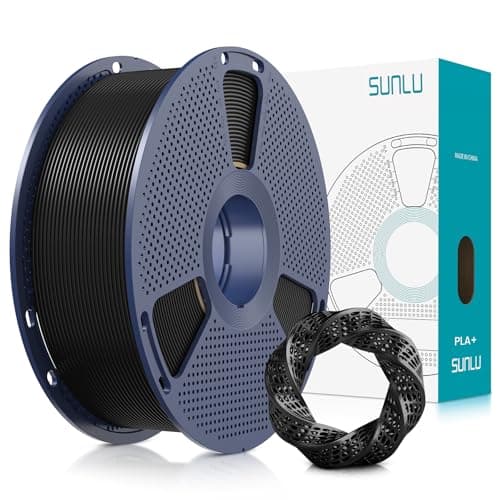
SUNLU PLA+Impact toughness at plain-PLA money. There is very little argument for buying plain PLA over this.PLA+ grade, published tolerance
Live prices verified October 17, 2026. Scores are our own fit rating for the stated use, not a measurement and not a customer rating.
Spools of PLA filament on a workshop shelf.
There is no standard
PLA+ is not a specification, a grade, or a certification. It is a name brands apply to a modified PLA compound, and different brands modify for different things. A page that tells you exactly what PLA+ is, across all brands, is telling you something nobody can verify.
What is verifiable is the pattern across the grades sold under it: the modification targets impact toughness. Parts survive being dropped where plain PLA cracks.
What genuinely changes
Impact resistance. Noticeably better. A dropped bracket survives.
Layer adhesion, generally somewhat better, which contributes to the same outcome.
Brittleness at thin cross sections. Thin features snap less readily.
What does not change
Heat resistance. A PLA+ part sags at the same temperature a PLA part does. This is PLA's hard limit and no grade fixes it — see heat-resistant filament.
UV stability. Still fails outdoors.
The printing window. Prusa's published 185 to 235 C nozzle and 50 to 60 C bed for PLA covers it unchanged Prusa Research. No new hardware, no new settings, no enclosure.
Stiffness. Broadly comparable. Toughening a polymer sometimes trades a little rigidity, which is a fair price for the impact gain.
The price argument
The reason this comparison resolves so cleanly is that PLA+ grades from the budget brands cost about what plain PLA costs. When the better option is the same price, there is not much to weigh.
Where plain PLA still wins is color range and stock consistency — some brands offer a much wider palette in their plain line, and matching a color you printed months ago is a real problem that only stock consistency solves. That is the actual reason to buy plain PLA.
Test it yourself in ten minutes
Print the same small hook or clip in both, and load each to failure by hand. Plain PLA snaps abruptly; the toughened grade bends further before it goes. That single comparison tells you more about your own use case than any published figure would, and it costs almost nothing.
When PLA+ is not enough
If parts still break, the next step is PETG rather than a different PLA — Prusa list impact resistance as PETG's noted property Prusa Research. And before changing material at all, check orientation and wall count, which affect strength more than either choice here: see how strong PLA is.
Every pick, in detail
01
SUNLU PLA+
SUNLU
The toughened option · 9.1/10 our fit score
The cheapest filament we would load without flinching, and the reason most people never need to spend more.
No. It is a brand name for a modified PLA compound and different brands modify for different things. The consistent pattern is that it targets impact toughness.
+ − Does PLA+ resist heat better?
No. Heat deflection is essentially unchanged and a PLA+ part sags at the same temperature plain PLA does. Heat is PLA's hard limit regardless of grade.
+ − Should I always buy PLA+ over PLA?
Usually, since budget PLA+ costs about what plain PLA costs. The exception is color: some plain lines have a much wider palette and better stock consistency, which matters if you need to match a color later.