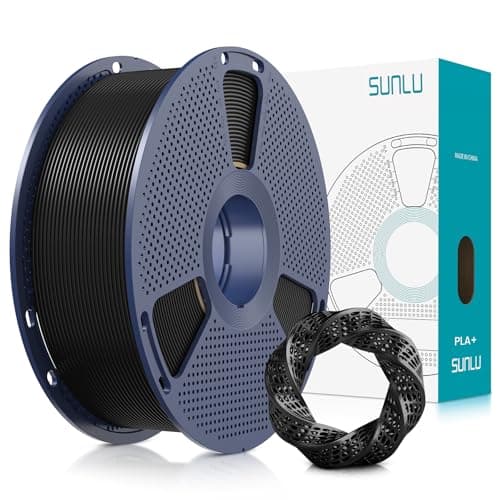
SUNLU PLA+ is the spool that made premium PLA hard to justify for most printing. It is a toughened grade at a plain-PLA price, and the honest criticisms of it are about packaging and color consistency rather than about how it prints.
How this page is funded. Buy links go to Amazon and we earn a commission on qualifying purchases at no extra cost to you. Commission never decides an order or a score, we accept no free products or sponsored placements, and every roundup names something to skip. Full disclosure.
The picks, ranked
The picks, ranked
#
Product
Best for
Score
Price
1
SUNLU PLA+The default recommendation on this site, and the spool the rest of the PLA ledger is measured against.1.75 mm +/- 0.02 mm published
Live prices verified October 17, 2026. Scores are our own fit rating for the stated use, not a measurement and not a customer rating.
Stacked spools of PLA filament on a workshop shelf.
What the plus actually means
There is no standard behind PLA+. It is a brand's word for a modified PLA compound, and different brands modify for different things. In SUNLU's case the modification targets impact toughness: parts survive being dropped where plain PLA cracks. This is the single most noticeable difference in day-to-day printing, because most PLA parts that fail in the real world fail by impact rather than by load.
What the plus does not do is worth stating too. It does not raise the heat-deflection temperature — a PLA+ part deforms in a hot car exactly as a PLA part does. It does not change the printing window; Prusa's published PLA range of 185 to 235 C at the nozzle Prusa Research covers it without adjustment. And it does not make the material weatherproof.
How it prints
Unremarkably, which is the highest compliment available in PLA. It runs in the middle of the standard PLA window, it does not need a heated chamber, it does not warp on a bare bed at 60 C, and it does not string noticeably at a sane retraction setting. A stock profile for generic PLA will produce a usable print on the first attempt in most slicers.
The one calibration worth doing on a new SUNLU spool is a flow test. Budget filament holds diameter less tightly than premium filament by definition of what the premium buys, and flow calibration absorbs the difference cleanly.
Where it disappoints
Color consistency between batches. If you are printing a large multi-spool object in one color, buy all the spools at once. Reordering the same color months later can produce a visible seam.
Spool material varies. Some colors ship on cardboard, which sheds dust into the extruder drive gear over time. This is worth knowing if you run an enclosed multi-material system where that dust has more places to settle.
No published data sheet. There is a stated diameter tolerance but not the sort of full technical document Polymaker or Prusa publish. If you need a number to make an engineering decision, this is not the spool to make it from.
Who should buy something else
People who need repeatability across many spools
If your prints span multiple spools and small variation compounds, Polymaker PolyLite is the step up worth making. You are paying for the next spool behaving like this one.
People running long, expensive prints
Prusament publishes a per-spool measurement record. On a 30-hour print, that record is insurance and the premium is cheap relative to the failure it prevents.
People who want a matte finish
PolyTerra hides layer lines properly and costs about what this does. See matte and silk PLA.
Every pick, in detail
01
SUNLU PLA+
SUNLU
General printing · 9.1/10 our fit score
The cheapest filament we would load without flinching, and the reason most people never need to spend more.
Tougher rather than stronger, and the distinction matters. It resists impact better, so parts survive being dropped. Tensile strength and heat resistance are essentially unchanged from plain PLA.
+ − Does SUNLU PLA+ need drying?
A fresh vacuum-sealed spool does not. A spool that has been open in a humid room for months might. Prusa publish 45 C for six hours as the PLA drying figure Prusa Research; SUNLU publish their own dryer guidance in the same broad range SUNLU.