JAYO's pitch is ten percent more filament for the same money, with a published dimensional tolerance that matches the brands people already trust. The pitch holds. What is missing is any document behind the strength claims.
How this page is funded. Buy links go to Amazon and we earn a commission on qualifying purchases at no extra cost to you. Commission never decides an order or a score, we accept no free products or sponsored placements, and every roundup names something to skip. Full disclosure.
The picks, ranked
The picks, ranked
#
Product
Best for
Score
Price
1
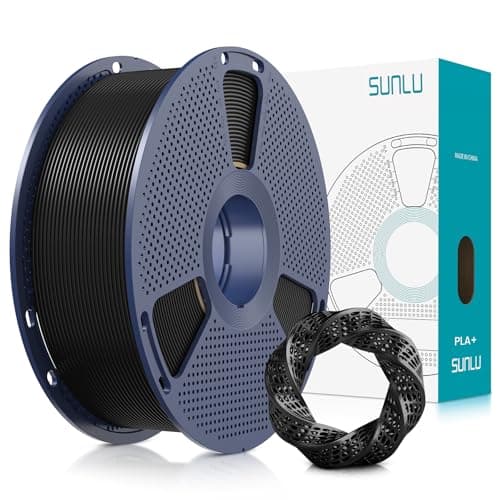
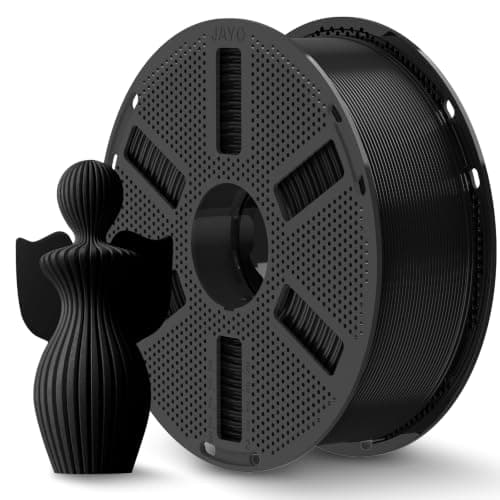
JAYO PLA+The reason to buy JAYO is arithmetic: a tenth more filament per spool at a budget-spool price, with the tolerance figure written down.1.1 kg spool, +/- 0.02 mm published
SUNLU PLA+The default budget PLA+ on this site. Buy JAYO when the price per kilogram beats it; buy this when it does not.1 kg spool, +/- 0.02 mm published
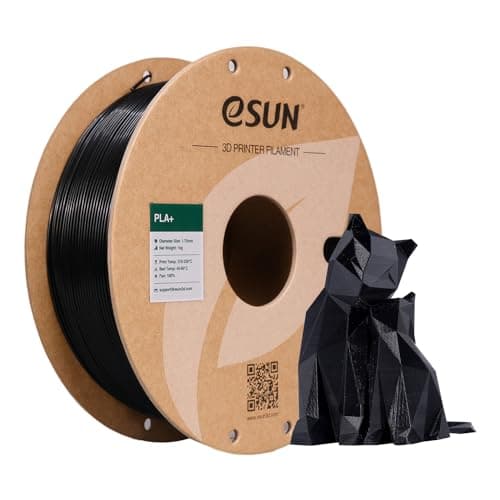
eSUN PLA+Longer track record and wider distribution than JAYO, at a looser published tolerance. Price is the sensible tiebreak.PLA+ grade, +/- 0.03 mm published
Live prices verified October 21, 2026. Scores are our own fit rating for the stated use, not a measurement and not a customer rating.
Spools of PLA filament stacked on a workshop shelf.
What JAYO actually sells
JAYO is a budget filament brand that competes on quantity rather than on documentation. Its range covers PLA, PLA+ and PETG on 1.1 kg spools, plus refill coils for reusable spools, and the store publishes a dimensional accuracy figure of +/- 0.02 mm across the line JAYO. That tolerance is the same number SUNLU and Overture commit to, and it is a number many budget brands decline to print at all.
What JAYO does not publish is a technical data sheet. There is no document giving a glass transition temperature, a tensile figure, a test method or a recommended drying schedule for its own product. The specification is a product listing, which is a different thing, and the difference matters the moment a print behaves oddly and you want to know what the material is supposed to do.
The 1.1 kg spool is the actual product
Filament is compared per kilogram, and the standard spool is 1 kg, so a 1.1 kg spool at the same price is a ten percent discount expressed as weight instead of as price. That is a real saving on a material bought in quantity, and it is invisible if you compare sticker prices instead of dividing by weight. The arithmetic, and the three things that make per-kilogram misleading, are on filament price per kilogram.
The refill coils are the other half of the cost story. A refill is the same filament without the plastic core, wound to fit a spool you already own, and JAYO sell them for PLA, PLA+ and PETG on the same 1.1 kg format JAYO. If you own reusable spools — from a Bambu Lab AMS setup or from any brand that sells them — the refill is cheaper per kilogram and produces less waste. If you do not, buy the spooled version; rewinding a loose coil by hand is how tangles happen.
The refill workflow — which spools a coil fits, how to wind one without tangling it, and whether a respooler is worth owning — is covered on filament joiners, refills and respoolers.
What the plus means, which is nothing standard
PLA+ is not a specification. It is each brand's word for a modified PLA compound, and different brands modify for different things — the full explanation is on PLA versus PLA+. JAYO's marketing describes its PLA+ as many times stronger than ordinary PLA. There is no published test method behind that number, no standard named, and no data sheet to check it against, so we treat it as advertising copy rather than as a figure.
The reasonable expectation for any budget PLA+ is what the category generally delivers: better impact toughness than plain PLA, no change to the printing window, and no change at all to heat resistance. Prusa are explicit that PLA gets soft and deforms above about 60 C Prusa Research, and no plus grade from any brand alters that.
How it prints
Like budget PLA+ from anyone else. It sits inside Prusa's published PLA window of 185 to 235 C at the nozzle with a 50 to 60 C bed Prusa Research, needs no enclosure, and a generic PLA profile will produce a usable first print in most slicers.
Two calibrations are worth the twenty minutes on any budget spool, this one included:
Flow. Budget filament holds diameter less tightly than premium filament — that is most of what the premium buys — and a flow calibration absorbs the difference in one step.
First layer. A 1.1 kg spool is physically larger and heavier than a 1 kg spool. On a top-mounted spool holder, check that the extra mass is not dragging on the extruder before you blame the filament for under-extrusion.
Storage guidance is the same as for any PLA: sealed with desiccant between prints. Prusa publish 45 C for 6 hours as the drying schedule for PLA if a spool has already taken up moisture Prusa Research, and the practical detail is that JAYO's own spools are unremarkable plastic, so they tolerate that temperature without deforming.
Where it disappoints
No technical data sheet. Every premium brand and several budget ones publish one. JAYO publishes listings. For a display print this costs you nothing; for a part with a requirement, it means there is nothing to design against.
Thinner distribution. SUNLU, Overture and eSUN are stocked deeply enough that a reorder is usually the same formulation. A smaller brand is more likely to hand you a different batch, and color-to-color variation is where budget filament varies most.
Claims that cannot be checked. A strength multiple with no test behind it is not a reason to buy, and treating it as one is how people end up disappointed by a material that was always going to behave like PLA.
Who should buy it
Buy JAYO PLA+ if you print a lot of PLA, you buy on cost per kilogram, and the parts are ordinary: prototypes, enclosures, display models, organizers. On that job it is exactly as good as the budget PLA+ it competes with and it costs less per kilogram when the spool weight is counted.
Buy something else if the part has a requirement you would want to look up later, if you need repeatability across many spools of one color, or if you are choosing a first spool and would rather learn on the material with the deepest pile of community profiles behind it. The full ranking is on best PLA filament brands.
Every pick, in detail
01
JAYO PLA+
JAYO
Cost per kilogram · 8.3/10 our fit score
A budget PLA+ that ships 1.1 kg instead of 1 kg and publishes the same tolerance the established budget brands do. The extra 100 grams is the whole argument.
For ordinary PLA printing, yes. It publishes a +/- 0.02 mm dimensional tolerance, the same figure SUNLU and Overture commit to, and it ships 1.1 kg spools rather than 1 kg. What it does not publish is a technical data sheet, so there is nothing to check its strength claims against.
+ − Is JAYO PLA+ stronger than normal PLA?
Expect what any PLA+ delivers: better impact toughness than plain PLA and no change to heat resistance. The specific strength multiples in JAYO's marketing have no published test method behind them, so they are advertising rather than data.
+ − Does JAYO filament work in a Bambu Lab AMS?
The filament itself prints like any PLA. The relevant question is the spool, not the plastic: JAYO sell refill coils sized for reusable spools, which is the format an AMS user wants, and the spooled version has to fit the AMS bay like any third-party spool. Set the material manually, because only the printer maker's own spools carry the tag the machine reads.
+ − Is a 1.1 kg spool really more filament?
Yes — it is 100 grams more than the 1 kg standard, which is ten percent. It only counts as a saving if you compare on price per kilogram, and it is worth checking that the larger spool physically fits your printer's holder before ordering several.