PLA has the highest stiffness of the common printing materials and the worst impact resistance. Both facts are true at once, which is why arguments about whether PLA is strong go in circles.
How this page is funded. Buy links go to Amazon and we earn a commission on qualifying purchases at no extra cost to you. Commission never decides an order or a score, we accept no free products or sponsored placements, and every roundup names something to skip. Full disclosure.
The picks, ranked
The picks, ranked
#
Product
Best for
Score
Price
1
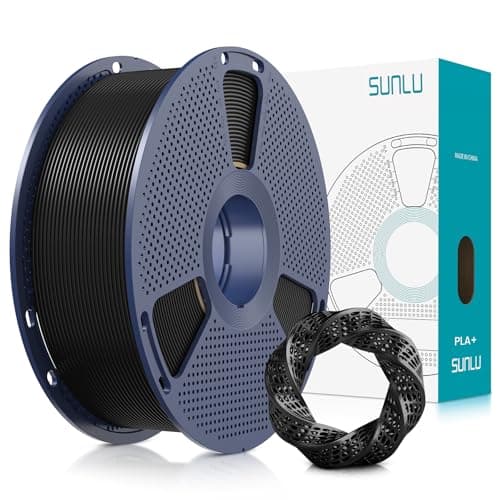
SUNLU PLA+The cheapest fix for PLA's real weakness. It does not change stiffness or heat resistance, but dropped parts stop snapping.Toughened PLA+ compound
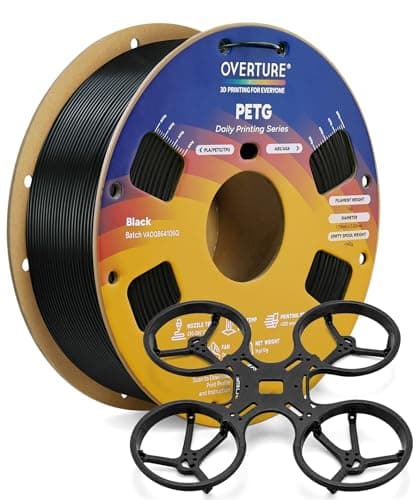
Overture PETGPrusa list impact resistance as PETG's headline property. If parts are breaking, this is the material change to make.Impact resistance, per Prusa
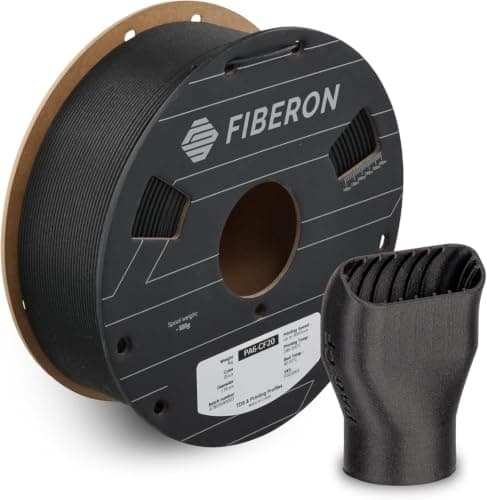
Polymaker Fiberon PA6-CF20A genuine engineering material, with genuine requirements. Only worth it when the part is load-bearing and failure is expensive.240-285 C nozzle, enclosure recommended
Live prices verified October 16, 2026. Scores are our own fit rating for the stated use, not a measurement and not a customer rating.
A broken plastic part after a stress test.
Two different questions called strength
The word covers at least four separate properties, and PLA scores very differently on each. This is the whole reason the question is confusing.
Stiffness. How much a part deflects under load before it does anything permanent. PLA is the stiffest of the common materials, noticeably stiffer than PETG or ABS.
Tensile strength. How much pull it takes to break it. PLA does well here — comparable to or better than ABS.
Impact resistance. How it responds to a sudden shock. PLA is the worst of the common materials by a wide margin. It shatters rather than deforming.
Heat deflection. The temperature at which it starts to sag under its own weight. PLA is the worst here too, and it is not close.
The property that matters more than any of them
A printed part is not the material. It is a stack of extruded layers bonded to each other, and the bond between layers is weaker than the plastic within a layer. This is true of every fused-filament material, and it means the same part can be twice as strong in one direction as another purely because of how it was oriented on the plate.
This matters more than brand choice, more than infill percentage, and usually more than material choice. A PETG part printed in the wrong orientation will break more easily than a PLA part printed in the right one. If a part keeps failing, look at where the fracture is before you look at what it is made of: a clean break along a layer line is an orientation problem, not a material problem.
The fixes, in order of cost
Reorient the part so the load runs along layers rather than across them. Free.
Add walls, not infill. Perimeters carry far more load than infill does. Going from two walls to four does more for strength than going from 20 to 50 percent infill, and costs less time.
Print hotter. Layer adhesion improves with temperature. Within the published window of 185 to 235 C Prusa Research, the top end bonds better than the bottom.
Switch to PLA+. A toughened grade at the same price fixes the impact weakness without changing anything else.
Switch material. PETG for impact, ASA for outdoors and heat, nylon or a carbon composite for genuine mechanical duty.
The infill myth
Infill is the setting people reach for first and it is rarely the right lever. Beyond about 40 percent, additional infill adds print time and material for very little strength. Perimeters are where the strength lives, because a part in bending loads its outer surfaces hardest and those surfaces are walls, not infill. If you are printing at 80 percent infill to make parts stronger, you are paying twice as much material for a result four walls would have given you.
When to stop using PLA
Stop when the part takes impact, when it lives above about 50 C, when it lives outdoors, or when failure has a real cost. The upgrade path is set out material by material in the master material ledger, and the two comparisons most people need are PLA versus PETG and PLA versus ABS.
Every pick, in detail
01
SUNLU PLA+
SUNLU
Tougher PLA at the same price · 9.0/10 our fit score
The cheapest filament we would load without flinching, and the reason most people never need to spend more.
It is stiffer and comparable in tensile strength. PETG is far better under impact, which is the failure mode most printed parts actually experience. Prusa list impact resistance as PETG's noted property and low warping as PLA's.
+ − Does more infill make a PLA part stronger?
Much less than people expect. Beyond roughly 40 percent, extra infill adds time and material for little gain. Adding perimeters is the more effective change, because a part in bending loads its outer walls hardest.
+ − Why did my PLA part snap along a line?
Because it broke along a layer boundary, which is the weakest direction in any fused-filament print. That is an orientation problem rather than a material problem, and reorienting the part on the plate usually fixes it without changing filament.