A printed gear fails in one of two ways: the teeth wear round, or a tooth shears along a layer line. Material choice addresses the first and print orientation addresses the second, and orientation matters more.
How this page is funded. Buy links go to Amazon and we earn a commission on qualifying purchases at no extra cost to you. Commission never decides an order or a score, we accept no free products or sponsored placements, and every roundup names something to skip. Full disclosure.
The picks, ranked
The picks, ranked
#
Product
Best for
Score
Price
1
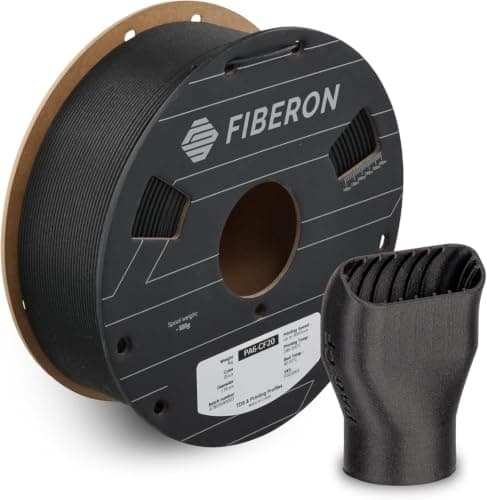
Polymaker Fiberon PA6-CF20Nylon slides against itself and against metal better than anything else here, which is the property a gear needs.Carbon-filled nylon, low friction
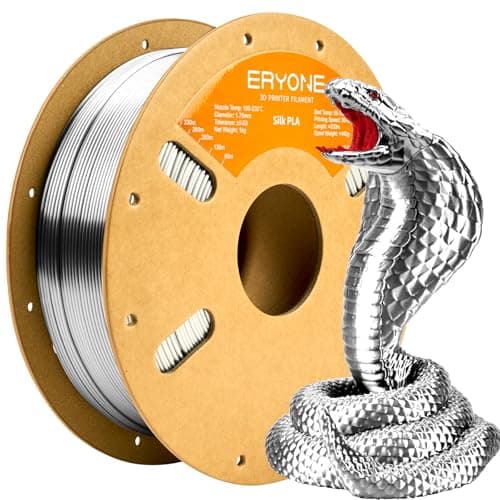
ERYONE Silk PLASilk PLA has worse layer adhesion than plain PLA, and a gear tooth is a cantilever loaded exactly across the layers.Reduced layer adhesionSkip this
Live prices verified October 17, 2026. Scores are our own fit rating for the stated use, not a measurement and not a customer rating.
A dark printed mechanical part on a workbench.
The two failure modes
Tooth shear
A gear tooth is a small cantilever, and in a printed gear laid flat on the plate the load runs across the layer boundaries — the weakest direction in any fused-filament part. This is why a PLA gear can shear teeth under a load that would not trouble the same material in a solid block.
The fix is not primarily material. It is orientation, tooth geometry and wall count. A gear printed flat with three perimeters has teeth made almost entirely of wall rather than infill, which is dramatically stronger than the same gear at two perimeters and 20 percent infill.
Tooth wear
The slower failure: teeth gradually round off from sliding contact, backlash increases, and eventually the gear skips. This one is a material property, and it is where nylon earns its place.
Why nylon for gears
Nylon has a low coefficient of friction against itself and against metal, and it is tough enough to deform slightly rather than chipping under shock load. Both matter in a gear: the low friction reduces the wear rate directly, and the toughness means a momentary jam does not shatter a tooth.
It is also self-lubricating to a useful degree, which is why nylon is used for gears in manufactured products, not just printed ones.
The cost is nylon's moisture sensitivity. Prusa publish drying below 90 C for polyamide Prusa Research and a wet nylon gear is both weaker and dimensionally off. This is not a material you print from a spool that has been open on a shelf — see the nylon page.
Does carbon fill help a gear?
Yes, in a specific way. Carbon-filled nylon is stiffer and more dimensionally stable, which keeps tooth geometry accurate under load and reduces backlash. It does not make the polymer more wear resistant on its own, and it requires a hardened nozzle E3D.
For a gear that carries load and must stay accurate, carbon-filled nylon is the best combination available on a consumer machine.
Design rules that matter more than material
More perimeters, less infill. Four walls makes gear teeth almost entirely solid wall. This is the single highest-value change.
Print the gear flat, axis vertical. Printing it on edge puts the layer boundaries across every tooth in the worst possible orientation.
Increase the module — bigger teeth — rather than adding more small ones. Printed small teeth are close to the resolution limit and lose accuracy.
Add clearance. Printed gears need more backlash than machined ones. A pair designed with zero clearance will bind.
Do not mix hard against hard where you can avoid it. A nylon gear running against a metal or harder-plastic gear wears better than two identical printed gears rubbing.
When PETG is enough
For hand-turned mechanisms, low-speed gears, and anything that runs intermittently under light load, PETG is a reasonable answer that needs no dryer and no enclosure. It wears faster than nylon under continuous running, but plenty of printed gears never run continuously.
PLA works for display mechanisms and prototypes and is a poor choice for anything that actually turns under load — see how strong PLA is for why stiffness and toughness diverge here.
Every pick, in detail
01
Polymaker Fiberon PA6-CF20
Polymaker
Gears that actually run · 8.8/10 our fit score
A genuine engineering material with genuine engineering requirements: a hardened nozzle, an enclosure, and a dryer you actually use.
Published specifications for Polymaker Fiberon PA6-CF20
Nylon, and carbon-filled nylon if the gear must stay dimensionally accurate under load. Nylon's low friction against itself and against metal is the property that determines wear rate.
+ − Why did my printed gear lose a tooth?
Almost certainly orientation and wall count rather than material. A gear tooth is a cantilever loaded across the layer boundaries, so printing flat with four perimeters makes the teeth mostly solid wall and dramatically stronger.
+ − Can I print gears in PLA?
For display mechanisms and prototypes, yes. For anything running under load, no — PLA is stiff but brittle, and a gear tooth is exactly the geometry that punishes brittleness.