Diameter decides three things: how tall a layer can be, how fast plastic can leave the hotend, and how small a feature can exist at all. Prusa publish the rule that governs the first one, and it is the one most people never apply.
How this page is funded. Buy links go to Amazon and we earn a commission on qualifying purchases at no extra cost to you. Commission never decides an order or a score, we accept no free products or sponsored placements, and every roundup names something to skip. Full disclosure.
The picks, ranked
The picks, ranked
#
Product
Best for
Score
Price
1
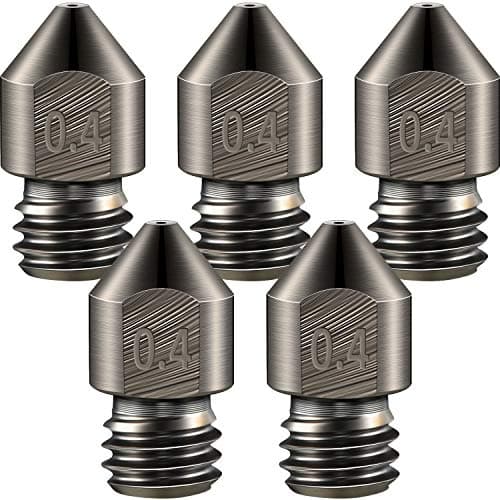
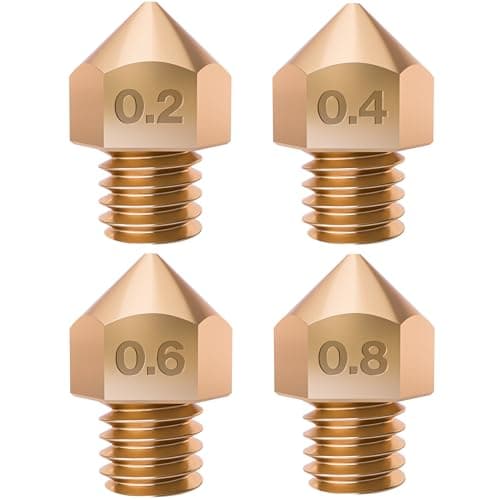
Brass Nozzle AssortmentThe whole point of this page is that diameter is a choice per job. A set costs less than one premium nozzle and makes the choice available.Typically 0.2 / 0.4 / 0.6 / 0.8 mm
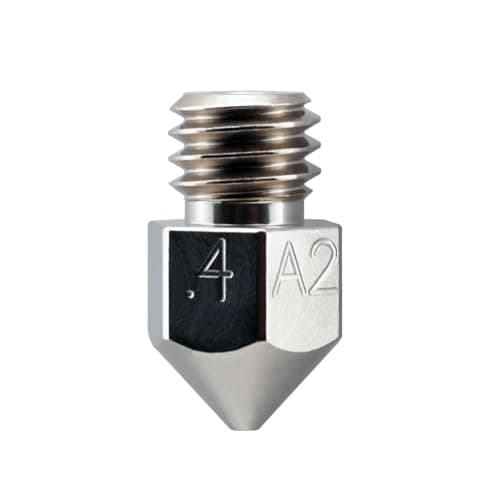
Micro Swiss Plated A2 Hardened Steel NozzleIf one nozzle stays in the machine most of the time, this is the one to make it. The plating keeps sticky material off the tip.Plated A2 hardened steel
Hardened Steel NozzleDiameter does not protect you from abrasion. Carbon fill wears a 0.6 mm brass nozzle exactly as it wears a 0.4 mm one, just less visibly at first.Hardened steel, abrasion resistant
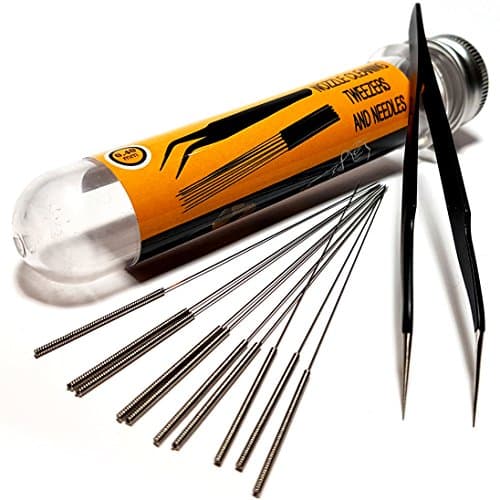
Nozzle Cleaning Needle KitMost under-extrusion blamed on a small nozzle is a partial clog. Two dollars and a minute before any purchase.Assorted needles, 0.2-0.6 mm
Live prices verified October 21, 2026. Scores are our own fit rating for the stated use, not a measurement and not a customer rating.
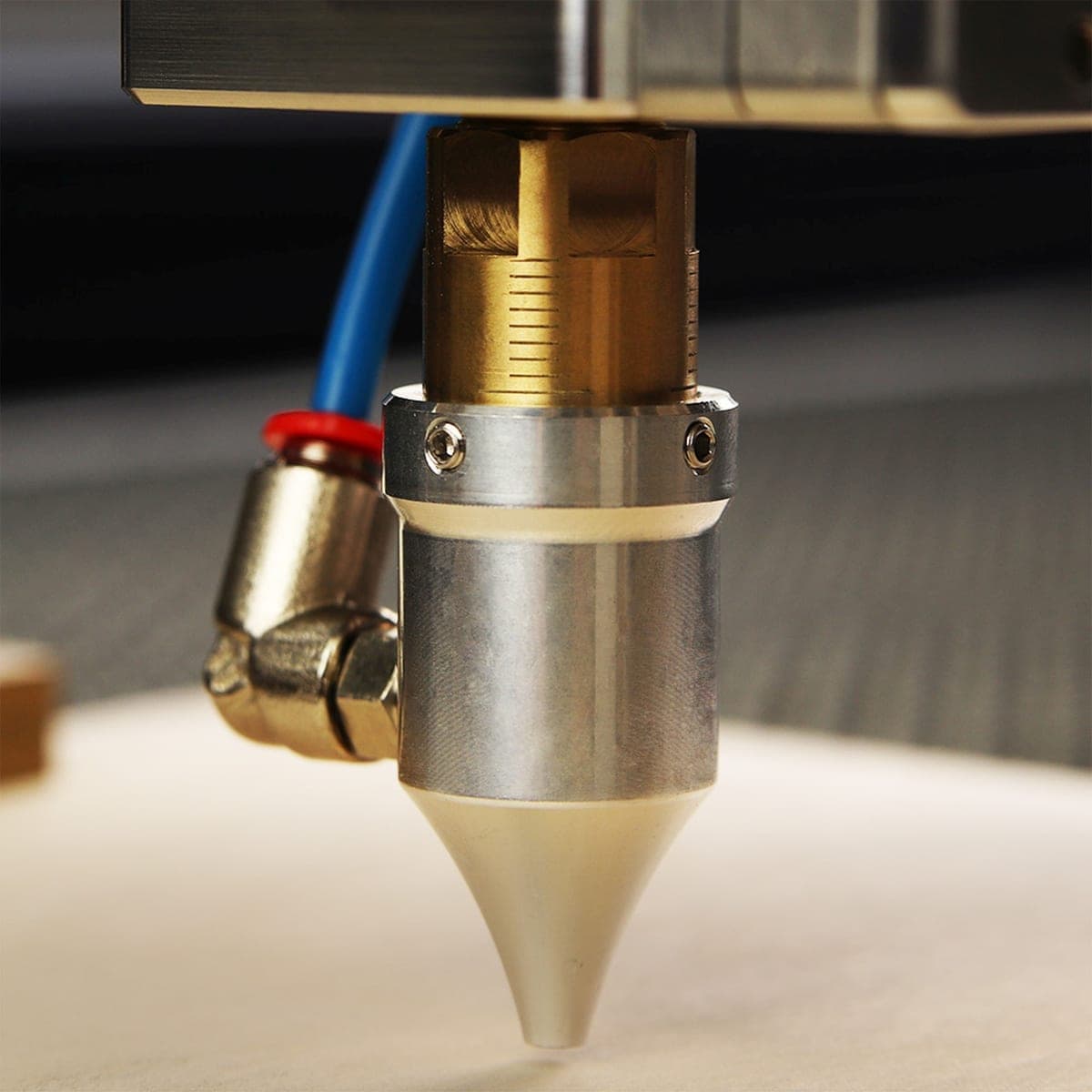
Close crop of a 3D printer hotend and the tip of its nozzle.
What the diameter actually changes
A nozzle is an orifice. Changing its diameter changes four things at once, and only one of them is the obvious one.
Maximum layer height. Prusa publish the rule plainly: layer height should stay below 80 percent of the nozzle diameter, so the ceiling on a 0.4 mm nozzle is about 0.32 mm Prusa Research. A bigger nozzle is what makes taller layers possible at all.
Flow ceiling. A wider orifice passes more plastic per second at the same pressure. This, combined with taller layers, is where the speed comes from — not from the printer moving faster.
Horizontal detail. This is the part people mix up. Prusa are explicit that layer height changes only vertical resolution, and that if you want more resolution in the XY plane, the nozzle diameter is what you change Prusa Research. A 0.4 mm nozzle cannot draw a 0.3 mm feature no matter how thin the layers are.
Strength, slightly. Fewer, fatter extrusions mean fewer internal boundaries in a wall of the same thickness, and usually a modest gain in part toughness for the same print time.
The four common sizes, and what each is for
0.2 mm — small objects only
Genuine fine detail, and a print time that grows accordingly. It earns its place on miniature-scale work a few centimeters across and is a poor choice for anything larger, because the time cost scales with volume while the visible benefit does not. It also clogs more readily than any other size, which makes filament cleanliness and drying non-negotiable.
0.4 mm — the default, for good reasons
Every stock profile, every community setting and every troubleshooting post assumes 0.4 mm. It sits at a genuine optimum: layer heights from 0.10 mm up to about 0.32 mm Prusa Research, enough detail for most models, and enough flow for most parts. If you own one nozzle, own this one.
0.6 mm — the upgrade most functional printers should make
The best speed-to-loss trade available. Layer heights up to roughly 0.48 mm, wider extrusions that fill a wall in fewer passes, and a detail loss that simply does not show on brackets, enclosures, organizers and jigs. For anyone printing functional parts rather than models, this is the single change that most reduces time spent waiting.
0.8 mm — drafts, big parts and vase mode
Enormous flow, layer heights up to about 0.64 mm, and a surface that looks like it was extruded rather than printed. Right for large planters, prototype massing models and single-wall vase-mode prints. Wrong for anything with a hole under about 3 mm or a feature you care about.
The arithmetic to run before you slice
Applying Prusa's 80 percent ceiling Prusa Research to the common sizes gives the maximum layer height for each:
0.2 mm nozzle: up to about 0.16 mm.
0.4 mm nozzle: up to about 0.32 mm.
0.6 mm nozzle: up to about 0.48 mm.
0.8 mm nozzle: up to about 0.64 mm.
At the other end, Prusa recommend against going below 0.10 mm, on the grounds that the quality improvement from 0.05 or 0.07 mm layers is small next to the print time it costs Prusa Research. That bracket — 0.10 mm to 80 percent of your nozzle — is the whole usable range, and most printing should happen in the middle of it.
Why a bigger nozzle is not free speed
Doubling the extrusion cross-section means the hotend has to melt twice as much plastic per second. Three consequences follow, and all three are printer problems rather than nozzle problems.
You will need more heat. Running near the top of a material's published range is normal with a large nozzle — for PETG that is the upper end of 215 to 270 C Prusa Research. A hotend that cannot keep up under-extrudes and the print looks starved.
Cooling has to keep up too. More hot plastic per second on a small part means it does not have time to solidify. Small models printed with a 0.8 mm nozzle slump.
Small features vanish. The slicer cannot produce a wall thinner than one extrusion. Text, thin ribs and small holes silently disappear or fuse shut, which is the most common surprise after a nozzle change.
Diameter interacts with the material
Two interactions matter enough to plan around.
Filled filaments want a larger orifice. Chopped carbon or glass fibers are physical particles, and a narrow bore is easier for them to bridge. A 0.6 mm nozzle is a far more comfortable home for composite filament than a 0.4 mm one — and it must still be hardened, because the fibers wear brass measurably E3D. The full case is on carbon fiber filament.
Flexible filament prefers a shorter, wider path. TPU pushed through a 0.2 mm orifice needs pressure that a soft filament transmits badly. If flexible printing is the goal, 0.4 mm is the smallest sensible size — see best TPU filament.
Nozzle material and nozzle diameter are separate decisions and both have to be made. Which material to buy, and why brass is still right for unfilled filament, is on best 3D printer nozzle.
After you change it, tell the software
A nozzle swap that is not declared produces baffling results, because the slicer keeps computing extrusion for the old diameter.
Set the diameter in the slicer's printer profile, not just in the print settings.
Set it in the printer's firmware too if your machine tracks it, so that any on-printer flow compensation matches.
Re-run first layer calibration. A different nozzle sits at a slightly different height and lays a different width.
Check the maximum layer height in the profile. A 0.6 mm nozzle with a 0.2 mm layer height set for the old nozzle is slower than the 0.4 mm it replaced, which is how people conclude the upgrade did nothing.
A worn nozzle looks like the wrong size
A nozzle that has been printing abrasive filament grows: the bore widens, extrusion widths drift, and dimensional accuracy goes with them. The symptom is a print that is subtly wrong rather than one that fails, which is why it goes undiagnosed for months. If your 0.4 mm nozzle has been running filled filament, measure before you blame the profile — the diagnosis is on the nozzle wear guide.
Diameter also decides whether a filled filament prints at all. Wood fiber bridges a 0.4 mm orifice far more readily than it bridges a 0.6 mm one, which is most of why that category has a clogging reputation — see best wood filament.
Every pick, in detail
01
Brass Nozzle Assortment
Generic MK8
Owning more than one diameter · 8.8/10 our fit score
The right nozzle for everything that is not abrasive, and the cheapest way to own a 0.6 mm for draft prints.
Published specifications for Brass Nozzle Assortment
Sizes
Typically 0.2 / 0.4 / 0.6 / 0.8 mm
Thermal conductivity
Brass conducts heat better than steel
What it does well
Brass is the best heat conductor of the common nozzle materials, which matters at high flow
A 0.6 mm nozzle roughly halves print time on large functional parts
What it does not
Wears fast on any filled filament — E3D document exactly this failure
Quality varies enormously between no-name sets; a badly finished bore causes inconsistent extrusion
Any filled filament, any size · 8.0/10 our fit score
The five-dollar part that stops abrasive filament from quietly widening your nozzle mid-print. Buy one before your first carbon fiber spool, not after.
Published specifications for Hardened Steel Nozzle
Common size
0.4 mm
Required for
Carbon fiber, glass filled, glow in the dark, metal filledE3D
Trade-off
Lower thermal conductivity than brass
What it does well
E3D document substantial wear on a brand new brass nozzle after only 250 g of carbon-fiber-filled filament
Cheap enough to keep a spare in the drawer
What it does not
Conducts heat worse than brass, so very high flow rates need a few degrees more
Hardened steel tempers and softens at extreme temperatures — E3D make this point explicitly
0.4 mm for general printing, 0.6 mm for functional parts where speed matters more than fine detail, 0.2 mm only for small detailed models, and 0.8 mm for large draft prints and vase mode. If you own two, own a 0.4 and a 0.6.
+ − What layer height can I use with a 0.6 mm nozzle?
Up to about 0.48 mm. Prusa publish the rule that layer height should stay below 80 percent of the nozzle diameter, and they recommend against going below 0.10 mm at the other end because the quality gain is small relative to the time cost.
+ − Does a smaller nozzle mean more detail?
In the horizontal plane, yes — that is exactly what nozzle diameter controls. Prusa note that layer height changes only vertical resolution and that XY resolution is a nozzle question. A smaller nozzle also means much longer prints and more clogs.
+ − Do I need a hardened nozzle in a larger size?
If you print filled filament, yes, at every diameter. Abrasion is caused by the fibers passing through, not by the size of the hole. A larger nozzle does make composite filament less prone to clogging, which is a separate benefit.