Jewelry is the one use case where weight and surface finish outrank every mechanical property. Matte PLA for pendants, foaming lightweight PLA for large earrings, TPU for anything that has to flex over a wrist, and no filament at all if you wanted metal.
How this page is funded. Buy links go to Amazon and we earn a commission on qualifying purchases at no extra cost to you. Commission never decides an order or a score, we accept no free products or sponsored placements, and every roundup names something to skip. Full disclosure.
The picks, ranked
The picks, ranked
#
Product
Best for
Score
Price
1
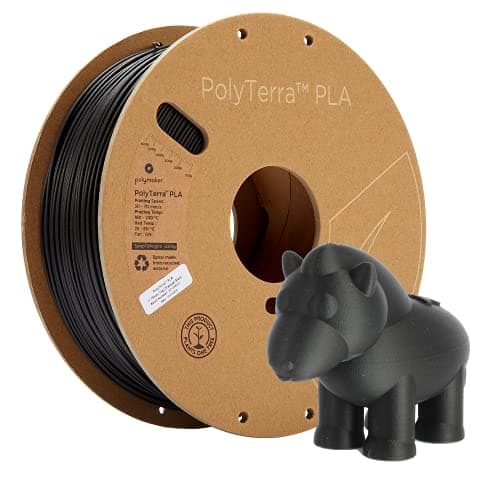
Polymaker PolyTerra PLAMatte diffuses the light that makes layer lines visible, which is most of what separates a printed pendant from a printed-looking one.Matte finish at ordinary PLA prices
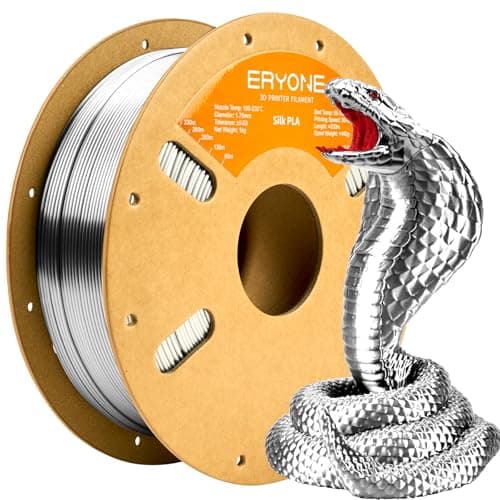
ERYONE Silk PLAThe gloss is genuine and it is the whole reason to buy it. Layer adhesion is worse than plain PLA, which matters for a thin ring shank and not for a pendant.High-gloss silk, 1.75 mm +/- 0.03 mm
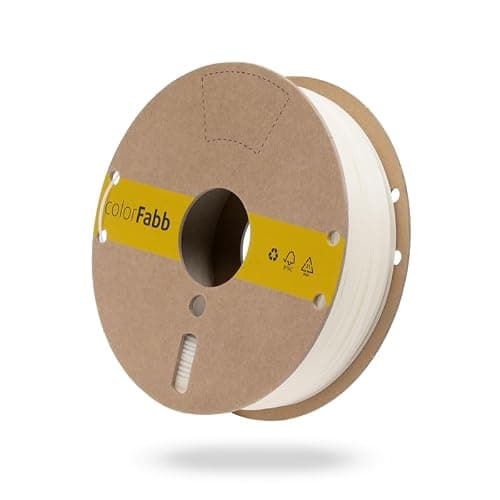
colorFabb LW-PLAThe published density drop is the difference between a large earring you take off after an hour and one you forget you are wearing.0.403-0.476 g/cm3 fully foamed
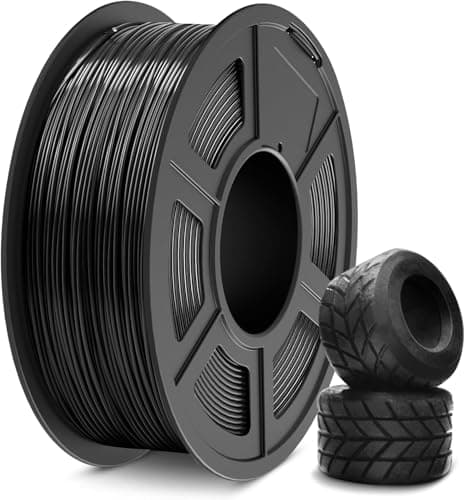
SUNLU TPU 95AA rigid bangle either does not fit or snaps. A flexible one opens over the hand and closes again, and TPU is the only printable material that does that.Shore 95A, roughly 20-40 mm/s
Bambu Lab PLA-CFCarbon fill buys stiffness a pendant does not need, makes thin sections more brittle, and leaves a fibrous surface that fights every finishing step.Hardened nozzle required, fibrous surfaceSkip this
Live prices verified October 24, 2026. Scores are our own fit rating for the stated use, not a measurement and not a customer rating.
A layered geometric pattern with a faceted gem at its center.
What printed jewelry can and cannot be
A filament printer makes plastic jewelry. That is not a criticism — large geometric earrings, architectural pendants, cuffs and hair ornaments are a genuine category, and printing is unusually good at them because a shape that would be prohibitively heavy in metal is trivial in plastic. What a filament printer cannot make is metal jewelry, and no material on this page changes that.
If you want silver or gold, the printer makes the pattern and a caster makes the jewelry — a different resin, a kiln and an investment workflow, all of which are on best castable resin for jewelry. This page is about the pieces where the plastic is the product.
Four criteria, in order
Weight, if it hangs from an ear. Earrings are the only jewelry with a hard mass budget, and it is smaller than people expect. This is the one criterion where a specialty filament earns its price.
Surface at arm's length. Jewelry is inspected at about the distance of a conversation. Layer lines that vanish on a bracket are the first thing anyone notices on a pendant.
What happens against skin. Sweat, warmth, and hours of contact — plus the metal findings, which are a separate purchase and a separate problem.
Whether thin sections survive. A ring shank, a hook, a chain link: these are the geometries that punish brittle material and bad layer orientation.
Weight is the constraint on earrings
A large statement earring in solid PLA is heavier than it looks because plastic that size adds up. Foaming lightweight PLA is the direct fix, and colorFabb publish the numbers for it: density falls from 1.210 to 1.430 g/cm3 unfoamed to 0.403 to 0.476 g/cm3 fully activated colorFabb. That is roughly a third of the mass for the same shape.
Three cheaper things do most of the same job and should be tried first, because they cost nothing:
Hollow the piece. A shell with two or three walls and no infill is a fraction of the mass of a solid one and, at this scale, indistinguishable.
Thin it. Most printed earrings are thicker than they need to be because the designer was thinking about strength. An earring carries no load but its own weight.
Make the back open. Nobody sees it, and a lattice or cut-out back halves the material.
The catch with foaming PLA is that it prints differently from ordinary PLA: foaming is controlled by nozzle temperature, so the flow rate that worked at 200 C is wrong at 240 C colorFabb. Expect to calibrate before a piece you care about. The same material and the same trade-off, at a much larger scale, are covered on filament for cosplay.
Finish: what the eye sees at arm's length
Layer lines are visible because each layer catches light as its own glossy band. Two filament choices attack that directly, in opposite directions.
Matte, for pieces that look like objects
A matte additive scatters reflection, so the eye stops resolving individual layers even though the geometry is unchanged. It is the cheapest upgrade in printed jewelry and it is also the best base for paint, because primer sits on it without fisheyeing off a gloss. The full trade — including the mildly abrasive matting agent — is on matte and silk PLA.
Silk, for pieces that want to look like metal
Silk PLA is the opposite bet: a high gloss that, on a small curved piece at conversation distance, reads convincingly as polished metal. It is a decorative material with a real cost — the additives that create the sheen make layer adhesion worse than plain PLA — so it belongs on pendants and charms rather than on anything that takes a repeated load.
Both benefit from the same finishing sequence: sand along the piece rather than across it, prime, and sand again. On jewelry this is twenty minutes of work that changes the result more than the filament choice does.
Fine detail is a nozzle decision
Jewelry is the one thing printed on this site where a 0.4 mm nozzle is genuinely limiting. Prusa are explicit about the distinction: layer height changes vertical resolution only, and if you want more resolution in the XY plane the nozzle diameter is what you change Prusa Research. A filigree strut thinner than one extrusion simply does not exist in the sliced file.
For small detailed pieces, a 0.2 mm nozzle is the tool, with the print time that implies. The published layer-height ceiling scales with it — below 80 percent of the nozzle diameter Prusa Research — so a 0.2 mm nozzle tops out near 0.16 mm layers. Which diameter for which job is on 3D printer nozzle sizes.
Skin contact, sweat and heat
Three honest cautions, none of which is solved by a spool.
No consumer filament is certified for skin contact. Filament is sold for printing, not as a wearable material. For occasional wear this is unremarkable; for something worn every day against damp skin, treat printed pieces as replaceable rather than permanent, and wash them with soap and water rather than trying to sterilize them.
Layer lines are crevices. The same property that makes printed parts a poor choice for food contact applies to anything worn against skin for hours — the surface cannot be scrubbed the way a molded one can. The reasoning is set out on is PETG food safe.
PLA is a low-temperature material. Prusa state that PLA gets soft and deforms above about 60 C Prusa Research. Body heat is nowhere near that, but a car dashboard in summer is, and a pair of earrings left on one comes back a different shape.
The metal parts are a separate purchase and worth doing properly. Ear wires, posts, jump rings and clasps come in hypoallergenic surgical steel and titanium for very little money, and a printed piece hung on a cheap nickel hook will be blamed on the plastic.
Pieces that have to flex
A bangle that fits over the widest part of a hand and then sits on a wrist has to either open or stretch. In rigid PLA it does neither: it is a bracelet that does not go on, or one that snaps the first time it is forced.
TPU at Shore 95A solves it, at the price of print speed. Prusa's flexible guidance puts printing at roughly 20 mm/s with 30 to 40 mm/s as the ceiling Prusa Research, and a direct-drive extruder is effectively required. For a small piece that is a short print anyway, which makes jewelry one of the easiest places to start with flexible filament — the full page is best TPU filament.
Design rules that decide whether it survives
Orient thin sections across the load. A ring shank or an earring hook printed with its layers perpendicular to the stress will split along a layer line the first time it flexes. Lay the piece flat so the load runs along the layers, not across them.
Do not print the hook. Buy findings. A printed ear wire is a thin plastic section under repeated bending, which is the exact geometry printing is worst at.
Round every edge. A sharp printed edge catches on clothing and on skin, and an elephant's-foot ridge on the first layer is sharper than it looks.
Print a size test first. Rings and bangles are dimensional parts, and a printer that is not flow-calibrated will be out by enough to matter at this scale.
What we would not use
Carbon-filled filament. It adds stiffness a pendant does not need, makes thin sections more brittle, requires a hardened nozzle because the fibers wear brass measurably E3D, and leaves a fibrous matte surface that resists sanding and primer alike. See carbon fiber filament for what it is actually for.
Metal-filled filament, for anything worn. The powder loading makes parts heavier — the opposite of the goal on earrings — and considerably more abrasive to print.
Resin, for daily-wear pieces. Resin holds finer detail than any filament and is the right tool for a display piece or a casting pattern. For something worn against skin all day, the handling requirements are a real consideration: Formlabs' safety guidance treats liquid photopolymer as a skin sensitizer Formlabs, and incompletely cured resin can remain in crevices on a finished part. Cure thoroughly, wash thoroughly, or print it in filament.
Every pick, in detail
01
Polymaker PolyTerra PLA
Polymaker
Pendants, charms and pieces you will paint · 8.6/10 our fit score
The matte finish that actually hides layer lines, on a spool priced with ordinary PLA rather than as a specialty.
Published specifications for Polymaker PolyTerra PLA
Statement earrings that stay wearable · 8.1/10 our fit score
The foaming PLA that publishes its own density figures, which is the only way to know what the weight saving actually is before you print a helmet in it.
Matte PLA for most pieces, because it hides layer lines and takes paint well. Silk PLA when you want a glossy, metal-like finish on a pendant. Foaming lightweight PLA for large earrings, where weight is the limit. TPU for bangles that have to flex over a hand.
+ − Is PLA safe to wear against skin?
No consumer filament is sold or certified as a skin-contact material, so treat printed jewelry as decorative and replaceable. Wash it with soap and water rather than sterilizing it — PLA softens above about 60 C — and buy hypoallergenic steel or titanium findings for the parts that pierce or clasp.
+ − How do I make printed jewelry look less 3D printed?
Three things, in order: use a matte filament so layers stop catching light, drop to a smaller nozzle for fine features because nozzle diameter sets horizontal detail, and spend twenty minutes sanding and priming. The finishing matters more than the spool.
+ − Can you 3D print metal jewelry at home?
Not with a filament printer. The realistic route is lost-wax casting: print the pattern in a castable resin, then have it invested and cast in metal. Metal-filled filaments contain metal powder in a plastic matrix and are still plastic parts.