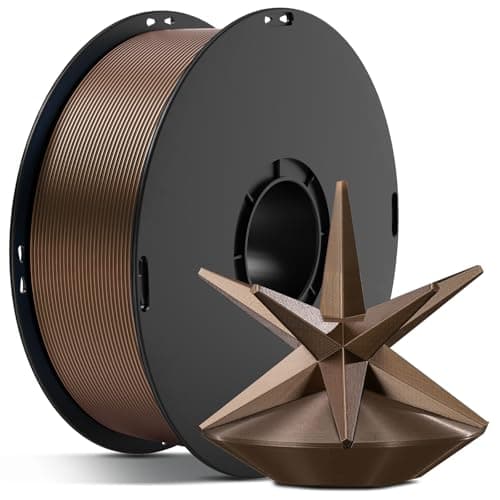
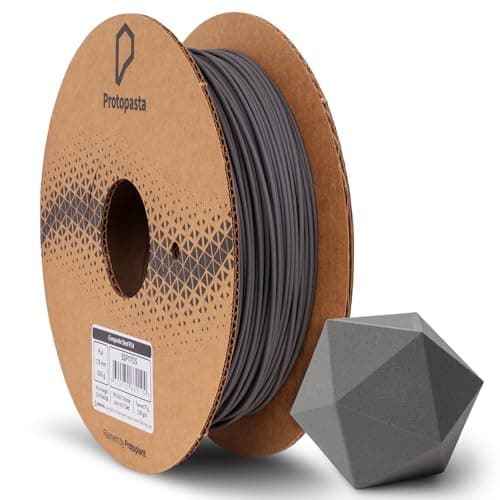
Metal filled filament is PLA carrying real metal powder, which is why it weighs roughly twice as much per part and finishes like cast metal when you polish it. It also wears nozzles and gives you far less length per spool. The cheap metallic spools contain no metal at all.
How this page is funded. Buy links go to Amazon and we earn a commission on qualifying purchases at no extra cost to you. Commission never decides an order or a score, we accept no free products or sponsored placements, and every roundup names something to skip. Full disclosure.
The picks, ranked
The picks, ranked
#
Product
Best for
Score
Price
1
Protopasta Stainless Steel Filled PLAProtopasta publish the fill, the particle size and the density, which is how you tell a filled filament from a painted one. It brushes, sands and polishes.Real steel powder, 2.30 g/cc, 185-215 C
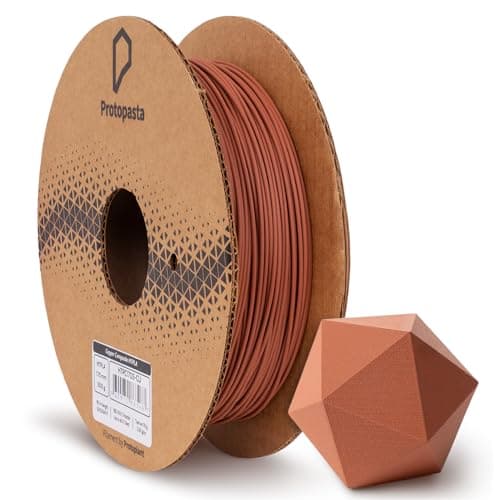
Protopasta Copper Filled HTPLAThe heat-treatable base is the hidden upgrade: annealed, stiffness survives to 150-175 C instead of 50-60 C, at a published 1.5 percent shrink.Copper powder in HTPLA, heat treat 110 C for 10 min
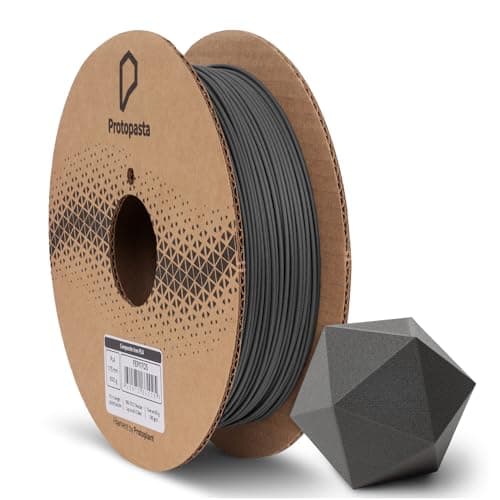
Protopasta Magnetic Iron PLAGenuinely ferromagnetic rather than metal-colored, and Protopasta document rusting it on purpose as a finish. The only functional pick on this page.Ferromagnetic iron powder, 1.85 g/cc
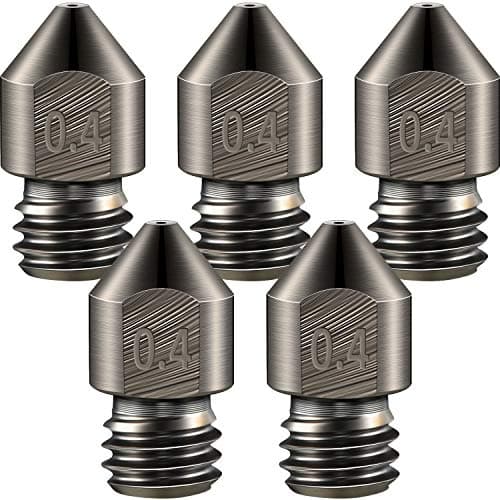
Hardened Steel NozzleProtopasta say outright that metal filled filament is more abrasive than standard PLA and to be prepared to replace your nozzle.Hardened steel, fits most hotends
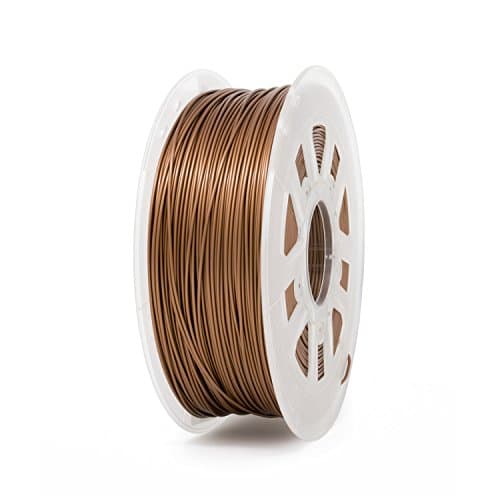
Gizmo Dorks Metal Copper Fill PLARoughly half the price of the premium spools for the same idea. Gizmo Dorks publish almost nothing about the fill, so you are buying on the label.Copper fill, 1 kg
ANYCUBIC Metal-Like Silk PLAAn honest product with a misleading category: it is silk PLA that looks metallic. Nothing to polish, nothing to patina, and it weighs what PLA weighs.Silk PLA, metal-like appearanceSkip this
Live prices verified September 21, 2026. Scores are our own fit rating for the stated use, not a measurement and not a customer rating.
A polished metal-look printed part on a workbench.
Published figures for the three filled spools here. Density is the giveaway: ordinary PLA sits near 1.24 g/cc.
Spool
Base
Density (g/cc)
Nozzle (C)
Noted for
Protopasta Stainless Steel
PLA
2.30
185-215
Heaviest, polishes brightest
Protopasta Copper
HTPLA
2.30
185-215
Heat treatable to 110 C
Protopasta Magnetic Iron
PLA
1.85
185-215
Ferromagnetic, rustable
Published figures for the three filled spools here. Density is the giveaway: ordinary PLA sits near 1.24 g/cc. All three publish the same printer settings and the same 97 m of filament per 500 g at 1.75 mm. Metal powder buys weight and finish, not strength. Figures from Protopasta, Protopasta, Protopasta, retrieved 2026-09-21.
What decides a metal filled buy
Metal filled filament is a PLA base carrying real metal powder — Protopasta specify steel, copper or iron powder at less than 250 micron particle size ProtopastaProtopastaProtopasta. It prints at PLA temperatures on an ordinary printer, and everything that makes it interesting also makes it awkward.
Check the density before anything else. Protopasta publish approximately 2.30 g/cc for their steel and copper spools and 1.85 g/cc for iron ProtopastaProtopastaProtopasta. Ordinary PLA sits near 1.24 g/cc. A listing selling a metal look with no density figure is selling pigment.
Budget for the finishing. These spools are bought for what happens after the print: brushing, sanding and polishing for steel, a mirror polish or a deliberate patina for copper ProtopastaProtopasta. Printed and untouched, the part is a matte cast-metal gray.
Accept the nozzle cost. Protopasta state the material is more abrasive than standard PLA and to be prepared to replace the nozzle, suggesting a wear-resistant or larger one for longer service intervals Protopasta.
Re-do your slicer arithmetic. Protopasta publish 97 m per 500 g at 1.75 mm Protopasta. A kilogram of ordinary PLA runs to roughly 330 m SUNLU, so a 500 g metal spool holds well under half the length of 500 g of normal PLA. Slicer estimates based on weight will be wrong unless you update the density.
Decide whether you need heat resistance. Only the HTPLA-based copper publishes a heat treatment, and it is a real one: 110 C for 10 minutes moves total loss of stiffness from 50 to 60 C up to 150 to 175 C Protopasta.
Metal filled against metal look
Two different products share a shelf. Metal filled filament contains metal powder, weighs what the density figures above say, and can be polished to a real metallic surface because there is metal at the surface to polish. Metallic or silk PLA contains no metal: the shine is in the polymer and the pigment, and sanding it removes the effect instead of improving it.
Neither is dishonest — the silk spools say “metal-like” on the label — but they answer different questions, and they are priced roughly three times apart. If you want a part that feels heavy in the hand and takes a polish, you want the filled one. If you want a gold vase for a shelf, silk is cheaper, easier, and covered on matte and silk PLA.
The other filled filaments
Metal fill sits in the same family as wood fill and mineral fill: ordinary PLA carrying a powder that changes how the surface reads. Wood-filled behaves similarly and sands and stains rather than polishes — best wood filament — and the stone-look version is on marble PLA. All three are abrasive to some degree, and all three are decorative rather than structural.
Printing it
Protopasta publish the same settings across the three spools: 10 to 20 mm/s on the first layer and 20 to 80 mm/s for the rest, a nozzle set point of 185 to 215 C with the hottest figure on the first layer for adhesion, 0.15 to 0.20 mm layers, and a bed from room temperature to 60 C, noting that going above 60 C can worsen warping ProtopastaProtopasta.
Use a bigger nozzle if you have one. Protopasta prefer 0.6 mm or larger, call 0.4 mm okay, and put 0.25 mm in expert-only territory Protopasta. Metal powder and small nozzles are a clog waiting to happen — the sizes are compared on nozzle sizes.
Slow the first layer right down. A dense, heavy extrusion needs time to bond, and the published 10 to 20 mm/s is far below a normal PLA first layer.
Watch for brittleness in the spool. Highly filled filaments snap more easily than unfilled ones, especially at the end of a spool where the bend radius tightens.
Expect the nozzle to wear anyway. E3D document measurable brass wear within a few hundred grams of filled filament E3D, and the symptoms are on the nozzle wear guide.
The finishing is the point
A metal filled print straight off the plate looks like matte cast metal. What you do next decides whether it looks like a prop or like an object.
Steel: Protopasta describe brushing, sanding or polishing to a stainless finish Protopasta. Work up through grits; the metal at the surface takes the shine, the plastic around it does not.
Copper: either a bright mirror polish like a coin or an aged patina, which Protopasta describe as the two ends of the finishing range for the material Protopasta.
Iron: the unusual one. Protopasta say the iron stays a stable matte cast-metal finish as printed but can be rusted when desired Protopasta, which is a finishing option no other filament offers.
Everything: sanding releases fine metal-loaded dust. Wet sand, wear a mask, and do not do it over a keyboard.
The ferromagnetic one is a different tool
Protopasta’s iron spool is genuinely ferromagnetic: it responds to magnets and behaves similarly to pure iron with the metal encapsulated in plastic Protopasta. That makes it the only pick here with a functional job rather than a cosmetic one — fridge-mounted parts, magnetic tool holders, sensor targets, or a printed part that a magnet has to grab.
It is still PLA underneath, so Prusa’s roughly 60 C softening point applies Prusa Research and the part has no more strength than an ordinary PLA one. Iron fill is also the lightest of the three at 1.85 g/cc Protopasta, which is worth knowing if the weight is the appeal.
What it actually costs per part
Two multipliers stack. Metal filled spools cost several times what ordinary PLA costs per kilogram, and each kilogram contains far less filament by length — 97 m per 500 g against roughly 330 m per kilogram for standard PLA ProtopastaSUNLU.
For a small pendant or a chess piece that is irrelevant. For a full-size helmet it is the difference between a project and a purchase, which is why most people print the shell in ordinary PLA and reserve the metal spool for the parts that get handled. The per-kilogram comparison across everything we track is on filament price per kg, and the jewelry case is on filament for jewelry.
What not to buy it for
Strength. Metal powder adds mass and abrasiveness, not toughness. The strongest printable options are on strongest filament.
Fine miniatures. Protopasta prefer a 0.6 mm nozzleProtopasta, which is the opposite of what fine detail wants — see filament for miniatures.
Heat, unless you heat treat. Only the HTPLA copper publishes a treatment, and it needs an oven and a 1.5 percent dimensional allowance Protopasta.
Long prints on a brass nozzle. The wear is documented and the failure is invisible until tolerances drift E3D.
Every pick, in detail
01
Protopasta Stainless Steel Filled PLA
Protopasta
The heaviest, most metal-looking finish · 8.5/10 our fit score
The densest, most convincing metal finish here, from the maker that publishes the fill, the particle size and the density rather than a color name.
Published specifications for Protopasta Stainless Steel Filled PLA
The five-dollar part that stops abrasive filament from quietly widening your nozzle mid-print. Buy one before your first carbon fiber spool, not after.
Published specifications for Hardened Steel Nozzle
Common size
0.4 mm
Required for
Carbon fiber, glass filled, glow in the dark, metal filledE3D
Trade-off
Lower thermal conductivity than brass
What it does well
E3D document substantial wear on a brand new brass nozzle after only 250 g of carbon-fiber-filled filament
Cheap enough to keep a spare in the drawer
What it does not
Conducts heat worse than brass, so very high flow rates need a few degrees more
Hardened steel tempers and softens at extreme temperatures — E3D make this point explicitly
It is PLA carrying real metal powder — Protopasta specify steel, copper or iron at under 250 micron particle size, with published densities of 1.85 to 2.30 g/cc against about 1.24 for ordinary PLA. The part is mostly plastic by volume, but there is enough metal at the surface to polish or patina.
+ − Does metal filled filament need a hardened nozzle?
Protopasta state it is more abrasive than standard PLA and to be prepared to replace your nozzle, suggesting a wear-resistant or larger nozzle for longer service intervals. E3D document measurable brass wear within a few hundred grams of filled filament, so fit hardened steel first.
+ − Is magnetic filament really magnetic?
Protopasta's iron-filled PLA is ferromagnetic: it responds to magnets and behaves similarly to pure iron, with the iron encapsulated in plastic. It is not itself a magnet — it is a material a magnet sticks to.
+ − Why does my metal filament spool run out so fast?
Because you buy it by weight and use it by length. Protopasta publish 97 m per 500 g at 1.75 mm, while a kilogram of ordinary PLA runs to roughly 330 m. Update the density in your slicer's filament profile or your print estimates will be wrong.