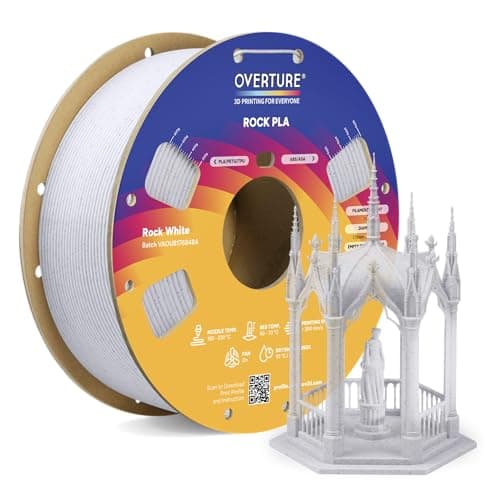
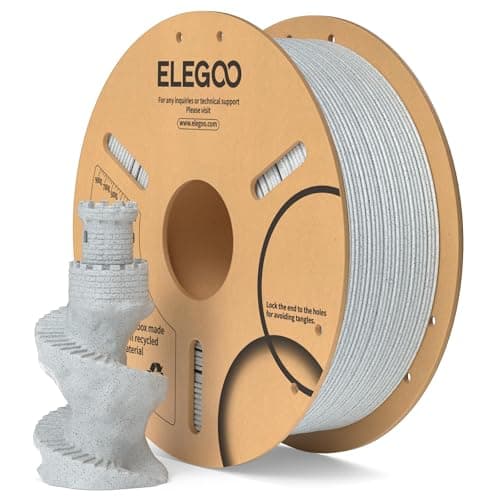
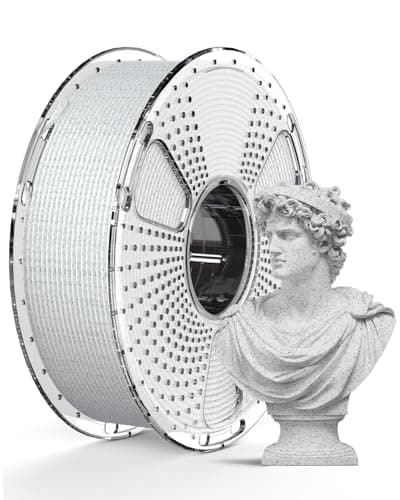
Marble PLA is ordinary PLA with mineral speckles that break up the eye's ability to follow a layer line. It is the cheapest way to make a printed vase look made rather than printed, and it works best on big, simple, matte shapes.
How this page is funded. Buy links go to Amazon and we earn a commission on qualifying purchases at no extra cost to you. Commission never decides an order or a score, we accept no free products or sponsored placements, and every roundup names something to skip. Full disclosure.
The picks, ranked
The picks, ranked
#
Product
Best for
Score
Price
1
SUNLU High Speed Marble PLASUNLU publish a full property table and speed-linked temperature bands for the marble line, which almost nobody in this category does.210-230 C at 60-150 mm/s, 55 C heat deflection
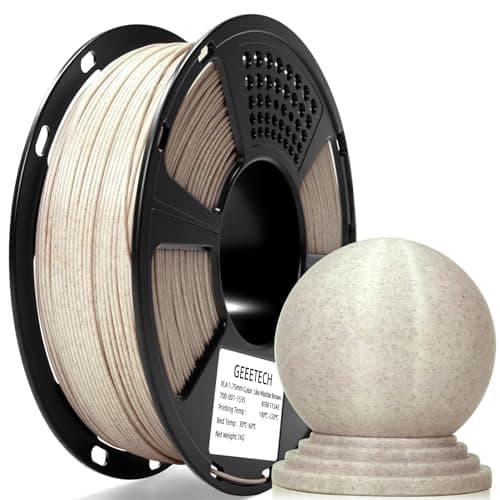
Geeetech Marble PLAA different palette from the gray-white norm, which suits pots and planters. Least documentation of the four.Marble brown, AMS-compatible spool
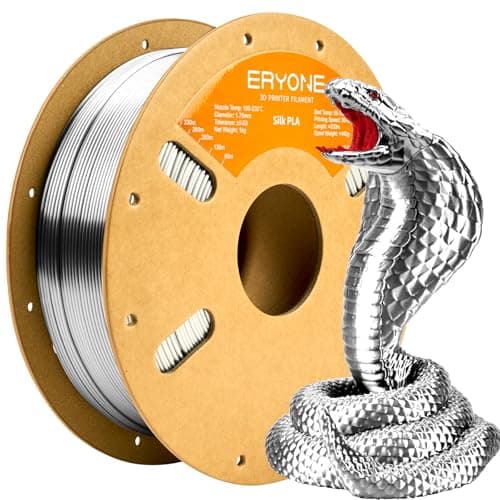
ERYONE Silk PLAGloss is the enemy of a stone illusion: it reflects, which is exactly what stone does not do, and it makes every layer line legible again.High-gloss silk PLASkip this
Live prices verified September 21, 2026. Scores are our own fit rating for the stated use, not a measurement and not a customer rating.
A speckled stone-look printed vase on a bench.
Why marble PLA hides layer lines
A layer line is visible because it is a regular, repeating horizontal feature. The eye is very good at spotting regularity and much worse at spotting it through visual noise. Marble filament adds exactly that noise: mineral-look flecks scattered through a matte base, so the surface reads as texture rather than as stripes.
This is the same reason matte PLA hides lines better than glossy PLA does, taken one step further. The finish comparison is on matte and silk PLA, and marble belongs on the matte end of it.
Printing it
Marble PLA prints like PLA. SUNLU publish 210 to 230 C at 60 to 150 mm/s and 230 to 260 C at 300 to 400 mm/s for their high-speed marble line, with a 50 to 60 C bed and drying at 50 C SUNLU. Prusa’s general PLA window of 185 to 235 C at the nozzle covers the rest of the category Prusa Research.
Print it matte. Anything that adds gloss — ironing, very slow outer walls, high temperatures — works against the effect.
Bigger nozzles suit it. A 0.6 mm nozzle lays down wider lines that carry more flecks per pass. Sizes are compared on nozzle sizes.
Vase mode is its natural home. A single continuous wall with no seam is where the illusion is strongest.
Mind the seam. A vertical seam line is a regular feature again, and the speckle does not hide it. Scatter or align the seam deliberately.
Expect ordinary PLA limits. SUNLU publish a heat deflection temperature of 55 +/- 3 C and a Vicat softening point of 54 C for the marble line SUNLU. It is decor, not a car part.
The abrasiveness question, answered honestly
Marble filaments are filled with mineral particles, and filled filaments are generally harder on a brass nozzle than unfilled ones — E3D document measurable wear from filled filaments within a few hundred grams E3D.
What we could not find is a manufacturer in this category publishing an abrasiveness warning for marble PLA the way Polymaker do for their UV and glow lines. So the honest position is: nobody selling marble PLA says it eats nozzles, and we have not tested it. If you own a hardened nozzle, use it; if you do not, a few kilograms of marble PLA is not the reason to panic-buy one. The wear symptoms to watch for are on the nozzle wear guide.
Which models suit it
Vases, pots and planters. Large curved surfaces, viewed from a distance, with no fine detail to lose.
Busts and statues. The classic use, and the one the color palette is designed around.
Coasters, trays and tiles. Flat matte surfaces where the fleck does the decorating.
Not miniatures. The speckle is the same size on a 28 mm figure as on a 300 mm vase, and at that scale it reads as dirt. Use the picks on filament for miniatures instead.
Not mechanical parts. Mineral fill does not add strength, and the PLA base is unchanged.
Other ways to get the same look
Marble PLA is the cheapest route, not the only one. Wood-filled PLA gives a different natural-material illusion and can be sanded and stained, which marble cannot — that ranking is on best wood filament. Plain matte PLA plus a stone-effect spray gets closer to real stone at the cost of post-processing time.
And if the object needs to live outside, none of these is the answer: PLA degrades in sunlight long before the finish stops mattering. The outdoor materials are on outdoor and UV, and the honest trade is that no outdoor material has a convincing marble finish yet.
What to check on the listing
Fleck size and density in a real photo. Product renders exaggerate both. Look for a printed part, not a spool.
Base color. Gray-white reads as marble, warm brown as sandstone, dark gray as granite. They are not interchangeable.
A published diameter tolerance. Filled filaments vary more than unfilled ones, and tolerance is the cheapest quality signal on any listing.
Spool weight. The category ships 1 kg spools; anything smaller should be cheaper in proportion — the arithmetic is on price per kg.
Every pick, in detail
01
SUNLU High Speed Marble PLA
SUNLU
The best-documented marble spool · 8.4/10 our fit score
The marble spool with a real property table behind it, including the speed bands the high-speed base allows.
Published specifications for SUNLU High Speed Marble PLA
Nozzle
210-230 C at 60-150 mm/s; 230-260 C at 300-400 mm/sSUNLU
On large, simple, matte shapes, yes — the speckle breaks up the regularity that makes a layer line visible. On small or detailed prints the effect is much weaker, because the flecks stay the same size while the features shrink.
+ − Is marble PLA abrasive?
It is mineral-filled, and E3D document measurable brass wear from filled filaments within a few hundred grams. No maker in this category publishes an abrasiveness warning for marble PLA, so treat a hardened nozzle as sensible insurance rather than a requirement.
+ − What temperature do you print marble PLA at?
Standard PLA temperatures. SUNLU publish 210 to 230 C at 60 to 150 mm/s for their high-speed marble line, rising to 230 to 260 C at 300 to 400 mm/s, with a 50 to 60 C bed.
+ − Can marble PLA be used outdoors?
Not for long. It is PLA underneath, which degrades in sunlight and softens around 60 C. For a planter that lives outside, choose an outdoor material and accept that the marble finish is not available there.