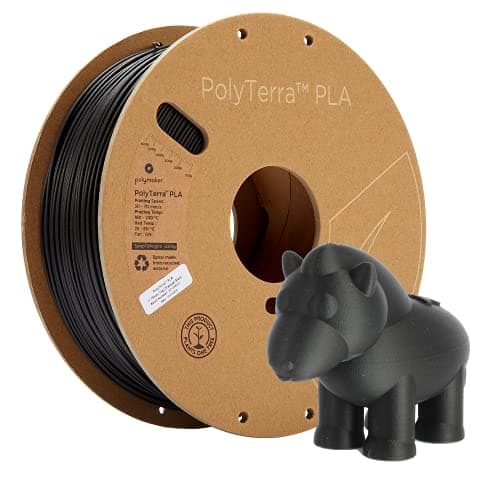
Two things decide a printed miniature: the nozzle you fit and whether the surface scatters light or reflects it. Matte PLA through a 0.2 mm nozzle is the answer for filament, and resin is still the answer if the face has to look like a face.
How this page is funded. Buy links go to Amazon and we earn a commission on qualifying purchases at no extra cost to you. Commission never decides an order or a score, we accept no free products or sponsored placements, and every roundup names something to skip. Full disclosure.
The picks, ranked
The picks, ranked
#
Product
Best for
Score
Price
1
Polymaker PolyTerra PLAMatte scatters the light that makes layer lines visible and gives primer something to hold. On a miniature, that is most of the result.Matte finish at ordinary PLA prices
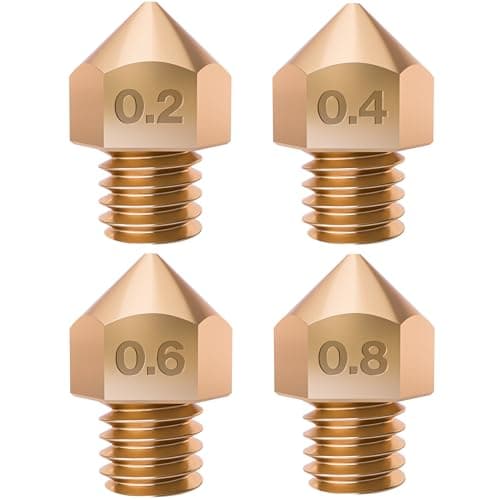
Brass Nozzle AssortmentHorizontal detail is set by nozzle diameter, and no filament fixes a 0.4 mm nozzle. A 0.2 mm costs less than a spool and changes more.Typically 0.2 / 0.4 / 0.6 / 0.8 mm
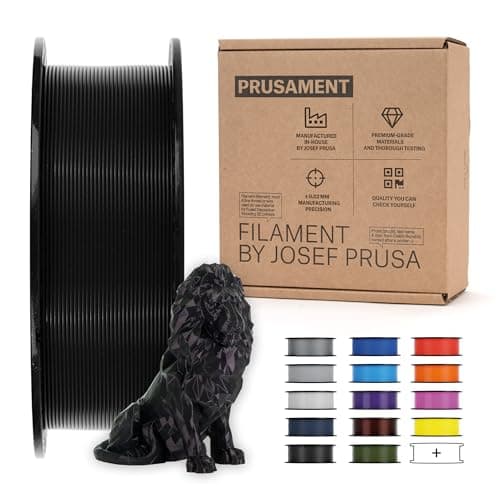
Prusament PLAYou are buying consistency for a print where a diameter wobble shows up as a visible band on a face. Overkill for terrain, sensible for character models.Per-spool measurement record
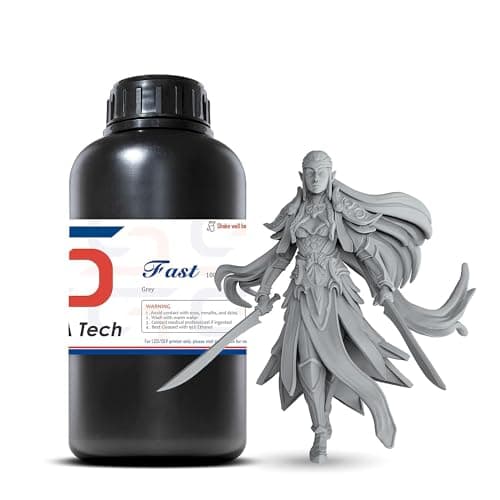
Siraya Tech Fast ABS-LikeResin resolves detail no FDM nozzle reaches. If the miniature is a character rather than a wall section, this is the honest recommendation even though it is a different machine.Standard fast-printing resin
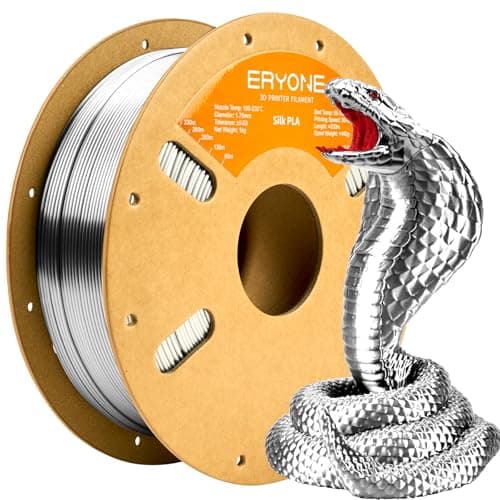
ERYONE Silk PLAGloss reflects along every layer boundary, which is exactly the artifact you are trying to hide, and primer sits badly on it. Buy silk for display pieces, never for models you will paint.High-gloss finishSkip this
Live prices verified September 13, 2026. Scores are our own fit rating for the stated use, not a measurement and not a customer rating.
Painted miniature figures in close-up detail.
What actually decides a printed miniature
Miniatures are the hardest thing an FDM printer is asked to do, and the reasons have almost nothing to do with which brand of PLA you buy. Four things decide the result, in this order.
Nozzle diameter. Prusa are explicit: layer height changes vertical resolution only, and if you want more resolution in the XY plane, the nozzle is what you change Prusa Research. A 0.4 mm nozzle cannot draw a 0.3 mm sword blade at all.
Whether the surface scatters light. Layer lines are visible because each layer catches light as a separate glossy band. Matte filament removes the highlight and the eye stops resolving them.
Layer height, within limits. Prusa cap layer height below 80 percent of nozzle diameter and recommend against going under 0.10 mm because the quality gain stops being worth the print time Prusa Research. On a 0.2 mm nozzle that means roughly 0.10 to 0.16 mm.
Whether it is FDM's job at all. Terrain, bases, vehicles and buildings: yes. A 28 mm character's face: honestly, no.
Fit the small nozzle before buying a better spool
This is the cheapest improvement available and the one most people skip. A 0.2 mm nozzle costs less than a spool of premium PLA and changes what the printer is physically able to produce, where the premium spool changes almost nothing visible at this scale.
The costs are real and worth knowing: print times grow sharply, small nozzles clog more readily, and filament cleanliness and dryness stop being optional. Prusa themselves suggest reserving a 0.25 mm nozzle for small objects a few centimeters across, which is exactly the miniature case. Which diameter does what is on 3D printer nozzle sizes, and if it blocks, the fix order is on why your nozzle keeps clogging.
Matte, every time
A matte additive diffuses reflection so the eye stops picking out individual layers, and it gives primer a surface to key into rather than beading off a gloss. For anything that will be painted — which is nearly every miniature — that combination is worth more than any difference in polymer between brands.
The trade-offs are small and honest: matting agents are mildly abrasive over a long working life, and matte PLA is slightly more brittle than the equivalent glossy spool. Neither matters on a 28 mm model. The fuller comparison is on matte and silk PLA.
Silk PLA is the opposite of what this page wants. Its gloss reflects along every layer boundary and its additives make primer harder to adhere, which is why it sits in the skip row above rather than in the picks.
Settings that do the work
Slow down. Small features need time for the extrusion to land accurately and for the previous layer to be cool enough to hold its shape.
Cool aggressively. PLA likes full part cooling, and small layers with tiny areas need it more, not less. This is one of the few places PLA's easy temperature window is a real advantage — Prusa publish 185 to 235 C at the nozzle for the class Prusa Research.
Watch the seam. On a figure, the layer start/stop column reads as a scar down one side. Set the slicer to hide it on a back edge rather than randomizing it across a face.
Support contact, not support material. Miniatures are ruined by support scarring more often than by layer lines. Tune contact distance and interface layers before blaming the spool.
Dry filament. Moisture shows up as fuzz and popping on features that are only a few extrusions wide. Prusa publish 45 C for 6 hours for PLA Prusa Research.
The honest line where resin takes over
A 0.2 mm nozzle cannot resolve chain mail, a nose, or a hand holding a weapon. A resin printer can, because it is not drawing lines at all. If you are printing character models to paint, the material question is really a machine question, and we would rather say so than sell you a spool that cannot do the job.
What resin costs you in exchange is a chemical workflow. Formlabs' safety guidance treats liquid photopolymer as a skin sensitizer requiring gloves and ventilation Formlabs, and uncured resin and contaminated alcohol are chemical waste rather than drain waste Formlabs. Which resin, and why opacity matters more than advertised resolution, is on best resin for miniatures, and the machine-level comparison is on filament versus resin.
What filament wins outright
Plenty, and this is where the money goes for most tabletop players.
Terrain and scenery. Large, chunky, cheap by volume, and nobody inspects a ruined wall at arm's length.
Bases, trays and inserts. Flat, dimensional, and tough enough to survive a bag — where a resin base snaps.
Vehicles and big models. A tank hull in PLA costs a fraction of the same volume in resin and takes paint just as well.
Anything handled by children. The material and safety reasoning is on filament for kids toys.
Every pick, in detail
01
Polymaker PolyTerra PLA
Polymaker
The default miniature spool · 8.7/10 our fit score
The matte finish that actually hides layer lines, on a spool priced with ordinary PLA rather than as a specialty.
Published specifications for Polymaker PolyTerra PLA
Matte PLA, printed through a 0.2 mm nozzle at 0.10 to 0.12 mm layers. Matte scatters the light that makes layer lines obvious and takes primer well; the small nozzle is what actually raises horizontal detail.
+ − Can an FDM printer print 28 mm miniatures?
It can print them; whether they satisfy you depends on the model. Terrain, vehicles, bases and chunky sculpts come out well. Faces, fingers and fine weapons do not, because nozzle diameter sets horizontal detail and 0.2 mm is as fine as consumer nozzles practically go.
+ − Should I use resin instead for miniatures?
For character models, yes. Resin resolves detail no FDM nozzle reaches. It brings a chemical workflow with it — Formlabs treat liquid resin as a skin sensitizer requiring gloves and ventilation, and waste has to be handled rather than poured away.
+ − Does a smaller layer height fix layer lines on miniatures?
Only vertically. Prusa are explicit that layer height changes vertical resolution and that nozzle diameter is what changes horizontal resolution. They also recommend against going below 0.10 mm, because the gain is small next to the print time it costs.