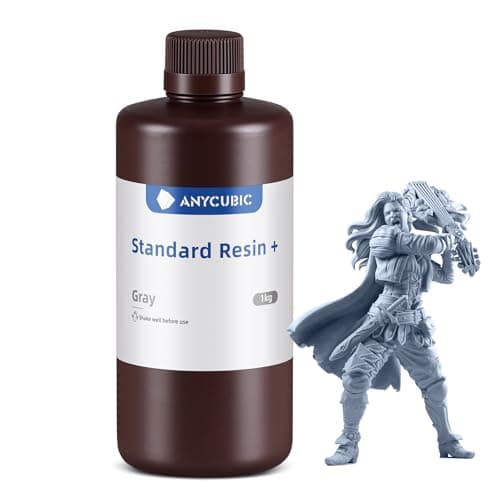
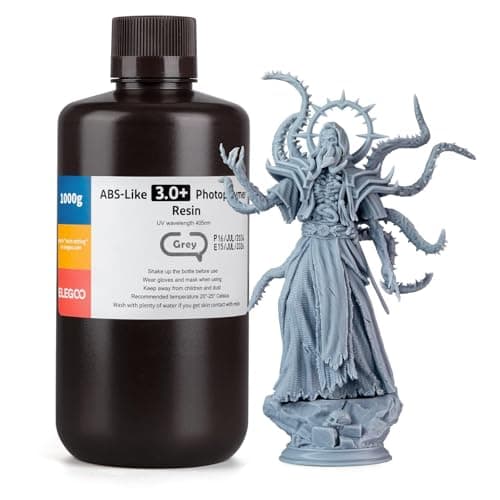
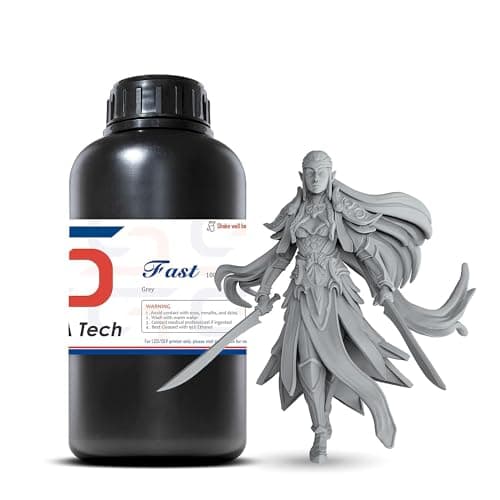
Miniature printing is an optics problem before it is a chemistry problem. Light scattering inside translucent resin is what softens a face, and opaque flat gray is the fix.
How this page is funded. Buy links go to Amazon and we earn a commission on qualifying purchases at no extra cost to you. Commission never decides an order or a score, we accept no free products or sponsored placements, and every roundup names something to skip. Full disclosure.
The picks, ranked
The picks, ranked
#
Product
Best for
Score
Price
1
Phrozen Aqua-Gray 8KFormulated for high-resolution screens and for the opacity that keeps small features sharp.Opaque flat gray, low translucency
ELEGOO ABS-Like ResinSlightly softer detail, far better survival odds for a gaming miniature that lives in a case and gets moved.Toughened standard resin
Siraya Tech Fast ABS-LikeWhen you are printing dozens of models, exposure time per layer is what decides how long the batch takes.Short exposure per layer
Live prices verified October 16, 2026. Scores are our own fit rating for the stated use, not a measurement and not a customer rating.
A painted miniature figure photographed in close detail.
The optics problem
A masked stereolithography printer cures resin by shining UV through an LCD mask. The intended cure is directly under the lit pixels. In a translucent resin, some of that light scatters sideways into resin that should have stayed liquid.
The result is that fine features come out slightly bigger and slightly softer than the model — a face loses definition, a fabric fold rounds off, a gap between two thin parts fills in. This is not a printer resolution limit. The printer resolved it correctly; the resin blurred it.
Pigment absorbs the scattered light. That is why opaque resins hold detail better, and why almost every resin marketed for miniatures is an opaque flat gray.
Settings matter more than the bottle
For miniatures specifically, exposure time is the dominant variable and over-exposure is the usual error. Extra exposure cures resin slightly beyond the intended boundary — the same blurring the translucency causes, from a different direction.
Run an exposure test with every new bottle. Not every new brand — every bottle.
Tune down, not up. Find the shortest exposure that still adheres reliably to the plate, then add a small margin.
Thinner layers for detail, at a real cost in print time. 0.03 mm is a common miniature layer height.
Angle the model. Steep angles reduce the cross section per layer, which reduces peel force and preserves fine features.
Standard resins hold the sharpest detail and are the most brittle. For a display piece in a cabinet that is fine. For a gaming miniature that gets picked up, moved and occasionally dropped, thin features — spears, antennae, outstretched arms — snap.
A toughened or ABS-like resin gives up a small amount of edge definition and returns a large amount of survival. If your minis are used rather than displayed, that is the right trade and it is why ELEGOO's ABS-like grade sits in this list alongside the detail resins.
Supports and cleanup
Support marks are the other thing that ruins miniature detail, and they are a slicing problem rather than a resin one. Light supports placed on flat areas rather than on faces, removed while the print is still slightly soft from the wash, leave far less to clean up.
Cure fully after washing. An under-cured miniature stays slightly tacky, attracts dust and primes badly. Every part of that workflow — wash, cure, dispose — is on resin cleanup, and the handling requirements are on resin safetyFormlabs.
Printing a pattern to be cast in metal rather than painted is a different resin and a different workflow entirely — wax content, burnout schedules and what a casting house needs from you are on best castable resin for jewelry.
If the models are terrain, vehicles or bases rather than characters, a filament printer does the job for a fraction of the cost and none of the chemistry — the material and nozzle choices are on best filament for miniatures.
Every pick, in detail
01
Phrozen Aqua-Gray 8K
Phrozen
Sharpest detail · 8.9/10 our fit score
Illustrative photo of the product type, not this exact item.
The miniature resin. Flat gray with almost no translucency, which is exactly what fine detail needs.
Published specifications for Phrozen Aqua-Gray 8K
Bottle size
1 kg
Cure wavelength
405 nm
What it does well
Low light bleed, so small raised detail survives that a translucent resin would blur
The neutral gray reads well under a paint primer
What it does not
Brittle; thin swords and antennae break in handling
One color, by design — there is no version of this for display pieces
Because opacity keeps detail sharp. Translucent resin scatters curing light sideways, which softens fine features. Flat gray is opaque, and it also primes and photographs better than dark or glossy alternatives.
+ − What layer height for miniatures?
0.03 mm is a common choice, and going finer costs print time for diminishing returns. Exposure time and model angle affect perceived detail more than layer height does past that point.
+ − Why do thin parts on my miniatures keep breaking?
Standard resins are brittle by formulation. A toughened or ABS-like resin gives up a small amount of edge definition and dramatically improves survival for spears, antennae and outstretched limbs.