Every complaint about resin being fragile is a complaint about standard formulations. Toughened resins genuinely close part of the gap, and it is worth knowing exactly how much of it they close.
How this page is funded. Buy links go to Amazon and we earn a commission on qualifying purchases at no extra cost to you. Commission never decides an order or a score, we accept no free products or sponsored placements, and every roundup names something to skip. Full disclosure.
The picks, ranked
The picks, ranked
#
Product
Best for
Score
Price
1
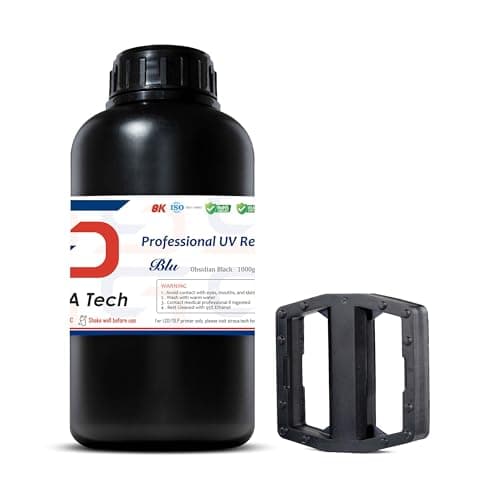
Siraya Tech BluThe bottle to buy when a broken print costs more than the resin. It is what Siraya Tech's whole positioning rests on.Toughened functional resin
ANYCUBIC Standard Resin+This is the resin that produced the reputation. Sharp, cheap, and it shatters under exactly the loads a functional part sees.Brittle standard resinSkip this
Live prices verified October 17, 2026. Scores are our own fit rating for the stated use, not a measurement and not a customer rating.
A resin vat with a printed model on the build plate.
What brittle actually means here
A standard photopolymer resin part fails by shattering: it holds its shape under increasing load and then fails suddenly, with no warning deformation. A PETG part in the same situation bends first. That difference — not the absolute strength number — is what makes standard resin unsuitable for functional parts.
Toughened and ABS-like resins are formulated to deform before failing. They are not as tough as an actual ABS or PETG print, and any claim that they are should be treated with suspicion, but the improvement over standard resin is real and large.
When a functional part should be resin
Small and detailed. A part with fine internal features or precise small geometry that a 0.4 mm nozzle cannot resolve.
Isotropic strength matters. Resin parts do not have the layer-boundary weakness filament parts do, so a resin part is similarly strong in every direction. For geometry that would have to be printed in a bad orientation in filament, that can be decisive.
Surface finish is functional. A smooth bore, a sealed surface, a part that has to slide.
When to print it in filament instead
Honestly, most of the time. If the part is larger than a fist, if it takes repeated impact, if it lives in heat or sunlight, or if it needs to flex, filament is the better answer and it is not close.
Resin also has no equivalent of nylon's sliding-wear behavior, which means printed gears and bearings are a filament job — see filament for gears. And resin parts continue to cure slowly in sunlight, becoming more brittle over time, which rules out most outdoor use.
Cure time affects final mechanical properties substantially, and over-curing makes resin parts more brittle rather than stronger. A part left in a UV station for an hour is not better than one cured for the recommended time.
For functional parts, cure to the manufacturer's recommendation and no further, and let the part reach room temperature before loading it. Warm freshly cured resin is softer than it will be an hour later.
The handling requirement does not change
Toughened resins are still photopolymer resins. Formlabs' guidance on non-reactive gloves and skin contact applies identically Formlabs, and used wash alcohol is still chemical waste Formlabs. See resin safety.
Every pick, in detail
01
Siraya Tech Blu
Siraya Tech
The toughest option here · 8.6/10 our fit score
The functional-parts resin. Buy it when a snapped print costs more than the bottle.
Published specifications for Siraya Tech Blu
Bottle size
1 kg
Cure wavelength
405 nm
What it does well
Genuinely tough — the closest a common resin gets to behaving like an engineering thermoplastic
Blends with other Siraya Tech resins to trade toughness against detail
What it does not
Detail resolution is lower than a standard or miniature resin
Among the more expensive consumer resins per kilogram
No. Toughened resins close part of the gap to filament but do not close it. Their real advantage over standard resin is that they deform before failing rather than shattering without warning.
+ − Does curing longer make resin parts stronger?
Up to the manufacturer's recommended time, yes. Beyond it, over-curing makes parts more brittle. Longer is not better.
+ − Can resin parts be used outdoors?
Not well. Resin continues to cure slowly under sunlight and becomes progressively more brittle. For outdoor parts, ASA printed in filament is the appropriate material.