Most people buying flexible resin do not want a bendy part. They want a part that stops snapping, and the fastest route to that is blending a flexible resin into a standard one - which is a use the manufacturers document themselves.
How this page is funded. Buy links go to Amazon and we earn a commission on qualifying purchases at no extra cost to you. Commission never decides an order or a score, we accept no free products or sponsored placements, and every roundup names something to skip. Full disclosure.
The picks, ranked
The picks, ranked
#
Product
Best for
Score
Price
1
Siraya Tech TenaciousSiraya publish the whole mechanical table and say directly that it can be mixed into other 405 nm resins to raise impact resistance. That is the main reason to own a bottle.65D, 70% elongation, 57 J/m notched Izod
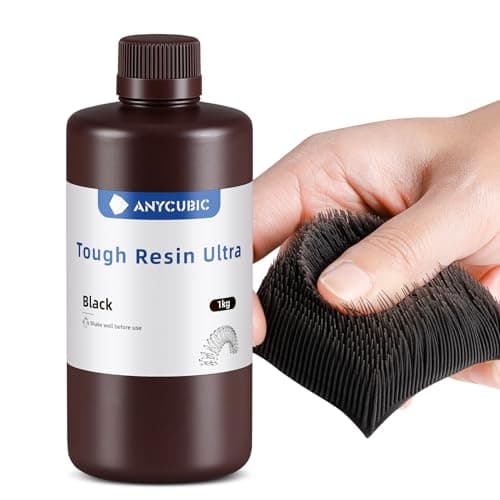
ANYCUBIC Ultra Tough ResinThe highest published elongation here, on a full spec sheet with exposure times. Lower modulus than Tenacious, so parts feel softer rather than springier.71-75 HD, 70-80% elongation
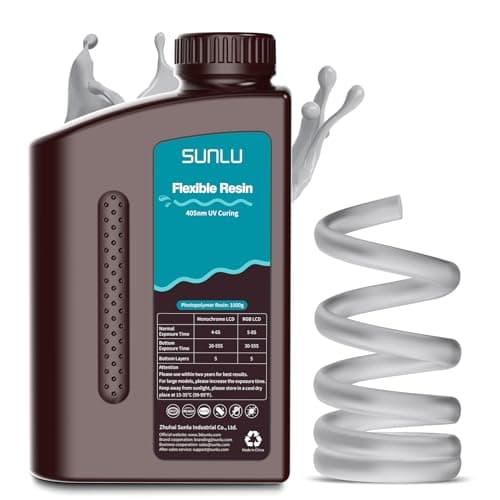
SUNLU Flexible Resin 70AA shore A rating rather than shore D, which is the real dividing line between a tough resin and a soft one. Documentation is thinner than the other two.70A shore, sold for bendable prints
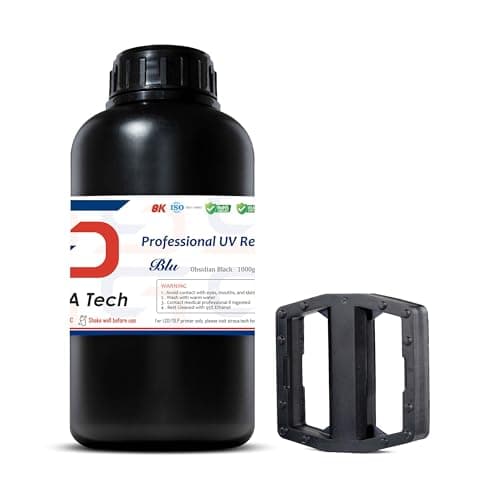
Siraya Tech BluIf the goal is parts that survive a drop rather than parts that bend, start here and skip the blending entirely.Impact-resistant standard resin
Nitrile Disposable GlovesFlexible resins are as much of a skin sensitizer as any other. Blending means more decanting, more pouring and more chances to get it on you.Nitrile or neoprene, per Formlabs
ANYCUBIC Standard Resin+Standard resin is brittle by design. A hinge, a strap or a clip printed in it will snap on the first real flex, which is the problem this page exists to solve.Standard 405 nm resinSkip this
Live prices verified September 21, 2026. Scores are our own fit rating for the stated use, not a measurement and not a customer rating.
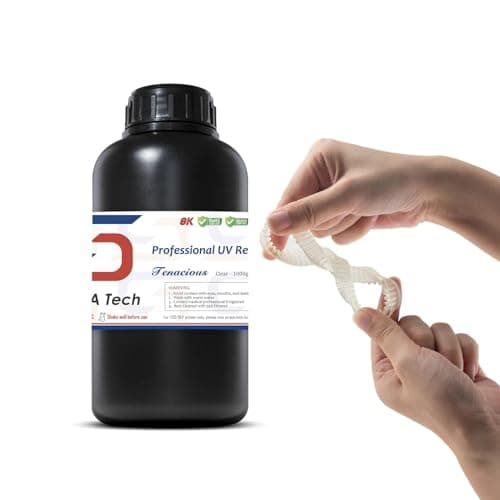
A flexible resin print being bent by hand.
Published figures. Note that hardness is quoted on two different scales.
Resin
Hardness
Elongation at break
Impact
Heat deflection
Siraya Tech Tenacious
65D
70%
57 J/m notched
55 C at 0.455 MPa
ANYCUBIC Ultra Tough
71-75 HD
70-80%
-
-
SUNLU Flexible
70A
-
-
-
Published figures. Note that hardness is quoted on two different scales. Shore A and shore D are different scales: 70A is soft like a shoe sole, 65D is firm like a hard hat. A resin quoted in shore A is a genuinely soft material; one quoted in shore D is a tough one. Figures from Siraya Tech, ANYCUBIC, retrieved 2026-09-21.
Work out which of these you actually want
Flexible resin covers two different products, and the hardness scale on the bottle tells you which is which.
Tough resins quoted in shore D. Siraya publish 65D for Tenacious with 70 percent elongation at break and 57 J/m notched Izod Siraya Tech. These bend a little and refuse to shatter; they are the answer to brittle prints.
Soft resins quoted in shore A. A 70A resin is in shoe-sole territory — genuinely rubbery. That is what you want for a gasket or a squeezable part, and it is not what most people mean when they search for flexible resin.
Blending, which is the real use case
Siraya state that Tenacious can be used alone or mixed into other 405 nm resins to enhance impact resistance Siraya Tech. That single sentence explains why this bottle sits on so many benches: a modest percentage blended into a standard or ABS-like resin takes the brittleness off it without changing the workflow.
Start small. A little goes further than expected, and every increment costs you detail sharpness and adds cure time.
Mix thoroughly and let it settle. Streaks in the vat print as inconsistent layers.
Re-run an exposure test after any blend change. The blend is a new resin as far as your printer is concerned — the method is on resin print settings.
Label the bottle. An unlabeled blend is an unrepeatable result, and you will not remember the ratio in a month.
Keep the ratio the same across a project. Parts printed from different blends will not match in color, flex or cure behavior.
Printing flexible resin neat
Soft resins are more demanding than standard ones in three specific ways, and none of them is about the resin being difficult so much as about the part not being rigid while it prints.
Peel forces matter more. A flexible part stretches instead of resisting when the plate lifts, which distorts layers. Slower lift speeds help more than any other single change.
Supports need to be denser. A soft part sags between supports while it prints.
Curing decides the final feel. Under-cure and the part stays tacky and weak; over-cure and the flexibility you paid for disappears. ANYCUBIC publish 1.5 to 3 seconds normal exposure and 3 minutes of 405 nm curing for Ultra Tough ANYCUBIC, which is a sensible starting point to calibrate around.
Expect a longer wash. Soft surfaces hold resin more stubbornly than hard ones.
What flexible resin is not
It is not TPU. A printed TPU part takes hundreds of flex cycles and shrugs; a flexible resin part is a photopolymer with elastomer-like behavior, and repeated deep flexing eventually tears it. ANYCUBIC publish 70 to 80 percent elongation at break for Ultra Tough ANYCUBIC and Siraya 70 percent for Tenacious Siraya Tech, which is impressive for a resin and modest next to a flexible filament.
It is also not heat resistant: Siraya publish a 55 C heat deflection temperature at 0.455 MPa for Tenacious Siraya Tech, which is car-dashboard territory in the wrong direction.
Safety, and why blending raises the stakes
Liquid resin is a skin sensitizer and Formlabs’ guidance calls for non-reactive nitrile or neoprene gloves and ventilation Formlabs. Blending means decanting, measuring and pouring — three more opportunities for a spill than a normal print has. Mix over a tray, not over the bench.
Leftover blended resin is still chemical waste: Formlabs treat liquid resin, including resin dissolved in solvent, as potential hazardous waste Formlabs. The disposal routine is on resin safety.
Where it genuinely earns its price
Miniature weapons, antennae and thin parts that snap in transit — a blend fixes this better than thicker geometry does. The detail ranking is on best resin for miniatures.
Snap-fit prototypes where the clip has to survive being assembled more than once.
Wearables and cosplay parts that need to flex onto a body without cracking — filament for cosplay covers the filament half of that build.
Soft-touch grips and pads in a genuine shore A resin, where a rigid part would be uncomfortable.
Every pick, in detail
01
Siraya Tech Tenacious
Siraya Tech
Blending toughness into a brittle resin · 8.7/10 our fit score
Bought more often as a blending ingredient than as a standalone resin, and Siraya document that use themselves.
Published specifications for Siraya Tech Tenacious
Two jobs. Tough resins quoted in shore D, like Siraya's 65D Tenacious with 70 percent elongation at break, stop parts shattering. Soft resins quoted in shore A make genuinely rubbery parts. Most people searching for flexible resin want the first one.
+ − Can you mix flexible resin with normal resin?
Yes, and the makers document it: Siraya state Tenacious can be mixed into other 405 nm resins to enhance impact resistance. Start with a small proportion, mix thoroughly, and re-run an exposure test, because the blend behaves as a new resin.
+ − Is flexible resin as flexible as TPU?
No. Published elongation at break runs around 70 to 80 percent for these resins, which is good for a photopolymer and modest beside a flexible filament. For parts that flex daily — hinges, straps, gaskets — TPU is the right material.
+ − Does flexible resin need different print settings?
Slower lift speeds, denser supports and a longer wash, plus a careful cure: under-curing leaves parts tacky and over-curing removes the flexibility. ANYCUBIC publish 1.5 to 3 seconds of normal exposure and around 3 minutes of 405 nm curing for Ultra Tough as a starting point.