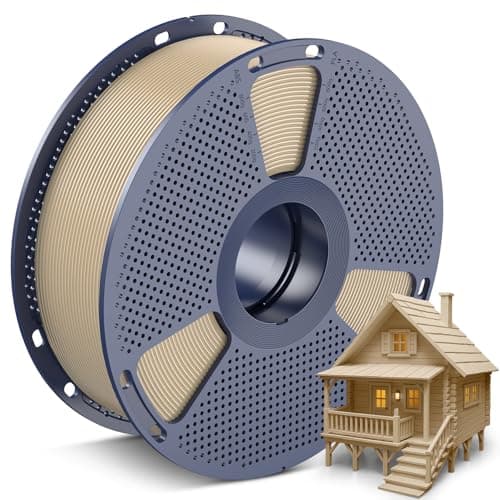
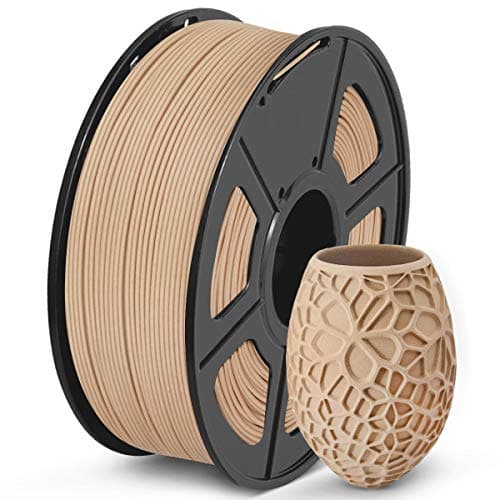
Wood filament is PLA with wood fiber mixed into it, and the published fill runs from 11 to 20 percent across the spools worth buying. That number decides everything downstream: how much grain you get, how readily it clogs, and whether the finished print sands and stains like wood or just looks brown.
How this page is funded. Buy links go to Amazon and we earn a commission on qualifying purchases at no extra cost to you. Commission never decides an order or a score, we accept no free products or sponsored placements, and every roundup names something to skip. Full disclosure.
The picks, ranked
The picks, ranked
#
Product
Best for
Score
Price
1
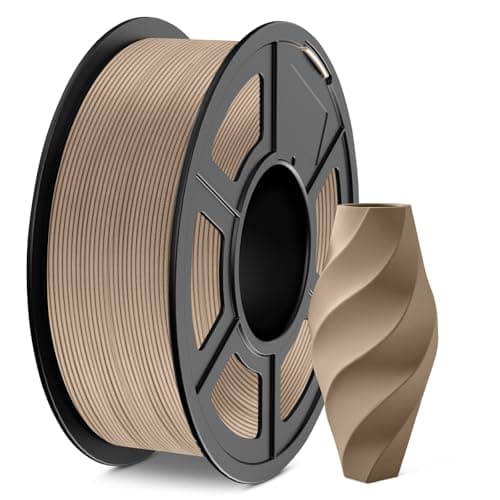
SUNLU Real Wood Fiber PLAThe highest published fill of the spools here, at budget-spool money. More grain, more scent when it prints, and more reason to fit a wider nozzle first.20% wood fiber published
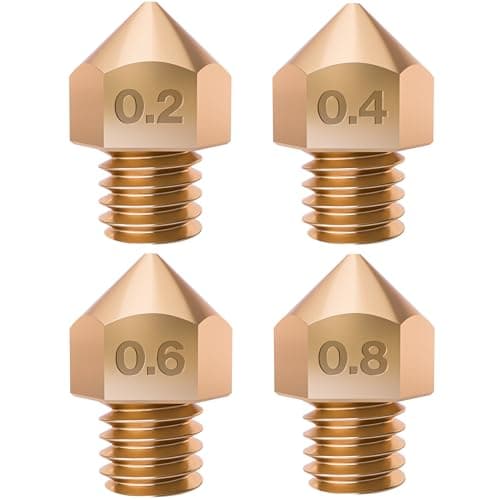
Brass Nozzle AssortmentWood fiber is a physical particle bridging a narrow orifice. Going from 0.4 to 0.6 mm removes most of this category's reputation for clogging.Typically 0.2 / 0.4 / 0.6 / 0.8 mm
JAYO Wood Fiber PLAEnough fiber to read as wood, little enough to print without a fight, on a spool that carries an extra 100 grams.15% wood fibers, 1.1 kg spool
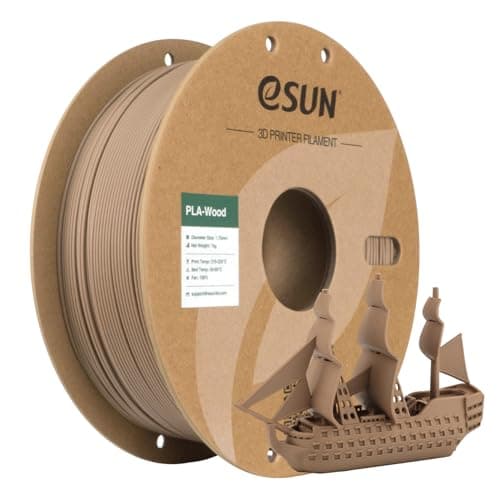
eSUN Wood PLAThe only one here that publishes what nozzle to use. Finer texture suits small models and gives up some drama on large flat faces.0.4 mm or larger; avoid 0.2 mm
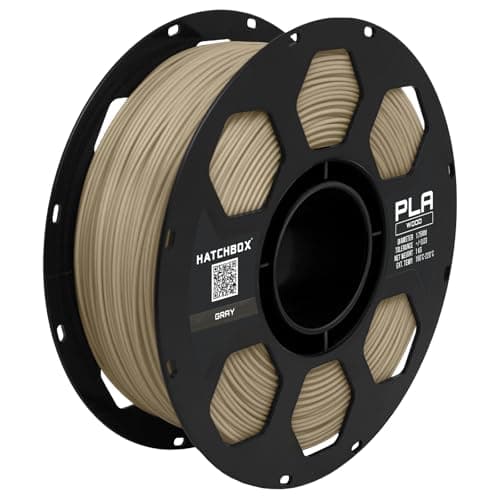
HATCHBOX Wood PLAThe low-fill end of the range: easiest to print, least wood-like off the plate, and the most expensive per kilogram of the four.11% recycled wood fibers, 175-220 C
SUNLU PLA, Wood ColorPerfectly good brown PLA sold under names like Wood Color and Oak. It will not sand, stain or smell like wood, because there is no wood in it.No fiber content — a colorSkip this
Live prices verified September 14, 2026. Scores are our own fit rating for the stated use, not a measurement and not a customer rating.
Spools of PLA filament stacked on a workshop shelf.
First question: is there wood in it?
This category has a naming problem that costs people money. Spools sold as "Wood", "Oak", "Walnut" or "Wood Color" fall into two entirely different groups, and the listings do not always make it obvious which one you are looking at.
Wood-filled filament is PLA with real wood fiber or wood flour mixed in, usually 10 to 20 percent by weight. It smells of sawdust while printing, sands like a soft wood, takes stain, and shows genuine grain variation.
Wood-colored filament is ordinary PLA in a brown pigment. It prints beautifully, never clogs, and does none of the above.
Neither is dishonest on its own — brown PLA is a legitimate product — but if you wanted the sanding and staining, the color version is a wasted order. The test is simple: the listing has to state a fiber percentage or say "wood fiber" or "wood flour" somewhere. If all it says is a wood name, treat it as a color.
Fill percentage is the axis everything else moves on
The spools worth buying publish where they sit: HATCHBOX state 11 percent recycled wood fibers, JAYO 15 percent, and SUNLU 20 percent for their wood-fiber line. SUNLU also publish a separate wood PLA line at 15 percent wood powder with a 200 to 220 C nozzle and a 50 to 60 C bed SUNLU, which is a useful reminder to check which line you are ordering rather than trusting the brand name.
More fiber gives you more of what you came for and more of what you did not:
More grain and texture. Higher fill reads as wood from further away and shows more variation between layers.
More clogging. Fiber is a solid particle, and particles bridge narrow orifices. This is the single most common complaint about the category and it scales with fill.
Less strength. Fiber interrupts the polymer, so layer adhesion and impact resistance both fall relative to plain PLA. Wood-filled parts snap where a PLA+ part would flex.
Better sanding and staining. The reason to accept the first three. A 20 percent spool sands to a surface that takes wood stain unevenly in the way real timber does.
The nozzle decision, made before the first print
Almost every "wood filament clogged my printer" story is a 0.4 mm nozzle story. eSUN publish the fix on their own listing: use 0.4 mm or larger and avoid 0.2 mm entirely. We would go further and fit a 0.6 mm for anything above about 15 percent fill — the wider bore is far more tolerant of particles, and at the sizes people print wood models the detail loss is invisible. Which diameter suits which job is on 3D printer nozzle sizes.
On nozzle material, wood is the mild case. Wood flour is much softer than the carbon and glass fibers E3D measured brass wear against E3D, so a brass nozzle is genuinely fine here in a way it is not for composites. If you print wood constantly a hardened nozzle is cheap insurance, but unlike carbon fiber filament it is not a prerequisite.
If it does block, work the causes in order rather than replacing hardware — the sequence is on why your nozzle keeps clogging.
Settings: hotter, slower, and no retraction games
Wood-filled PLA sits inside the standard PLA window — Prusa publish 185 to 235 C at the nozzle with a 50 to 60 C bed for the class Prusa Research — and SUNLU narrow that to 200 to 220 C for their own wood line SUNLU. Four practical adjustments do most of the work.
Run hotter than your plain PLA profile. Fiber raises viscosity; a temperature that flowed fine unfilled will under-extrude filled.
Slow down. Lower flow rate through a partially obstructed path is the difference between a print and a jam.
Reduce retraction. Long retractions drag fiber back into the cold zone where it packs. Shorter, fewer retractions and a little more stringing to clean up is the right trade.
Dry it like PLA. Wood fiber is hygroscopic in its own right, so damp wood filament pops and foams more than damp plain PLA does. Prusa publish 45 C for 6 hours for PLA Prusa Research, and wood-filled spools are worth drying before a piece you care about.
The temperature trick that makes it look like wood
Wood-filled PLA darkens as it gets hotter, because the fiber scorches slightly. That is usually described as a defect and it is also the most useful feature of the material: varying nozzle temperature between layers produces bands of light and dark that read as grain.
Most slicers can change temperature at a given layer, and some generators produce a modifier script for exactly this. Start with a narrow band — a few degrees either side of your working temperature — and print a test tower before committing to a tall model. Two cautions: staying at the top of the range for hours accelerates scorch deposits inside the nozzle, and the effect varies between spools, so a recipe from a forum post is a starting point rather than a setting.
Finishing: this is where the material pays off
A wood-filled print is the rare FDM output that gets better with ordinary woodworking tools rather than 3D-printing ones.
Sand it. Start around 120 grit and work up. The fiber sands away with the polymer instead of gumming the paper the way plain PLA does, and layer lines disappear far more readily.
Stain it. Wood stain takes unevenly, which is exactly what you want — it pools in the fiber and leaves the polymer lighter, which is what produces a convincing grain.
Seal it. Wax, oil or a matte clear coat. Sealing also mitigates the material's biggest weakness, which is that the fiber will take up moisture from the room over time.
Skip the primer. Priming and painting a wood-filled print throws away the only reason to have bought it. If the piece is getting painted, print it in matte PLA instead — the comparison is on matte and silk PLA.
What not to print in it
Anything structural. Fiber reduces layer adhesion, so brackets, hooks and clips snap. Use a toughened PLA+ or PETG and accept that it looks like plastic — the ranking is on strongest filament.
Anything that gets wet. Wood fiber swells. A printed planter liner or coaster will not survive standing water even sealed, for the same porosity reasons set out on is PLA waterproof.
Fine miniatures. The texture that makes a bowl look like oak makes a 28 mm face look like a smudge, and the nozzle you need for wood is the opposite of the one detail needs — see best filament for miniatures.
Anything hot. It is still PLA underneath. Prusa state PLA softens and deforms above about 60 C Prusa Research, and the fiber does not change that.
Is it worth it?
For lamp shades, bowls, boxes, picture frames, architectural models and anything meant to be handled and admired rather than used, yes — and the price gap over plain PLA is small enough that a single spool is a cheap experiment. For everything else the honest answer is that a matte brown PLA prints more reliably, costs less and looks close enough at arm's length.
Buy one spool with a published fiber percentage, fit a 0.6 mm nozzle, and print a small bowl before you commit to a project. If you like what sanding does to it, the material will keep rewarding you. If you do not, you have spent less than a dryer costs finding out.
Every pick, in detail
01
SUNLU Real Wood Fiber PLA
SUNLU
The most wood for the money · 8.7/10 our fit score
The highest published wood content of the spools worth buying, at a price that makes experimenting with it painless.
Published specifications for SUNLU Real Wood Fiber PLA
PLA with wood fiber or wood flour mixed in, typically 10 to 20 percent by weight. HATCHBOX publish 11 percent recycled fibers, JAYO 15 percent, and SUNLU 20 percent for their wood-fiber line. Spools sold only as a wood color contain no wood at all.
+ − Does wood filament clog nozzles?
It can, and the fix is nozzle size rather than brand. eSUN publish guidance to use 0.4 mm or larger and avoid 0.2 mm; we would fit a 0.6 mm for anything above about 15 percent fill. Printing hotter and slower with less retraction removes most of the rest.
+ − Do you need a hardened nozzle for wood filament?
Not usually. Wood flour is far softer than the carbon and glass fibers that E3D measured brass wear against, so brass is genuinely fine for occasional wood printing. If you print it constantly, a hardened nozzle is cheap insurance rather than a requirement.
+ − Can you sand and stain 3D printed wood filament?
Yes, and it is the main reason to buy it. Start around 120 grit; the fiber sands away with the polymer rather than gumming the paper. Wood stain takes unevenly, pooling in the fiber, which is what produces a convincing grain. Seal with wax, oil or a matte clear coat afterwards.