Two things decide whether you are happy with a glow print: what color the spool is in daylight, and how thick you printed the walls. The filament is phosphorescent powder suspended in PLA or PETG, which makes it abrasive, slightly weaker than plain filament, and brighter the more of it you put in the part.
How this page is funded. Buy links go to Amazon and we earn a commission on qualifying purchases at no extra cost to you. Commission never decides an order or a score, we accept no free products or sponsored placements, and every roundup names something to skip. Full disclosure.
The picks, ranked
The picks, ranked
#
Product
Best for
Score
Price
1
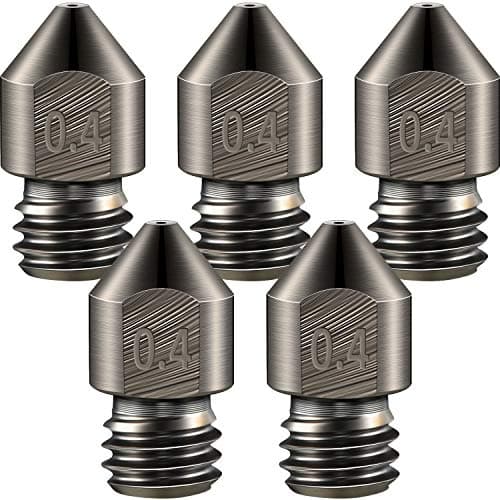
Hardened Steel NozzlePhosphorescent powder is a hard mineral filler. E3D document brass wearing measurably within a few hundred grams of filled filament, and glow is squarely in that category.Hardened steel, abrasion resistant
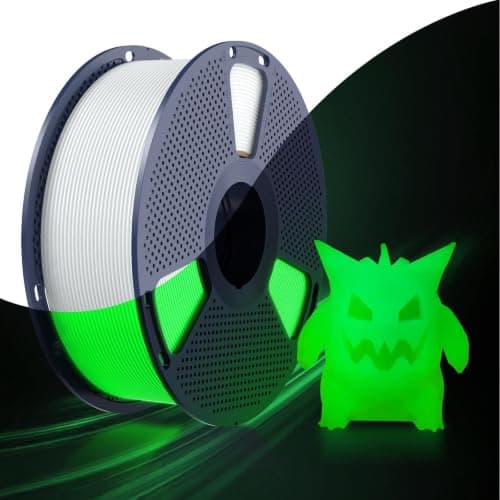
SUNLU Glow PLA, White BodyThe pairing most people want and the one they most often fail to order. Neutral on the shelf, green when the lights go out.White body, glows green
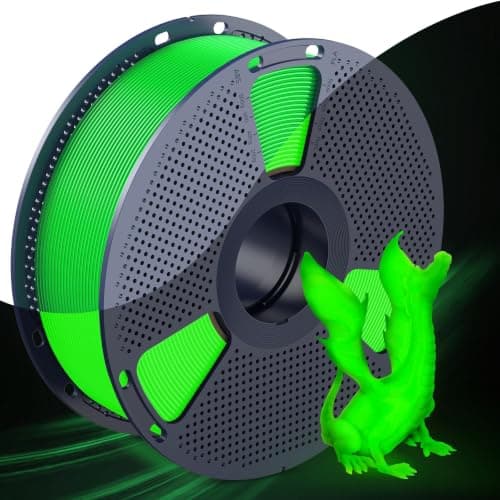
SUNLU Glow PLA, Green BodyUsually the cheapest glow spool on the shelf, and the right one when the print is meant to read as luminous in daylight too.Green body, glows green
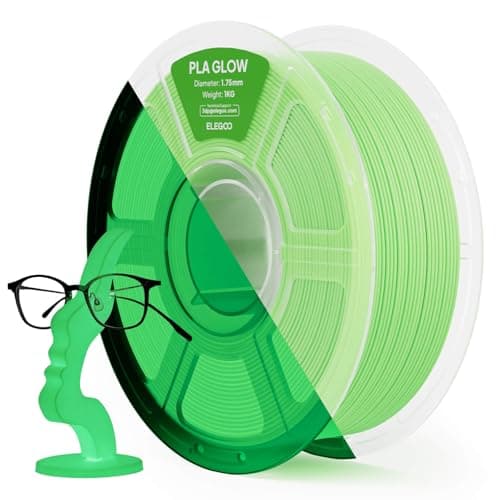
ELEGOO PLA GlowLeans on even pigment distribution, which is the property that decides whether a big print glows uniformly or in patches.190-230 C published window
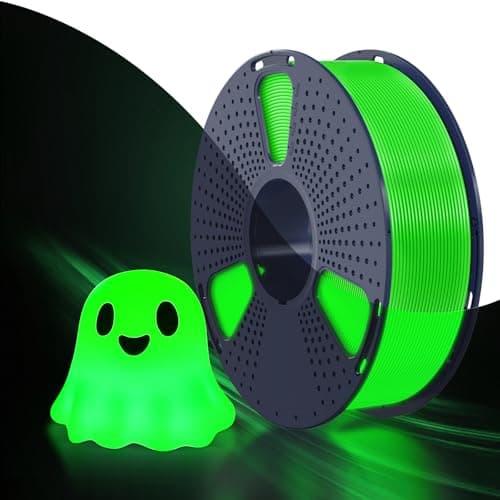
SUNLU PETG GlowGarden markers, door signs, anything dropped. PETG's toughness matters more than usual here because the filler already costs you layer strength.PETG base, 215-270 C nozzle
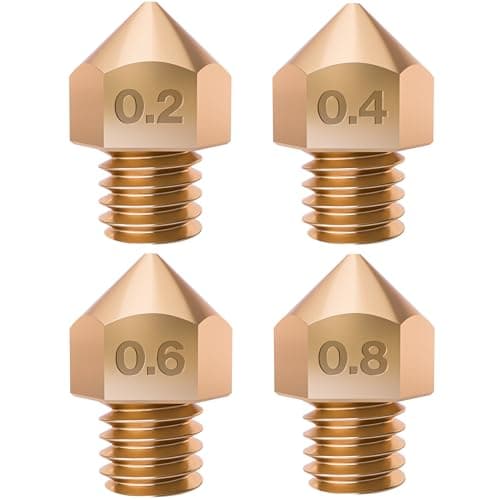
Brass Nozzle AssortmentBrass is the right nozzle for most of this site and the wrong one for this page. The bore widens silently and your dimensions drift before anything looks broken.Brass, wears on filled filamentSkip this
Live prices verified September 14, 2026. Scores are our own fit rating for the stated use, not a measurement and not a customer rating.
Spools of PLA filament stacked on a workshop shelf.
What you are actually buying
Glow filament is ordinary PLA or PETG with phosphorescent powder mixed into it. The powder absorbs light, stores the energy, and releases it slowly as visible light — which is why it is properly called an afterglow rather than a light source. Everything that makes this category different from plain filament follows from the fact that there is a hard mineral powder in the plastic.
It is abrasive. The powder wears nozzles. This is not a preference, and it is the one place we would stop you buying the spool before you buy the nozzle.
It is slightly weaker. Filler interrupts the polymer, so layer adhesion drops relative to the unfilled version. Glow prints are decorative.
Brightness scales with material. More pigment in the light path means a brighter glow, so wall thickness matters more than which brand you bought.
The body color is a separate decision from the glow color. This is the one that costs people an order.
Daytime color is not the glow color
Every glow spool has two colors and the listing usually names both, in a format people skim past: a body color, which is what the print looks like in daylight, and a glow color, which is what it does in the dark. SUNLU sell the same green glow in both a white body and a green body, and the difference in the finished object is total.
White or natural body looks like an ordinary print on a shelf and glows green at night. Right for lamp parts, signage, models and anything that spends most of its life lit.
Green (or blue, or orange) body looks luminous in daylight too. Right for props, toys and Halloween pieces where the novelty is the point.
The glow is almost always green, whatever the body. Green phosphors are the brightest and longest-lasting of the common pigments; blue and orange glows exist and are noticeably dimmer for the same charge.
How to make it actually glow
Most disappointment with this category is a thin-wall problem, not a filament problem. The glow you see is the sum of the pigment along the light path, so a two-perimeter shell with sparse infill has very little pigment to work with and looks feeble next to the marketing photos.
More perimeters. Three or four rather than two. On a small model, printing solid is not extravagant.
Thicker walls in the model. If you are designing it, 2 mm reads far brighter than 0.8 mm. Thin translucent shells are the worst case.
Charge it with UV. SUNLU state plainly that the luminous effect is better after exposure to UV light. A cheap UV torch for thirty seconds beats an hour under a room lamp.
Expect the decay curve. Phosphorescent pigments are bright for the first minutes and faint for hours. That is how the chemistry behaves, not a defect in the spool, and no brand escapes it.
Keep the surface matte. Sanding to a gloss scatters less light out of the part; a slightly rough surface reads brighter to the eye.
The nozzle warning this category earns
This site tells you a brass nozzle is fine for most filament. Glow is one of the exceptions. The phosphor is a hard mineral powder, and E3D document substantial brass wear from filled filaments within a few hundred grams E3D. The failure mode is the insidious one: the bore widens gradually, extrusion widths creep up, and prints drift out of tolerance long before anything looks wrong — which is the whole subject of the nozzle wear guide.
Fit hardened steel before the first spool. A few dollars against a failure you cannot see. Steel conducts heat less well than brass, so add a few degrees to your usual profile.
Consider going up a size. Filler particles bridge narrow orifices; a 0.6 mm nozzle is far more tolerant than a 0.4 mm one, and glow prints rarely need fine detail — see nozzle sizes.
If it blocks, do not immediately replace it. Work the causes in order on why your nozzle keeps clogging; filled filament is on that list but so is moisture.
Printing it
SUNLU publish a real window for their glow PLA: 200 to 210 C at the nozzle for 50 to 100 mm/s, 210 to 240 C for 100 to 200 mm/s, with a 50 to 60 C bed and a 1.75 mm diameter held to +/- 0.02 mm SUNLU. ELEGOO publish a wider 190 to 230 C range for their own glow line. Both sit inside Prusa's general PLA envelope of 185 to 235 C Prusa Research.
Run at the warmer end. Filler raises viscosity, so the temperature that flowed nicely in plain PLA will under-extrude here.
Slow down on small features. Filled filament is less forgiving of high flow through a partially obstructed path.
Dry it like PLA. Prusa publish 45 C for 6 hours for PLA and 55 C for 6 hours for PETG Prusa Research. Damp glow filament pops and leaves a rough surface that dulls the effect.
Do not chase a glossy finish. The filler makes the surface slightly grainy. That is normal, and it helps the glow read evenly.
When to buy the PETG version instead
Glow PETG exists and is worth the swap for anything that is handled, dropped or left outdoors overnight. PETG is noted by Prusa for impact resistance and prints at 215 to 270 C with a 70 to 90 C bed Prusa Research, and that toughness matters more than usual here because the glow filler has already cost you some layer strength.
The trade is tuning: PETG plus an abrasive filler strings more enthusiastically than either alone, and it is more hygroscopic, so drying stops being optional. The order of operations for taming it is on PETG print settings.
The warning the listings bury
SUNLU's own product listing says something worth repeating: glow filament should avoid long exposure to direct sunlight, and the longer the exposure, the faster the color fades. That is a real constraint on how you use the material, and it cuts against the most obvious use case.
So a glow garden marker that bakes in full sun all summer will fade, whichever base polymer it uses. If the piece lives outdoors permanently, the honest recommendation is a UV-stable material in a normal color — ASA, per best filament for outdoor use — and to accept that glow is an indoor or seasonal effect. Charging the part indoors under a UV lamp for a minute before you need it works better than leaving it in a window all day anyway.
What not to print in it
Anything structural. The filler reduces layer adhesion, so brackets and clips snap sooner than their plain equivalents. The ranking of materials that do carry load is on strongest filament.
Fine miniatures. The grainy surface and the larger nozzle you want for filled filament both fight detail — see best filament for miniatures.
Anything hot. Glow PLA is still PLA, and Prusa state PLA softens and deforms above about 60 C Prusa Research. A glowing part on a warm lamp housing is a slowly sagging part.
Anything you expect to look like a light. Manage expectations: this is a soft afterglow you notice in a dark room, not illumination you could read by.
Is it worth it?
For Halloween props, night-light covers, light-switch surrounds, star-map models, tabletop terrain and anything a child will be delighted by at bedtime, yes — and one spool goes a long way because the effect works best on small, thick-walled objects. For everything else the filler costs you nozzle life and layer strength in exchange for an effect nobody sees in daylight.
Buy the hardened nozzle, buy one white-bodied spool, print something small with four perimeters, and charge it with a UV torch before deciding whether the category is for you. If you like the look and want the other decorative options, wood-filled PLA is the other material that changes a print's character rather than its color — that one is on best wood filament.
Every pick, in detail
01
Hardened Steel Nozzle
Creality / generic MK8
Buy this before the spool · 9.0/10 our fit score
The five-dollar part that stops abrasive filament from quietly widening your nozzle mid-print. Buy one before your first carbon fiber spool, not after.
Published specifications for Hardened Steel Nozzle
Common size
0.4 mm
Required for
Carbon fiber, glass filled, glow in the dark, metal filledE3D
Trade-off
Lower thermal conductivity than brass
What it does well
E3D document substantial wear on a brand new brass nozzle after only 250 g of carbon-fiber-filled filament
Cheap enough to keep a spare in the drawer
What it does not
Conducts heat worse than brass, so very high flow rates need a few degrees more
Hardened steel tempers and softens at extreme temperatures — E3D make this point explicitly
The one that publishes a wider printing window and leans on even pigment distribution, which is the property that decides whether a large print glows in patches.
A white-bodied glow PLA if you want the print to look normal in daylight, and a green-bodied one if the novelty look is the point. Green glow is the brightest and longest-lasting of the common pigment colors whatever body you choose. Fit a hardened nozzle first — the pigment is abrasive.
+ − Why is my glow in the dark print so dim?
Usually thin walls. The glow is the sum of the pigment in the light path, so a two-perimeter shell with light infill has very little to work with. Print three or four perimeters or solid, design walls around 2 mm, and charge it with a UV torch rather than a room lamp.
+ − Does glow in the dark filament wear out nozzles?
Yes. The phosphorescent powder is a hard mineral filler, and E3D document measurable brass wear from filled filaments within a few hundred grams. Use a hardened steel nozzle, and consider a 0.6 mm since glow prints rarely need fine detail.
+ − Does glow filament fade over time?
The glow effect itself does not wear out from being charged, but SUNLU warn that prolonged direct sunlight fades the material, and faster the longer it is exposed. For permanent outdoor pieces use a UV-stable material such as ASA and treat glow as an indoor or seasonal effect.