Nothing on this page is a wire. Conductive filaments print parts that carry a small current or dissipate static, with resistance measured in kilohms rather than fractions of an ohm. Decide which of those two jobs you have before you buy, because the materials are not interchangeable.
How this page is funded. Buy links go to Amazon and we earn a commission on qualifying purchases at no extra cost to you. Commission never decides an order or a score, we accept no free products or sponsored placements, and every roundup names something to skip. Full disclosure.
The picks, ranked
The picks, ranked
#
Product
Best for
Score
Price
1
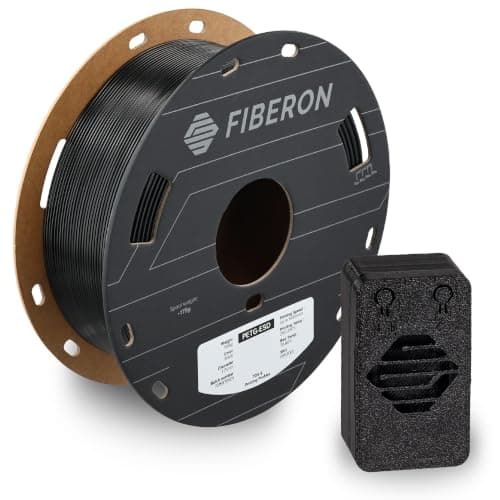
Polymaker Fiberon PETG-ESDThe only spool here with a dated, standards-referenced test report, and it shows resistivity changing with print temperature. That is the level of disclosure this category needs.Surface resistivity 10^4 to 10^7 ohms
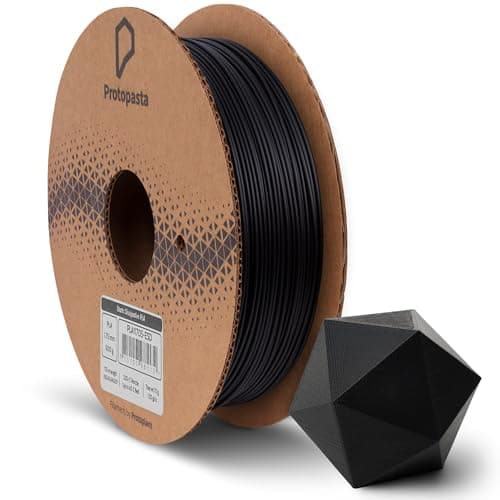
Protopasta Static Dissipative PLAPLA-based, so it prints without an enclosure or high temperatures. The trade is PLA's heat limit, which rules out anything near a soldering station.Static dissipative PLA, low warp
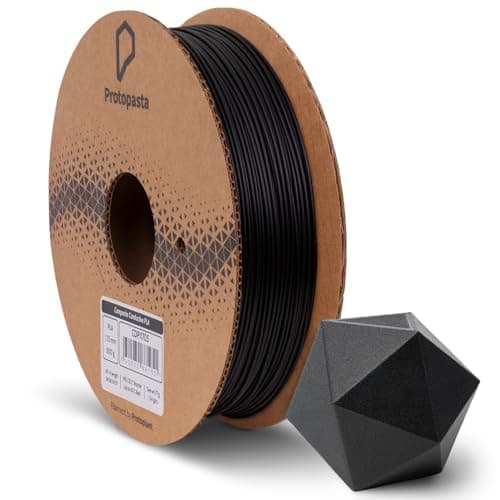
Protopasta Conductive PLAProtopasta publish a resistance figure for the raw filament and say plainly that a printed part's resistance depends on geometry and settings. Treat it as a resistor.2.0-3.5 kohm per 10 cm of filament
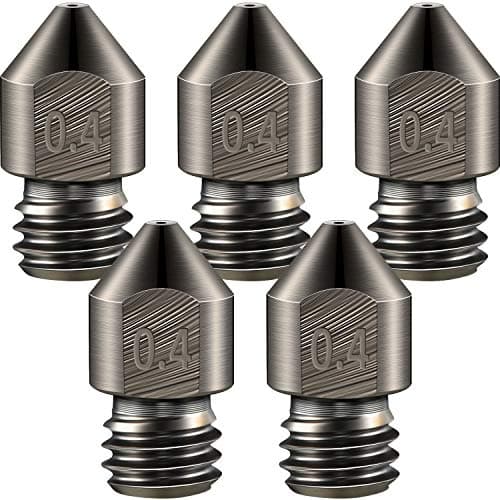
Hardened Steel NozzleEvery filament on this page is carbon-loaded and abrasive. A brass nozzle wears measurably within a few hundred grams.Hardened steel, fits most hotends
Bambu Lab PLA-CFCarbon-filled does not mean ESD-safe. A material with no published surface-resistivity figure is not a static-control material, however black it looks.No published resistivity figureSkip this
Live prices verified September 21, 2026. Scores are our own fit rating for the stated use, not a measurement and not a customer rating.
A black printed part beside electronic components.
Published electrical figures. Note that these are different measurements, not competing ones.
Spool
Base
Published figure
Nozzle (C)
Bed (C)
Polymaker Fiberon PETG-ESD
PETG
10^4-10^7 ohm surface
250-290
70-80
Protopasta Conductive
PLA
2.0-3.5 kohm / 10 cm
-
-
ESD-safe target range
-
10^4-10^9 ohm/sq
-
-
Published electrical figures. Note that these are different measurements, not competing ones. Surface resistivity is measured across a surface in ohms per square; the Protopasta figure is the resistance of a length of raw filament. Neither converts into the other, and neither makes the material a conductor in the wiring sense. Figures from Polymaker, Protopasta, Polymaker, retrieved 2026-09-21.
Two different jobs, two different materials
Almost every disappointed buyer in this category bought the wrong one of these two things.
Conductive filament is for carrying a small current: capacitive touch pads, simple sensors, low-current traces, EL projects. It behaves like a resistor, not like copper.
ESD-safe or static-dissipative filament is for handling electronics: trays, jigs, fixtures and housings that bleed static away instead of storing it. Polymaker put the useful band at a surface resistivity of 10^4 to 10^9 ohms per square, and note that below about 10^4 the material starts behaving like a conductor, which risks unwanted current flow Polymaker.
What the numbers actually promise
Protopasta publish a typical resistance of 2.0 to 3.5 kilohms for 10 cm of 1.75 mm filament, and add the sentence that matters: measured resistance varies, and a printed part’s resistance depends on geometry and settings Protopasta. A long thin trace has far more resistance than a short fat one, and layer boundaries add resistance in the Z direction.
Polymaker go further and publish a dated test report for PETG-ESD against ANSI/ESD STM11.11, showing surface resistivity falling as the print temperature rises: around 10^7 ohms at 250 C, around 10^5 at 270 C, and below 10^4 at 290 C Polymaker. That is a startling result for anyone who assumed the material has one fixed value — your slicer profile is part of the electrical specification.
What this rules out
Power. A printed part with kilohms of resistance will not carry meaningful current without heating, and nothing here replaces a conductor in a mains or motor circuit. The useful applications are signal-level: sensing, static control, and shielding-adjacent parts where a defined resistance is the point.
Printing carbon-loaded filament
Fit a hardened nozzle first. These compounds are carbon-loaded and abrasive; E3D document measurable brass wear within a few hundred grams of filled filament E3D. The detail is on the nozzle wear guide.
Watch the hotend temperature as a spec, not a preference. Polymaker publish 250 to 290 C for PETG-ESD and pair each temperature with a measured resistivity Polymaker. Print at the temperature that produces the property you need.
Keep the fan low. Polymaker cap cooling at 50 percent for PETG-ESD and suggest reducing it further if layer adhesion suffers Polymaker.
Expect brittleness and feed carefully. Highly filled filaments snap in tight bends. Keep the path from spool to extruder gentle, and do not leave a loaded spool under tension overnight.
Design fat traces. Cross-section is resistance. If a printed trace must carry a signal reliably, make it wider and shorter than instinct suggests.
Choosing an ESD-safe spool properly
Polymaker describe carbon nanotube compounding as what gives PETG-ESD its consistent conductivity, and note the property survives machining and wear because the additive runs through the part rather than sitting on it Polymaker. That is the practical difference between a real ESD material and a black spool.
Demand a published figure. A surface resistivity range in ohms per square, ideally with a test standard. No figure means no claim.
Match the base polymer to the environment. A PLA-based ESD spool prints on anything but softens around 60 C Prusa Research; PETG-based handles a warm bench.
Remember the rest of the chain. A dissipative tray on an insulating bench mat is half a solution; static control is a system, not a spool.
Do not confuse it with shielding. Enclosures that block interference are a different requirement again, and printed plastic is not the answer to it.
When to print something else
If you only need a black, tough, dimensionally stable jig and static is not part of the job, a carbon-filled PETG is cheaper, stronger and easier — see carbon fiber filament and PLA-CF versus PETG-CF. If the part needs heat resistance alongside static control, start from most heat resistant filament and work backward to what is available in an ESD grade.
And if the goal is a decorative black part, you are paying several times the price of ordinary PLA for an electrical property you will never measure. The ordinary spools are on best PLA filament.
Every pick, in detail
01
Polymaker Fiberon PETG-ESD
Polymaker
Trays, jigs and fixtures for electronics · 8.6/10 our fit score
The only static-control spool here with a dated, standards-referenced test report, and it shows resistivity moving with print temperature.
Published specifications for Polymaker Fiberon PETG-ESD
Buy this before any of them · 8.7/10 our fit score
The five-dollar part that stops abrasive filament from quietly widening your nozzle mid-print. Buy one before your first carbon fiber spool, not after.
Published specifications for Hardened Steel Nozzle
Common size
0.4 mm
Required for
Carbon fiber, glass filled, glow in the dark, metal filledE3D
Trade-off
Lower thermal conductivity than brass
What it does well
E3D document substantial wear on a brand new brass nozzle after only 250 g of carbon-fiber-filled filament
Cheap enough to keep a spare in the drawer
What it does not
Conducts heat worse than brass, so very high flow rates need a few degrees more
Hardened steel tempers and softens at extreme temperatures — E3D make this point explicitly
No. Protopasta publish a typical resistance of 2.0 to 3.5 kilohms per 10 cm of filament and note that a printed part's resistance depends on geometry and settings. That is resistor territory, useful for sensors and touch pads, not for carrying current.
+ − What is the difference between conductive and ESD-safe filament?
Conductive filament is meant to carry a small current. ESD-safe filament is meant to bleed static away without becoming a conductor: Polymaker put the useful surface resistivity band at 10^4 to 10^9 ohms per square and warn that below about 10^4 the material starts acting like a conductor.
+ − Does print temperature change how conductive the part is?
For PETG-ESD, measurably. Polymaker's test report shows surface resistivity around 10^7 ohms when printed at 250 C, around 10^5 at 270 C and below 10^4 at 290 C. The slicer profile is part of the electrical specification.
+ − Do I need a hardened nozzle for conductive filament?
Yes. These are carbon-loaded compounds, and E3D document measurable brass wear within a few hundred grams of filled filament. A hardened nozzle costs a few dollars and removes the failure mode entirely.