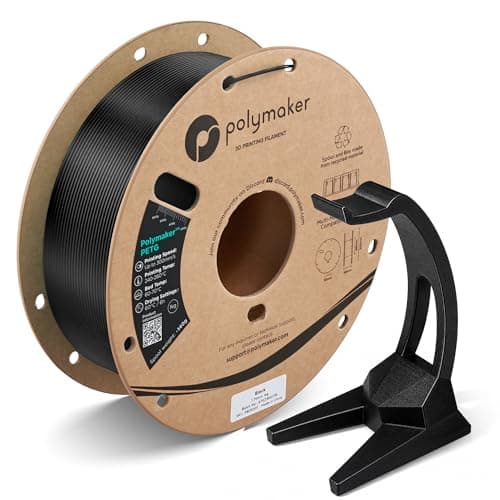
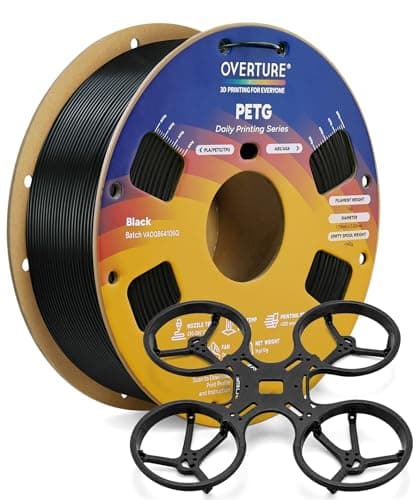
Overture PETG's real virtue is that it is hard to get badly wrong. It prints across a wide band, it is cheap, and it is always in stock — which makes it the right spool to make your PETG mistakes on.
How this page is funded. Buy links go to Amazon and we earn a commission on qualifying purchases at no extra cost to you. Commission never decides an order or a score, we accept no free products or sponsored placements, and every roundup names something to skip. Full disclosure.
The picks, ranked
The picks, ranked
#
Product
Best for
Score
Price
1
Overture PETGForgiving across a wide temperature band, which matters more than peak quality while you are still calibrating.215-270 C nozzle, 70-90 C bed
Live prices verified October 17, 2026. Scores are our own fit rating for the stated use, not a measurement and not a customer rating.
A spool of translucent filament beside a 3D printer.
What forgiving means in practice
PETG's published class window is wide — 215 to 270 C at the nozzle Prusa Research — and different spools behave very differently inside it. Some have a narrow sweet spot where a five-degree error produces visible stringing or poor layer bonding. Overture's does not. It produces usable prints across a broad band, which is precisely the property you want while you are still working out what your machine does.
That is a real advantage even though it is not a quality claim. A spool that tolerates being printed slightly wrong lets you separate your mistakes from the material's behavior, which is the hardest part of learning a new filament.
Stringing, honestly
It strings. All PETG strings. The wisps come off with a heat gun or a quick pass with a lighter held well away from the part, and after retraction tuning the amount is cosmetic rather than structural.
What matters is the order you attack it in. Dry first, temperature second, retraction third. Overture publish their own drying guidance at 65 C for seven hours for PETG Overture, which runs hotter and longer than Prusa's 55 C for six Prusa Research. Both figures are in our drying ledger, and the fact that two manufacturers disagree by ten degrees is itself worth knowing.
Build plate warning
Overture PETG bonds to smooth PEI like every other PETG. If your printer shipped with a smooth PEI sheet, use a glue stick as a deliberate release layer or move to a textured plate before the first print. This is not a brand-specific caution — it is the single most expensive mistake available in PETG, and it destroys plates rather than prints. See build plates.
Where it falls short
No published technical data sheet. A stated temperature range, but not the sort of document you can design against.
Batch variation. Wider than the premium spools, as you would expect at the price. Re-run a flow test when you open a new batch.
Translucent colors vary. Clarity in the clear and translucent colors is inconsistent between batches, which matters if you are printing light diffusers or anything where transparency is the point.
Every pick, in detail
01
Overture PETG
Overture
Learning PETG · 8.8/10 our fit score
The PETG most people should start with: forgiving on temperature, widely stocked, and cheap enough to learn on.
+ − What temperature should I print Overture PETG at?
Start at 240 C and run a temperature tower across the published class window of 215 to 270 C. Overture's forgiving response means several points in that range will look acceptable; take the lowest one with clean layer bonding to minimize stringing.
+ − Is Overture PETG good for beginners?
It is the one we would start on. Its wide tolerance to temperature error means your early mistakes still produce usable prints, which makes it much easier to tell your errors apart from the material's behavior.