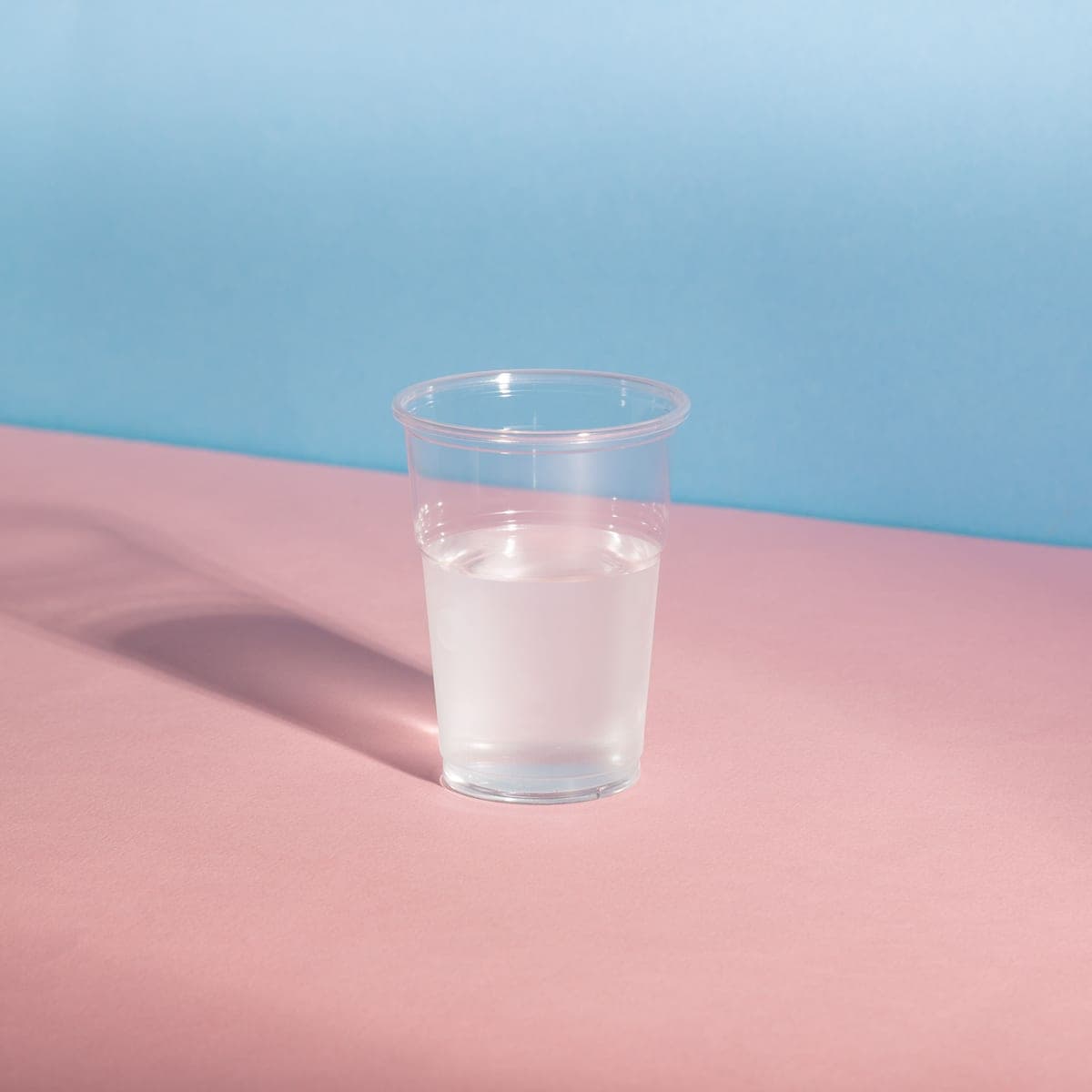
Clear filament produces a frosted part on a default profile. Transparency comes from eliminating internal boundaries — walls, infill, cooling and layer height decide it, and the spool only decides the starting point.
How this page is funded. Buy links go to Amazon and we earn a commission on qualifying purchases at no extra cost to you. Commission never decides an order or a score, we accept no free products or sponsored placements, and every roundup names something to skip. Full disclosure.
The picks, ranked
The picks, ranked
#
Product
Best for
Score
Price
1
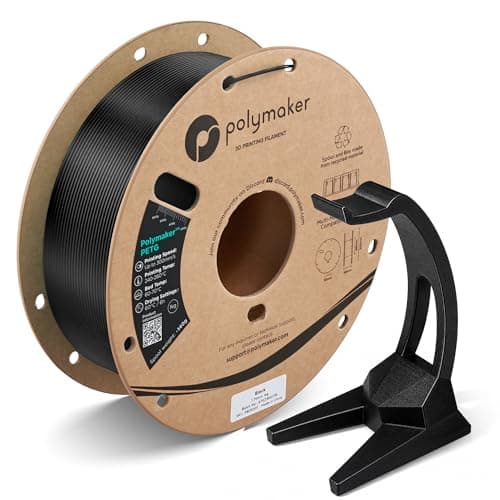
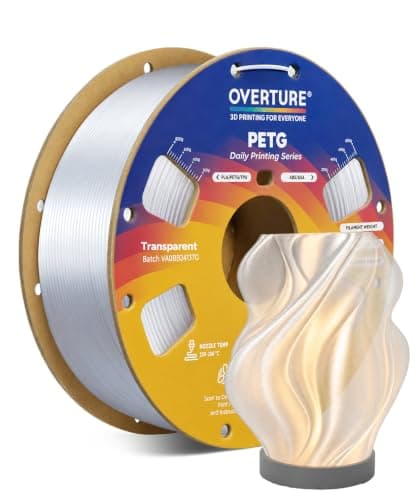
Overture PETG, TransparentOverture list Transparent in their current PETG collection rather than as an occasional run, which is the difference between a color you can reorder and one you cannot.Transparent color, 1 kg spool
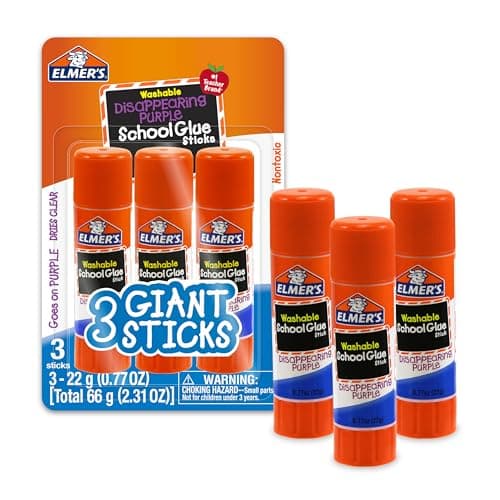
Disappearing Purple Glue StickThe bottom face of a clear print is free optics, and a smooth plate is how you get it. Glue is what stops PETG from taking the plate with it.Release layer under PETG
Polymaker PolyLite PETGPolymaker publish a dedicated translucent PETG line with its own temperatures; when that line is out of stock, the standard PolyLite clear is the same chemistry to work from.Clear and translucent colors offered
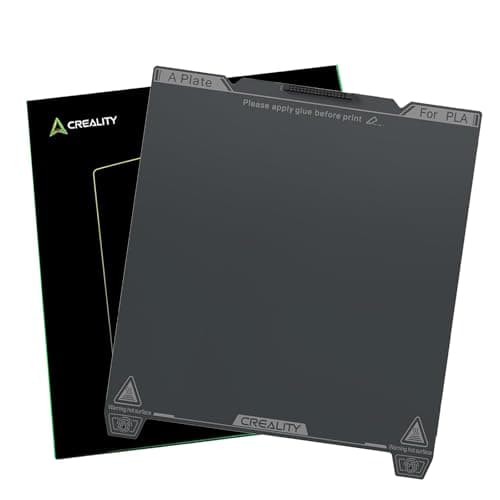
Smooth PEI Spring Steel PlateThe only way to get a genuinely glassy face without sanding. Never run PETG on it bare — Prusa warn against exactly this combination.Smooth PEI, glue stick mandatory for PETG
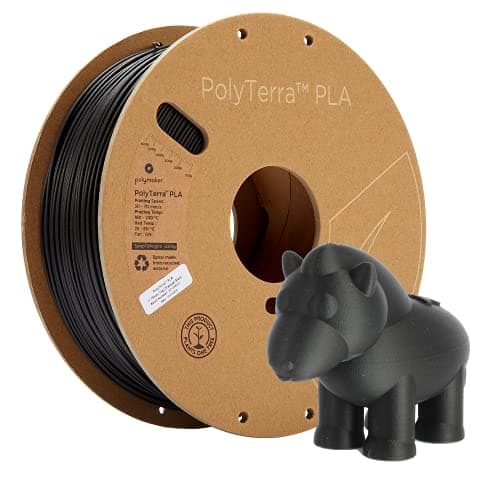
Polymaker PolyTerra PLAMatte additives exist to diffuse light so layer lines stop being visible. That is precisely the property a clear print has to avoid.Matte finish, engineered to scatter lightSkip this
Live prices verified October 21, 2026. Scores are our own fit rating for the stated use, not a measurement and not a customer rating.
A spool of translucent filament beside a printed part.
Why a clear spool prints a frosted part
Transparent filament is transparent. A printed part made from it usually is not, and the reason is geometry rather than chemistry. Light passing through the part meets an interface every time it crosses from plastic into a void and back again, and each interface bends and scatters it. A part printed with ordinary walls and 20 percent infill is thousands of tiny air gaps arranged in a grid.
So the question is not which spool is clearest. It is how to print a part that is solid plastic all the way through, with as few internal boundaries as the geometry allows. Every setting below exists to remove an interface.
The five settings that decide it
Print it solid. Not 50 percent infill: solid. Set wall count high enough that the walls meet in the middle, or set infill to 100 percent with a line pattern that overlaps well. Every infill void is a scattering surface.
Run hot, inside the published range. PETG's window is 215 to 270 C at the nozzle Prusa Research, and the top half of it fuses adjacent extrusions more completely. Hotter plastic flows together instead of stacking as distinguishable beads.
Cut the cooling. Fast cooling freezes each bead before it merges with its neighbor, which is exactly the interface you are trying to remove. PETG already wants low part cooling; for clarity, lower still.
Slow down. Slower extrusion gives the polymer time to wet the previous layer. This is the setting people skip and then blame the filament.
Use fewer, thicker layers. Each layer boundary is an optical interface, so halving the number of them helps. Prusa publish the ceiling: layer height should stay below 80 percent of the nozzle diameter Prusa Research, which is 0.32 mm on a standard 0.4 mm nozzle.
The extreme version of all five is vase mode: a single continuous wall with no layer starts and no infill at all. For a lamp shade, a diffuser or a vessel, it is the clearest result a consumer printer produces, and it is worth designing a part around.
Dry filament matters more here than anywhere
Moisture in filament boils in the nozzle and leaves bubbles in the extrusion. In an opaque part those bubbles are a slight surface roughness you might not notice. In a clear part they are visible all the way through, and no amount of tuning removes them.
PETG is hygroscopic enough that this is a routine problem rather than an unlucky one. Prusa publish 55 C for 6 hours as the drying schedule for PETG Prusa Research. Dry the spool before a clear print you care about, and keep it sealed between sessions — the storage numbers are on how to store filament and the symptoms are on wet filament signs.
The bottom face is the one free optical surface
Every other face of a print carries layer lines. The first layer carries an impression of the build plate, so a smooth plate hands you one genuinely flat, glossy surface at no cost. On a lens-like part or a light guide, orient the model so the face that matters is the one against the plate.
The caution is the standing one on this site: PETG bonds chemically to smooth PEI and can tear the film off the steel. Prusa warn against the combination Prusa Research, and a glue stick used as a release layer is what makes it safe. The full explanation is on build plates, and the glue technique is on bed adhesion.
Which lines actually publish a clear color
Color availability moves faster than filament formulations do, so the useful question is which manufacturers treat transparent as a standing part of the range rather than as a one-off.
Overture list a Transparent color in their current PETG collection Overture, on the same 1 kg spool as the opaque colors and with the same printing window.
Polymaker go further and publish a dedicated translucent PETG line with its own figures: 230 to 260 C at the nozzle, a 70 to 80 C bed, and 65 C for 6 hours if it needs drying Polymaker. That line sells out regularly at the manufacturer, so treat the standard PolyLite clear as the reliable stock and the translucent line as the upgrade when it is available.
Everyone else varies by season. If a brand's clear color is listed as a limited run, buy enough for the project in one order — a second spool of clear from a different batch is the most visible color mismatch in filament.
Should you use clear PLA instead?
PLA prints more easily and is available in transparent colors too, and for a decorative piece that never gets warm it is a reasonable choice. PETG wins here for two reasons that matter on the kind of part people print clear: it is tougher, so a thin-walled vessel survives being knocked over, and it tolerates heat far better, which matters the moment a clear part goes near a lamp. Prusa are explicit that PLA deforms above about 60 C Prusa Research, and a light fixture reaches that.
The wider comparison is on PLA versus PETG. For anything that holds liquid, PETG is also the sensible answer for the reasons set out on is PLA waterproof.
Every pick, in detail
01
Overture PETG, Transparent
Overture
The clear spool to start with · 8.6/10 our fit score
The clear PETG that is actually in stock. Transparency is mostly a slicer problem, and this is the cheapest honest starting point for solving it.
Published specifications for Overture PETG, Transparent
Because the part is full of internal boundaries. Infill voids and layer starts scatter light. Print solid rather than infilled, run near the top of the 215 to 270 C range, cut part cooling, slow down, and use thicker layers so there are fewer boundaries in total.
+ − What is the clearest 3D printing filament?
No filament prints optically clear from a normal profile. Clear PETG in a solid, slowly printed, hot part is the best result most people get without post-processing. True optical clarity needs sanding through grits and polishing or coating afterwards.
+ − Does drying filament help transparency?
Yes, more than on any opaque print. Moisture boils in the nozzle and leaves bubbles that are visible right through a clear part. Prusa publish 55 C for 6 hours for PETG.
+ − Can I print clear PETG on a smooth PEI plate?
Only with a glue stick as a release layer. Prusa warn that PETG bonds to smooth PEI, and the bond can be strong enough to pull the film off the plate. With glue, the smooth plate gives the glassiest bottom face available.