Translucency in a printed part is mostly geometry. A translucent spool printed at four walls comes out frosted and pale; the same spool at one or two walls glows. Choose the filament second and the wall count first.
How this page is funded. Buy links go to Amazon and we earn a commission on qualifying purchases at no extra cost to you. Commission never decides an order or a score, we accept no free products or sponsored placements, and every roundup names something to skip. Full disclosure.
The picks, ranked
The picks, ranked
#
Product
Best for
Score
Price
1
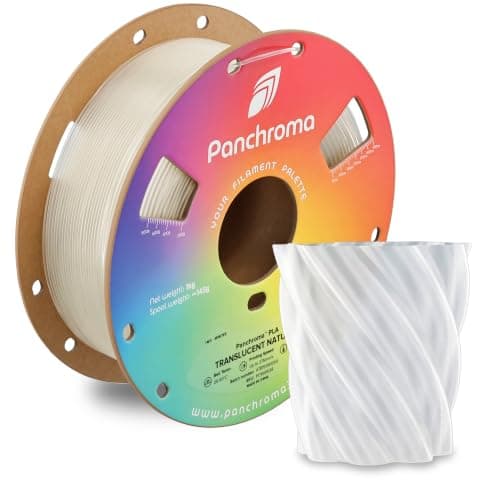
Polymaker Panchroma Translucent PLAPolymaker formulate this line specifically for single-wall and thin-wall prints, and publish a full settings table. It prints like ordinary PLA.190-230 C, formulated for thin walls
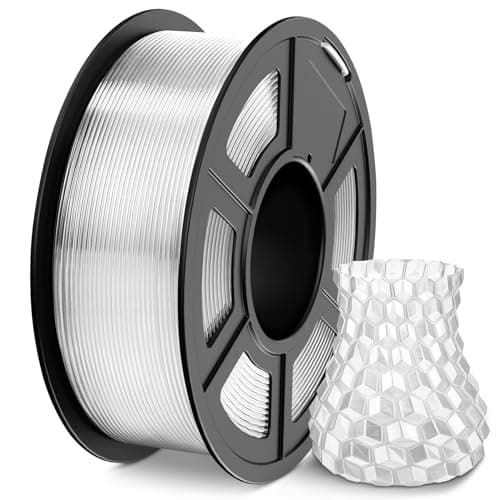
SUNLU Transparent PLASUNLU publish real temperature bands by speed rather than one number. Expect frosted rather than glass, which is true of every FDM clear.200-210 C at 50-100 mm/s, 1.23 g/cm3
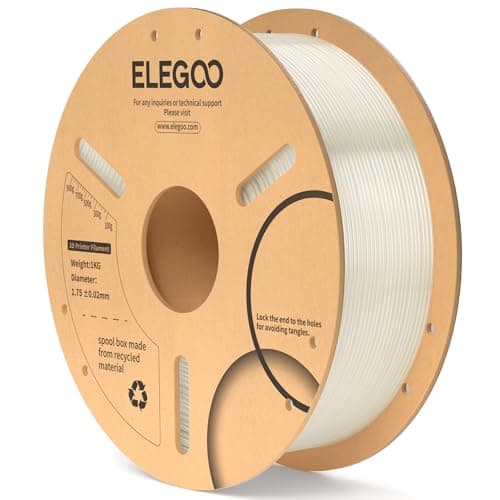
ELEGOO Translucent PLACheap enough to experiment with wall counts, which is the part of this that actually decides the look. Published data is thinner than Polymaker's.Standard PLA settings
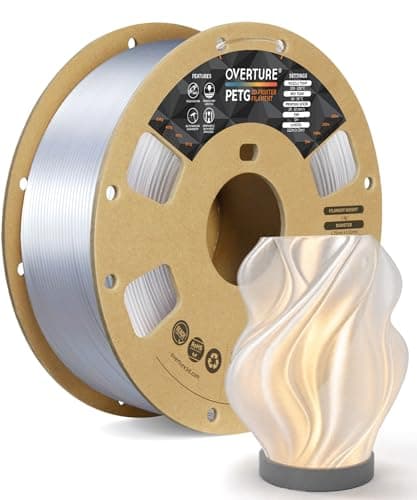
Overture PETG, TransparentFor light covers and anything approaching optical clarity, a clear PETG beats a translucent PLA. It also survives heat that PLA does not.PETG, prints clearer than PLA
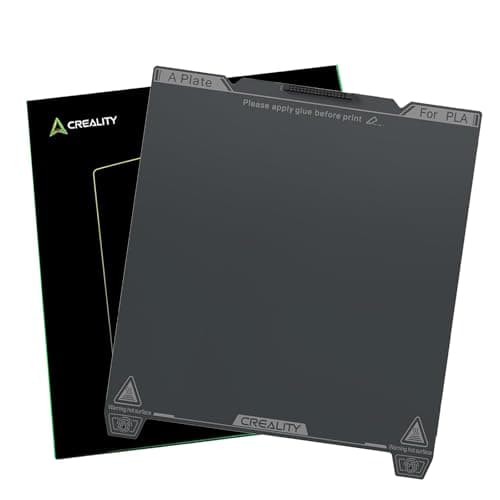
Smooth PEI Spring Steel PlateThe bottom layer takes the plate's finish. On a smooth plate that face comes out genuinely clear, which is worth designing around.Smooth PEI spring steel
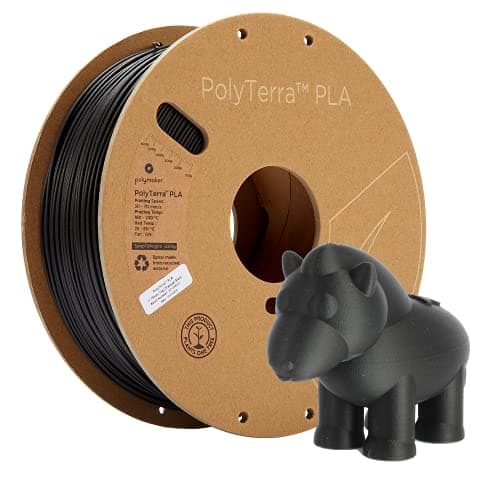
Polymaker PolyTerra PLAMatte additives scatter light at the surface and kill transmission. Excellent filament, exactly wrong for a lamp.Opaque matte finishSkip this
Live prices verified September 21, 2026. Scores are our own fit rating for the stated use, not a measurement and not a customer rating.
A translucent printed part lit from behind on a bench.
Why your translucent print came out frosted
Light does not pass through a printed wall the way it passes through injection-molded plastic, because a printed wall is a stack of partially fused extrusions with microscopic voids between them. Every boundary scatters light. The more boundaries, the more the part approaches white rather than clear.
That is why wall count dominates. Polymaker formulate their translucent line for single-wall and thin-wall prints specifically, and describe the effect as light passing through to produce glowing models Polymaker. At four perimeters and 20 percent infill, the same filament is a pale solid.
The settings that decide it
Wall count, first and by a distance. Design the part as a shell. Vase mode is the extreme version and it is the one that looks like the product photos.
Infill at zero, or close. Infill lines behind a translucent wall read as shadows. If the part needs strength, add ribs rather than infill.
Thicker layers, fewer boundaries. A 0.28 mm layer has fewer interfaces per millimeter than a 0.12 mm layer. Prusa publish the usual layer-height limits relative to nozzle diameter Prusa Research.
Slow down and turn the fan down. Both help neighboring extrusions fuse into something closer to a continuous wall.
Print dry. Moisture makes micro-bubbles, and bubbles are scattering sites. SUNLU publish 50 C drying for their PLA SUNLU; the ranking of dryers is on best filament dryer.
Which spools are genuinely translucent
The published settings for translucent PLA are ordinary PLA settings: Polymaker quote 190 to 230 C with a 25 to 60 C bed and the fan on Polymaker, and SUNLU quote 200 to 210 C at 50 to 100 mm/s, rising to 210 to 240 C above that, with a 50 to 60 C bed SUNLU. Nothing here needs special hardware.
What differs between spools is pigment loading and how the color was formulated. Polymaker’s translucent line is engineered for the effect; a generic “clear” PLA is often just unpigmented natural PLA, which looks milky. Both have uses, and the second one is cheaper.
Translucent PLA against clear PETG
If the goal is genuine transparency rather than a glow, PETG is the better material: it prints clearer, tolerates heat that PLA does not, and the technique is documented on clear and transparent PETG. PLA wins on ease, color range and price — and for a lamp diffuser, which is the most common use, translucent PLA is the right answer.
If the part is a lamp
One caution that gets skipped: PLA softens at around 60 C Prusa Research, and an incandescent or halogen bulb in an enclosed shade passes that easily. Use an LED, leave ventilation gaps, and keep the plastic away from the lamp holder.
Put the pattern in the wall. Varying wall thickness across a shell gives you a gradient when it is lit — this is the same trick as a lithophane, covered on best filament for lithophanes.
Use the plate. The bottom face takes the finish of the sheet it was printed on, so on smooth PEI it is the one genuinely clear surface you get without post-processing.
Avoid supports on visible faces. Support scarring shows twice as much through a translucent wall. Reorient instead, or use a support interface material — see soluble support filament.
Sand and coat if you need clarity. Clarity comes from filling surface texture; a gloss clear coat does more for transparency than any spool swap.
What not to buy for this
Matte PLA. The additive that kills reflections also kills transmission.
Silk PLA. It is glossy on the surface and opaque through it — the finish trade is on matte and silk PLA.
Any spool bought to fix a four-wall print. The walls are the problem. Re-slice before you re-order.
Every pick, in detail
01
Polymaker Panchroma Translucent PLA
Polymaker
Lampshades and light-diffusing parts · 8.6/10 our fit score
Formulated for the effect rather than merely unpigmented: Polymaker design this line around single-wall and thin-wall prints, which is exactly where translucency shows.
Published specifications for Polymaker Panchroma Translucent PLA
+ − Why is my translucent PLA print not translucent?
Almost always wall count and infill. Light scatters at every boundary between extrusions, so a four-wall part reads as pale solid. Print one or two walls with little or no infill, thicker layers and a slower speed, and the same spool transmits light.
+ − Is translucent PLA the same as clear PLA?
Not usually. Translucent lines are formulated to transmit light with a color cast, while a generic clear or natural PLA is often just unpigmented and reads milky. Neither reaches optical clarity on an FDM printer.
+ − Can I use translucent PLA for a lampshade?
Yes, with an LED. Prusa put PLA's softening point at around 60 C, which an incandescent or halogen bulb passes easily inside an enclosed shade. Leave ventilation gaps and keep plastic away from the holder.
+ − What settings make PLA more transparent?
Fewer walls, minimal infill, thicker layers, slower speeds, lower fan and dry filament — in that order of impact. A smooth build plate gives the bottom face a genuinely clear finish, and a gloss clear coat improves clarity more than changing spools.