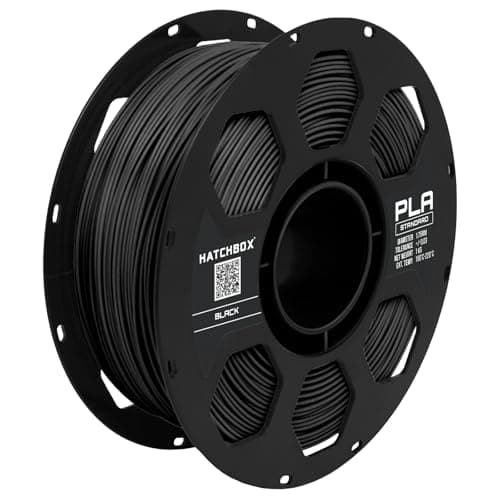
A lot of printer profiles floating around the internet were tuned on HATCHBOX, and it still prints exactly as well as it used to. The problem is that everything around it improved and its price did not.
How this page is funded. Buy links go to Amazon and we earn a commission on qualifying purchases at no extra cost to you. Commission never decides an order or a score, we accept no free products or sponsored placements, and every roundup names something to skip. Full disclosure.
The picks, ranked
The picks, ranked
#
Product
Best for
Score
Price
1
HATCHBOX PLAThe one real reason left to buy it: your profile was tuned on it and you do not want to re-tune.1.75 mm +/- 0.03 mm publishedSkip this
Live prices verified October 16, 2026. Scores are our own fit rating for the stated use, not a measurement and not a customer rating.
Spools of PLA filament on a shelf.
Why this is in the skip row
Not because it is bad. HATCHBOX PLA prints cleanly, arrives well wound, and is the material a very large number of community printer profiles were originally tuned against. If you have an old profile that works, buying the same filament is a legitimate reason to keep buying it.
The problem is that there is no longer a category in which it is the best answer. It publishes a looser diameter tolerance than the budget PLA+ brands. It is not cheaper than them. It is plain PLA rather than a toughened grade, so it is more brittle on impact. Every axis on which someone might choose it now has a better option at the same price or less.
The one case where it still wins
Re-tuning a profile costs an evening. If you have a dialed-in profile for HATCHBOX and you print production-ish parts against it, the value of not touching anything is real. That is a genuine argument and we are not going to pretend otherwise. It is also an argument with a shelf life: at some point the price difference over a year exceeds the evening.
If you do switch
Run a temperature tower and a flow calibration on the first spool of whatever you move to. Both take under an hour. Prusa's published PLA window of 185 to 235 C at the nozzle Prusa Research brackets essentially every PLA on the market, so the tower is looking for the best point inside a range you already know rather than searching blind. Our PLA print settings page has the sequence.
Every pick, in detail
01
HATCHBOX PLA
HATCHBOXSkip this
Matching an old tuned profile · 6.8/10 our fit score
The long-standing default a lot of printers were tuned on. Fine, unremarkable, and no longer the cheapest way to get here.
No. It prints cleanly and it is well made. It is simply no longer the cheapest, the tightest, or the toughest option at its price, which means there is no longer a specific buyer for whom it is the best choice.
+ − Why do so many profiles reference HATCHBOX?
Because it was the reliable default during the years when a lot of community printer profiles were written, and profiles get copied forward long after the reason for the original choice has faded.