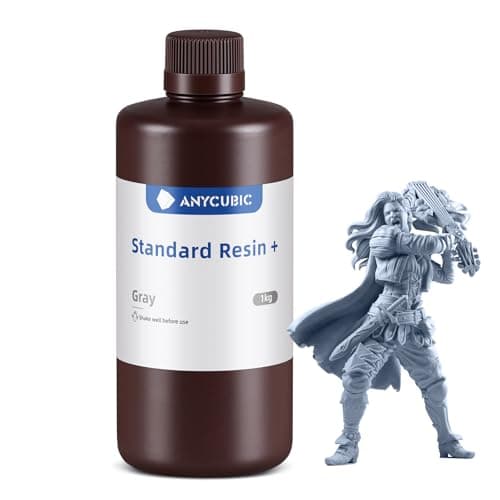
ANYCUBIC Standard Resin+ is the cheapest resin we would recommend, and it is brittle — 12 to 16% elongation at break, published by ANYCUBIC themselves, against 32% for Siraya Tech's Blu. Buy it for display models and prototypes where cost per bottle decides, and buy their Ultra Tough instead for anything that gets handled.
How this page is funded. Buy links go to Amazon and we earn a commission on qualifying purchases at no extra cost to you. Commission never decides an order or a score, we accept no free products or sponsored placements, and every roundup names something to skip. Full disclosure.
The picks, ranked
The picks, ranked
#
Product
Best for
Score
Price
1
ANYCUBIC Standard Resin+Crisp at short exposures and consistently among the cheapest per kilogram. The brittleness is published rather than hidden, which is worth something.12-16% elongation, published
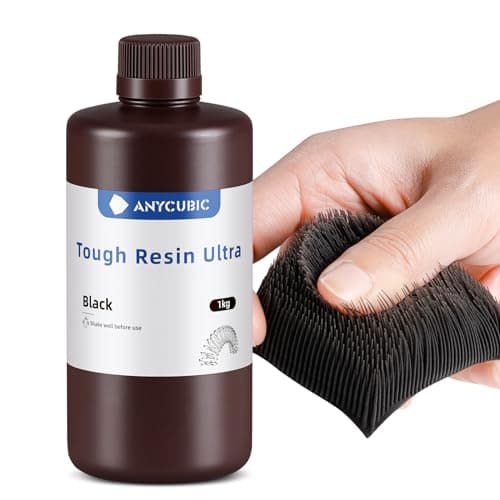
ANYCUBIC Ultra Tough ResinThe right answer inside the brand when Standard would snap. It costs roughly what a mid-tier bottle from anyone else costs, which is the honest catch.Impact and flexibility focused
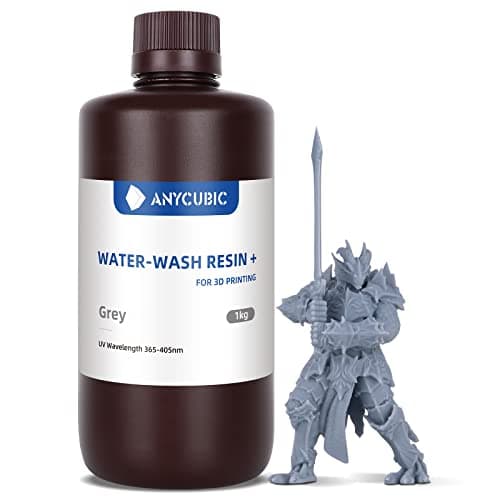
ANYCUBIC Water-Wash Resin+The cheaper of the two water washable bottles we track. Same wastewater obligation as every other one — the rinse water is not drain-safe.Water rinse, low viscosity
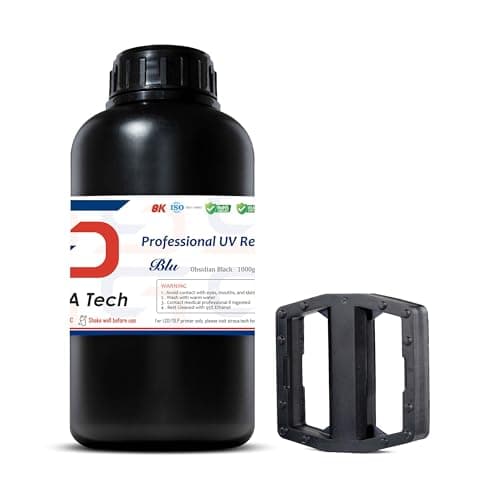
Siraya Tech BluTwice the published elongation of Standard Resin, with a full mechanical table behind it. This is the jump worth making when a snap would cost real money.32% elongation, 50 MPa
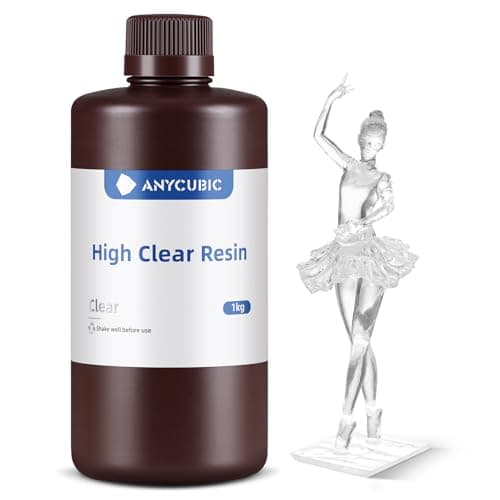
ANYCUBIC High Clear ResinA good product bought at the wrong time. Clear resins scatter curing light, need their own exposure calibration and yellow with UV exposure — not the bottle to learn a new printer on.Clear, hardest to exposeSkip this
Live prices verified October 30, 2026. Scores are our own fit rating for the stated use, not a measurement and not a customer rating.
A resin printer with a model on the build plate.
ANYCUBIC's published property and exposure figures for Standard Resin.
Property
Published figure
Wavelength
365-405 nm
Viscosity
200-230 mPa-s at 25 C
Density
1.13 g/cm3
Hardness
84-86 HD
Tensile strength
40-50 MPa
Elongation at break
12-16%
IZOD impact strength
103 J/m
Young's modulus
1600-1800 MPa
Volume shrinkage
4.5-5.5%
First layer exposure
20-40 s
Normal exposure
2-3.6 s
Post-cure
Wash 3 min or more, then cure 3 min at 405 nm
ANYCUBIC's published property and exposure figures for Standard Resin. ANYCUBIC also publish a per-printer parameter table covering eighteen of their machines, which is the single most useful thing on their product page. Figures from ANYCUBIC, retrieved 2026-10-30.
The one figure that decides this brand
ANYCUBIC publish an elongation at break of 12 to 16% for Standard Resin ANYCUBIC. Siraya Tech publish 32% for Regular Blu Siraya Tech. Those two numbers, from the two makers themselves, are the entire quality conversation about cheap resin, and they are consistent with what people actually experience: a thin part in a standard resin snaps rather than bends.
Note what that does not mean. Tensile strength for ANYCUBIC Standard is published at 40 to 50 MPa and Blu at 50 MPa — nearly the same. Standard resin is not weak; it is unforgiving. It will take a similar pull before it fails, and it will fail without any warning deformation. For a static display model, that distinction never surfaces. For a clip, a hinge or a gaming piece, it is the whole story.
The feature nobody mentions: a per-printer table
The most useful thing on ANYCUBIC’s product page is not a property at all. They publish a recommended-parameters table covering eighteen of their own machines, with layer thickness, exposure time, light-off time, bottom exposure time, bottom layer count and Z lift distance for each ANYCUBIC.
If you own an ANYCUBIC printer, that eliminates the worst part of starting a new bottle. Their general figures are a 20 to 40 second first layer and 2 to 3.6 seconds for normal layers ANYCUBIC, but the per-machine row is better than any generic starting point — and you should still run an exposure test, which is what our resin exposure settings page is for.
Their published post-processing is equally concrete: wash for three minutes or more, then cure for three minutes at 405 nm ANYCUBIC. A very short cure is a common cause of tacky parts.
Yellowing, and the thing to plan for
Standard photopolymer resins yellow under UV exposure over months. This is not specific to ANYCUBIC, and it is not something a bottle choice fixes at this price point — it is why our clear resin page exists as a separate decision and why a non-yellowing clear costs several times what Standard does.
The practical consequence is that a white or clear ANYCUBIC print on a sunny windowsill will not look the same in a year. A gray one will mostly get away with it, which is one more reason the miniature world defaults to gray.
Which ANYCUBIC bottle for which job
Standard Resin+ — display models, prototypes, test prints, anything where you would rather have two bottles than one. The published shrinkage of 4.5 to 5.5% ANYCUBIC is worth knowing if you are printing anything dimensionally critical.
Ultra Tough — the in-brand answer for parts that get handled. Honestly priced against the rest of the market rather than against ANYCUBIC’s own Standard, so the cheap-brand advantage largely disappears here.
Water Washable — the cheapest route out of the alcohol workflow, with the wastewater caveat that applies to all of them.
High Clear — good, and not a first purchase. Clear resin needs its own exposure calibration because the light goes further into the part than the slicer assumes.
Plant-based — their entry in the low odor category, which we cover on the low odor page.
Safety does not get cheaper with the resin
ANYCUBIC describe Standard Resin as low odor and safe to use. Treat odor and hazard as separate things: liquid photopolymer is a skin sensitizer regardless of how it smells, the sensitization builds up over months rather than announcing itself, and the controls are gloves, ventilation and a disposal plan Formlabs. Their own storage instruction is the short version of the right one — keep it at room temperature, away from light ANYCUBIC.
Verdict
ANYCUBIC Standard Resin+ is the correct purchase for display printing on a budget, and the published 12 to 16% elongation tells you exactly where its limit is. That transparency is genuinely to the brand’s credit and it is why we are comfortable recommending the cheapest bottle on the shelf for the right job.
Step up inside the brand to Ultra Tough when a part gets handled, and step out of the brand to Siraya Tech when a part is structural. Do not step up to High Clear as your first bottle.
Every pick, in detail
01
ANYCUBIC Standard Resin+
ANYCUBIC
Best for display models at the lowest cost · 8.1/10 our fit score
The cheapest resin we would recommend, and the right choice when detail matters more than durability.
Published specifications for ANYCUBIC Standard Resin+
Yes, and ANYCUBIC publish the figure: 12 to 16% elongation at break for Standard Resin, against 32% for Siraya Tech’s Regular Blu. Its tensile strength is competitive at 40 to 50 MPa, so it is not weak — it fails suddenly rather than bending first. Fine for display models, wrong for anything that gets handled.
+ − What exposure time should I use for ANYCUBIC Standard Resin?
ANYCUBIC publish 20 to 40 seconds for the first layer and 2 to 3.6 seconds for normal layers, plus a per-printer table covering eighteen of their machines with layer thickness, light-off time, bottom layer count and Z lift. Use your machine’s row as the starting point, then run an exposure test — resin, screen age and room temperature all shift it.
+ − Is ELEGOO or ANYCUBIC resin better?
They answer different questions. ANYCUBIC is cheaper and publishes its figures, including the brittleness. ELEGOO ABS-Like is tougher in practice and publishes no mechanical numbers at all, so you are trusting the label. For a display model, buy on price. For anything handled, ABS-Like or a genuinely tough resin is the better call.
+ − Does ANYCUBIC resin yellow over time?
Standard photopolymer resins yellow under UV exposure over months, and ANYCUBIC’s Standard is no exception. Their own storage instruction is to keep the bottle at room temperature away from light. For finished prints, a gray model hides it and a white or clear one does not — a non-yellowing clear resin is a separate and more expensive purchase.