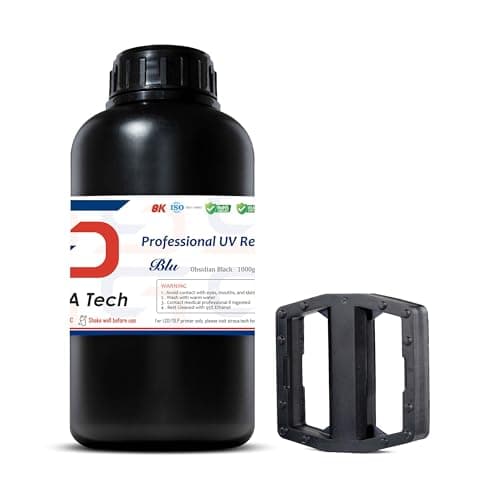
Siraya Tech Blu is the bottle to buy when a snapped print costs more than the resin does: 32% elongation at break against 12 to 16% for a standard resin, both figures published by their own makers. The limit to know before you buy is heat — Siraya Tech publish a 70 C heat deflection temperature, so this is tough, not heat resistant.
How this page is funded. Buy links go to Amazon and we earn a commission on qualifying purchases at no extra cost to you. Commission never decides an order or a score, we accept no free products or sponsored placements, and every roundup names something to skip. Full disclosure.
The picks, ranked
The picks, ranked
#
Product
Best for
Score
Price
1
Siraya Tech BluThe reason this brand is on the site. Published mechanical figures across the whole series, and the toughest common resin that still prints like a normal one.32% elongation, 50 MPa
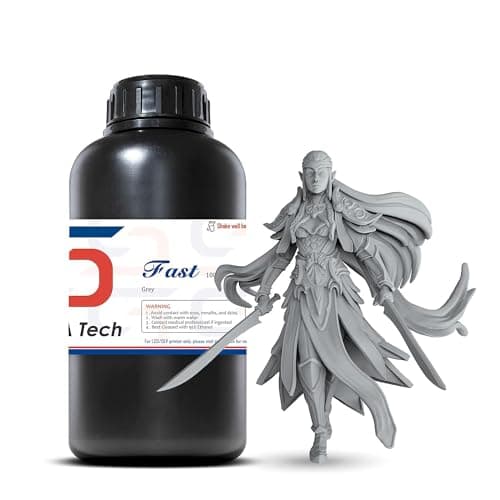
Siraya Tech Fast ABS-LikeChanges how many prints fit in an evening on a tall plate. The advantage disappears if your printer's light source is the limiting factor rather than the resin.Short exposures
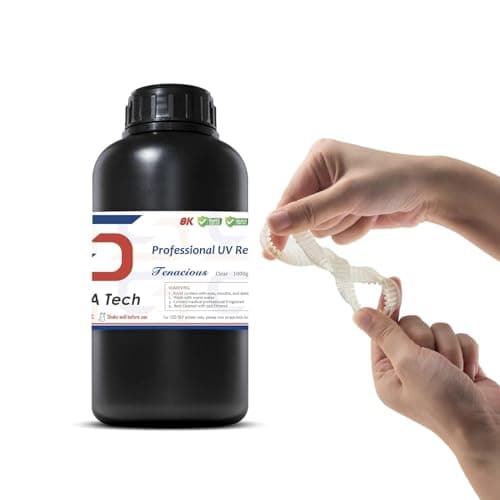
Siraya Tech TenaciousWhere Blu stops. Blend it into Blu to trade stiffness for impact tolerance, which is a genuine capability few brands offer.High-impact, flexible
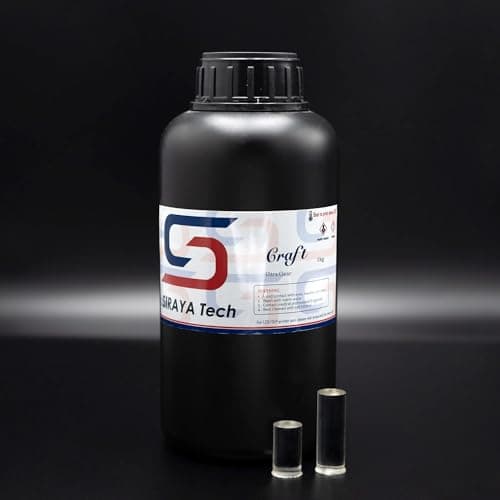
Siraya Tech Craft Ultra ClearThe expensive answer to the problem every cheap clear resin has. Worth it for lenses and display cases, overkill for anything you will paint.Non-yellowing clear
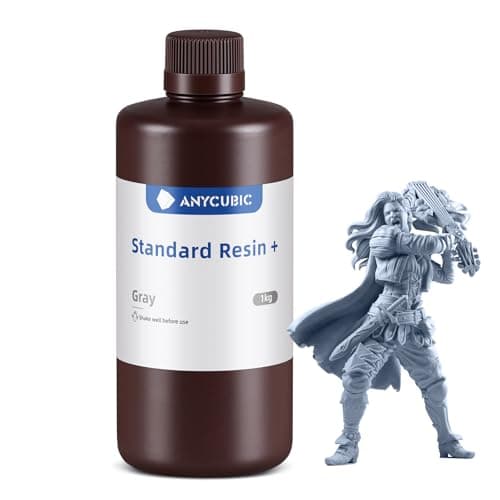
ANYCUBIC Standard Resin+Half the published elongation at a third of the price. The right economy on a display model and the wrong one on the part you came to this page about.12-16% elongationSkip this
Live prices verified October 30, 2026. Scores are our own fit rating for the stated use, not a measurement and not a customer rating.
A broken plastic part after a stress test.
The Blu series mechanical properties, as published by Siraya Tech on the product page.
Grade
Shore D
Tensile at break (MPa)
Elongation (%)
IZOD notched (J/m)
HDT 0.455 MPa (C)
Young's modulus (MPa)
Regular Blu
80
50
32
45
70
1800
Blu Nylon Black
78
45
50
53
63
1750
Blu Nylon Mecha
73
58
45
50
65
1900
Blu Easy
75
42
43
42
62
1000
Blu Lava
87
60
12
47
75
2500
The Blu series mechanical properties, as published by Siraya Tech on the product page. Read the elongation column against a standard resin's published 12-16% and the reason this brand exists becomes obvious. Figures from Siraya Tech, retrieved 2026-10-30.
The table is the product
Siraya Tech publish a mechanical table covering five Blu grades, with Shore hardness, tensile stress at break, notched IZOD impact, heat deflection temperature, elongation at break and Young’s modulus for each Siraya Tech. It is reproduced above, unedited.
Nobody else at this price point does that. ANYCUBIC publish a single grade’s figures ANYCUBIC; ELEGOO publish none at all ELEGOO. If you are choosing a resin for a part with a job to do, this is the practical difference: you can pick the grade from a column instead of from a forum thread.
Regular Blu, and what 32% buys you
The headline grade publishes 80 Shore D, 50 MPa tensile stress at break, 45 J/m notched IZOD, 70 C HDT, 32% elongation and 1800 MPa Young’s modulus Siraya Tech.
Set the elongation figure against a standard resin’s published 12 to 16% ANYCUBIC and you have the whole argument. Both will take a similar pull before failing — the tensile numbers are close. The difference is that one of them bends on the way there and gives you a warning, and the other does not. For a bracket, a clip, a housing or a drone part, that is the property you are buying.
Siraya Tech also document ISO 10993-5 and ISO 10993-10 skin-contact testing for Blu Siraya Tech. That applies to the cured part, and it does not change the handling requirements for the liquid, which are unchanged from every other photopolymer Formlabs.
The limit: 70 C
A 70 C heat deflection temperature at 0.455 MPa Siraya Tech is the number that stops people misapplying this resin. Blu is tough; it is not a high-temperature material. A part that lives in a parked car, sits against a heatsink or gets washed in hot water is outside its envelope, and the two grades that improve it only reach 75 C (Blu Lava).
If heat is the requirement rather than toughness, resin is the wrong technology and the answer is a filament. Our heat resistant filament page covers the materials that actually hold shape past 100 C, and filament versus resin is the honest framing of when to switch.
Choosing between the Blu grades
Blu Nylon Black and Blu Nylon Mecha
The high-elongation grades: 50% and 45% respectively Siraya Tech. Mecha is also the strongest in the table at 58 MPa with the highest modulus at 1900 MPa, which makes it the pick for a mechanical part rather than a tough one. Note the HDT drops to 63 and 65 C, so you trade a little heat tolerance for the toughness.
Blu Easy
Softer and more forgiving at 75 Shore D, 42 MPa and a 1000 MPa modulus Siraya Tech — a third of Blu Lava’s stiffness. The grade for a first functional print rather than for the final one.
Blu Lava
The stiff end: 87 Shore D, 60 MPa, 2500 MPa modulus, 75 C HDT and 12% elongation Siraya Tech. Read that last figure carefully — this grade is as brittle as a standard resin and is bought for rigidity, not for toughness. It is the single easiest mistake to make in this range.
Blending, which is the brand's real trick
Siraya Tech resins are formulated to be mixed with each other, and that is a capability nobody else offers at consumer scale. Blu plus Tenacious trades stiffness for impact tolerance along a continuum; Blu plus a detail resin trades toughness for feature sharpness.
Two caveats. A blend has no published data sheet, so you are back to trusting your own test prints — which is fine, as long as you notice you have left the documented part of the range. And a blend needs its own exposure calibration; see resin exposure settings.
What it costs, and when that is the wrong question
Blu is among the more expensive consumer resins per kilogram, roughly double the cheapest bottle on the shelf. For a plate of display miniatures that is a bad trade and we would not make it — buy a standard resin and accept the brittleness, as our miniatures page argues.
For a functional part, run the arithmetic the other way: a bottle costs less than one failed assembly, and a resin that gives you a bend-before-break warning is cheap insurance. That is the same logic we apply to premium filament on is cheap filament worth it, and it points the same direction.
Verdict
Buy Regular Blu when the print has a job. It is the toughest common resin that still behaves like a normal resin to print, and the published table means you can check that claim rather than take it on faith — which, in this category, is genuinely unusual.
Do not buy it for miniatures you will only look at, do not buy Blu Lava expecting toughness, and do not buy any of it expecting heat resistance. 70 C is 70 C.
Every pick, in detail
01
Siraya Tech Blu
Siraya Tech
Best for parts that must not snap · 9.0/10 our fit score
The functional-parts resin. Buy it when a snapped print costs more than the bottle.
For functional parts, yes. Its published 32% elongation at break against a standard resin’s 12 to 16% is the difference between a part that bends and warns you and one that snaps without notice, and a bottle costs less than one failed assembly. For display miniatures it is a poor trade — buy a cheap standard resin and accept the brittleness.
+ − Is Siraya Tech Blu heat resistant?
No. Siraya Tech publish a 70 C heat deflection temperature at 0.455 MPa for Regular Blu, and the stiffest grade in the series only reaches 75 C. It is a tough resin, not a high-temperature one. If a part has to survive a parked car or hot water, use a filament instead.
+ − Which Blu grade should I buy?
Regular Blu for general functional printing. Blu Nylon Mecha if the part is mechanical and needs the highest strength and elongation in the table — 58 MPa and 45%. Blu Easy for a forgiving first attempt. Not Blu Lava unless you specifically want stiffness: its published elongation is 12%, which is standard-resin brittle.
+ − Can you mix Siraya Tech resins?
Yes — they are formulated to blend, which is unusual at consumer scale. Blu with Tenacious trades stiffness for impact tolerance along a continuum. Two things to accept: a blend has no published data sheet, so you are relying on your own test prints, and it needs its own exposure calibration.