Buy the SUNLU FilaDryer S4 if you own more than two or three spools and want them dried in one pass: four 1 kg chambers at a published 70 C, run to a humidity setpoint rather than a timer, is the most capacity per dollar in this category. Buy something else if you print nylon or polycarbonate, because 70 C is below what both of those need.
How this page is funded. Buy links go to Amazon and we earn a commission on qualifying purchases at no extra cost to you. Commission never decides an order or a score, we accept no free products or sponsored placements, and every roundup names something to skip. Full disclosure.
The picks, ranked
The picks, ranked
#
Product
Best for
Score
Price
1
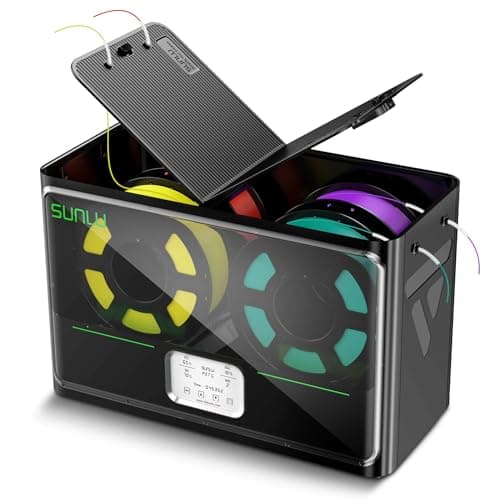
SUNLU FilaDryer S4The capacity answer. 70 C clears every published drying figure on this site except nylon and polycarbonate, and the humidity setpoint means it stops when the job is done rather than when a timer runs out.70 C, four 1 kg spools
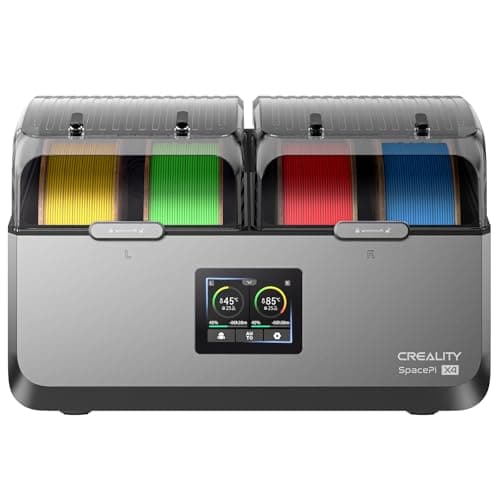
Creality Space Pi X4The same four-spool shape with 15 C more ceiling, which is the difference between nylon being theoretical and nylon being printable.45-85 C, four spools
SUNLU FilaDryer S2Same ceiling, a third of the price and a seventh of the power draw. If three of the S4's four chambers would sit empty, this is the honest buy.70 C, 48 W, one chamber
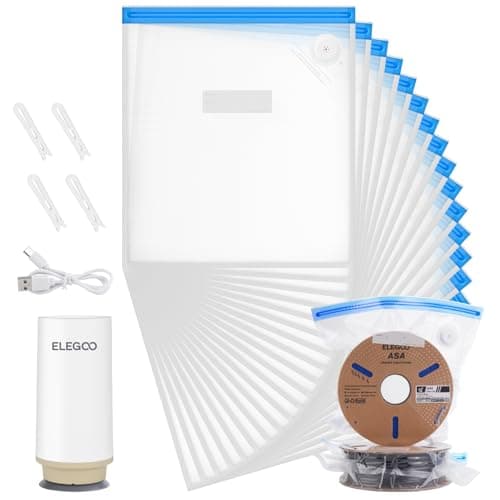
ELEGOO Filament Vacuum Storage BagsA dryer you have to run weekly is a storage problem wearing a disguise. Bag the spools you are not using and the dryer becomes an occasional tool.Sealed bag plus desiccant
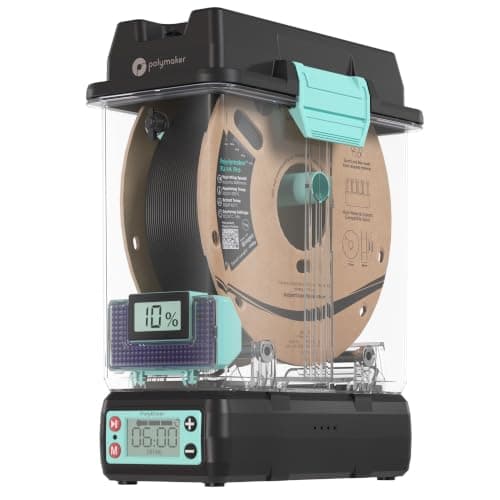
Polymaker PolyDryerA better answer to storage and a worse one to throughput: the per-spool cost climbs every time you add a box, which is the opposite of what someone shopping for a four-spool dryer wants.Modular box, detachable heaterSkip this
The four-spool dryers compared on the specification that decides them. Every figure is from the manufacturer's own product page. Figures from SUNLU, Creality, SUNLU, retrieved 2026-09-01.
What SUNLU actually publish
Four figures decide this unit, and SUNLU publish all four, which is more than several competitors manage SUNLU.
70 C maximum temperature. The number everything below turns on.
Four 1 kg spools, in an internal space of 450 x 210 x 211 mm.
A 350 W PTC heater, with a quoted chamber tolerance of about plus or minus 3 C.
Humidity control that runs to a 30-50% setpoint and stops at 25%, rather than simply counting down a timer.
That last one is the feature worth paying for and the one buyers skip past. A timer-only dryer runs for the hours you guessed at. A setpoint dryer runs until the air inside the chamber is as dry as you asked, which is the actual goal.
70 C: what it clears and what it does not
Cross-reference the published drying tables and the S4 is comfortably sufficient for the materials most people own. PLA, PETG, ABS, ASA and TPU all sit inside 70 C against the figures Prusa, Bambu Lab and Overture publish Prusa ResearchBambu Lab WikiOverture. For a bench that runs PLA and PETG with occasional ASA, there is no argument for spending more.
Nylon is where it stops. The published drying figures for polyamide and for carbon-filled polycarbonate sit in the 90 to 95 C region Prusa Research, which a 70 C box cannot reach by design. This is not a marginal shortfall you can compensate for with a longer run — it is below the temperature the material needs to release the water, and our best filament dryer page is built around exactly this specification for that reason.
Capacity is the actual product
Single-chamber dryers are cheaper, quieter and easier to place. What they are not is fast, and the way this plays out is specific: after a humid month, someone with eight spools and a one-spool dryer is looking at a queue measured in days. The dry box is what should have prevented that, but once you are in the hole, four chambers is how you get out of it in an afternoon.
The corollary is the honest reason not to buy one. If you own two spools and print one at a time, three of the four chambers are furniture, and the S2 does the same job at a third of the price and 48 W against 350 W SUNLU. Running cost is not trivial if you dry weekly; we work the arithmetic on is a filament dryer worth it.
Printing directly from the chamber
The S4 is shaped to feed a printer while it runs, and this is a genuine convenience for PETG and TPU on long jobs. Two caveats belong with it.
First, a heated chamber that is also your spool holder is a chamber you cannot close properly, and a dryer with a filament path open to the room is working against ambient air the whole time. It will hold a spool better than a bench will; it is not the same as a sealed dry-out cycle.
Second, the advice from the competition is worth repeating because it is against their own interest: Creality’s own page for the X4 recommends drying thoroughly before printing rather than feeding straight from the box Creality. Treat print-while-drying as maintenance, not as the drying step.
The things that annoy people
It is a shelf appliance. 450 mm of internal width plus the casing is not a desk object. Measure before you buy.
350 W. Higher than the single-chamber units by an order of magnitude, which only matters if you dry often — but if you dry often, see the vacuum bags.
No per-material preset will save you from reading the table. The published drying temperature for your specific material is the number to dial in, and it is lower than the maximum for almost everything.
Who should buy it, and who should not
Buy it if you own four or more spools, print PLA, PETG, ABS, ASA or TPU, and want drying to be a job you do in one pass rather than a rolling queue. The humidity setpoint and the published tolerance are real engineering, and 70 C is enough for that materials list.
Do not buy it if nylon or polycarbonate is on your shelf, or if you genuinely print one spool at a time. Those are the Creality X4 and the SUNLU S2 respectively, and both are better buys for their case than the S4 is.
Before either, buy vacuum bags. A dryer is the correct answer to a spool that is already wet and the wrong answer to a spool that keeps getting wet. Our storage page orders those purchases by what they actually return, and the dryer is not first on the list.
Every pick, in detail
01
SUNLU FilaDryer S4
SUNLU
Best for a shelf of spools and PLA through ASA · 8.8/10 our fit score
Four spools at once, 70 C, and a humidity setpoint rather than a bare timer. The right shape for someone who buys filament by the case.
Best if you print one spool at a time · 8.2/10 our fit score
The one-spool version of the same idea at a third of the price. The right buy if you print one spool at a time and the S4's four chambers would sit empty.
SUNLU publish a 70 C maximum, with a chamber tolerance of about plus or minus 3 C. That covers the published drying temperatures for PLA, PETG, ABS, ASA and TPU. It does not reach the 90 to 95 C region published for nylon and carbon-filled polycarbonate.
+ − Is the SUNLU S4 better than the Creality Space Pi X4?
It depends on one thing: whether you print nylon. Both hold four spools and draw similar power. The X4 publishes 45 to 85 C against the S4’s 70 C, and that 15 C is the difference between nylon drying properly and not. If you do not print nylon or polycarbonate, the S4 gives you the same capacity for less money.
+ − Should I buy the S4 or the S2?
Count your spools. Both have the same 70 C ceiling, so there is no capability difference — the S4 holds four spools and draws 350 W, the S2 holds one and draws 48 W at roughly a third of the price. If three chambers would sit empty, the S2 is the better purchase.
+ − Can you print directly from the SUNLU S4?
Yes, and it is useful for PETG and TPU on long prints. Treat it as holding a dry spool dry rather than as the drying step itself — a chamber with a filament path open to the room is fighting ambient air. Creality make the same point on their own competing product, recommending a proper dry-out before printing.